Oregon Laborers Union Endorses HR 676
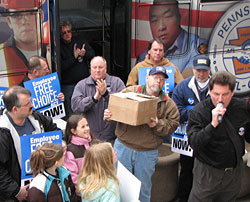
Portland, OR Laborers Local 483 (LIUNA) has endorsed HR 676, single
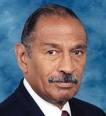
payer healthcare legislation introduced by Congressman John Conyers
(D-MI). The local represents 900 City of Portland workers in the
Maintenance, Parks and Environmental Services Bureau.
Wesley Buchholz, Director of Political Action for the local who made the
presentation to the membership meeting, said: “Like the rest of the
nation we are in dire economic times and facing layoffs. Relief must come
for all working people. HR 676 is the most sensible way to provide
massive aid both economic and physical. Our members want to add their
voices to the demand for social and economic justice and join this
groundswell movement attempting to amend the tyrannical system that values
profits before people.”
Why Single Payer Healthcare – HR 676 Is the Only Solution
Is a public Medicare-like option in a market of private plans a viable solution?
Response by Drs. David Himmelstein and Steffie Woolhandler:
The “public plan option” won’t work to fix the health care system for 2 reasons.
1 – It foregoes at least 84% of the administrative savings available through single payer. The public plan option would do nothing to streamline the administrative tasks (and costs) of hospitals, physicians offices, and nursing homes, which would still contend with multiple payers, and hence still need the complex cost tracking and billing apparatus that drives administrative costs. These unnecessary provider administrative costs account for the vast majority of bureaucratic waste. Hence, even 95% of Americans who are currently privately insured were to join the public plan (and it had overhead costs at current Medicare levels), the savings on insurance overhead would amount to only 16% of the roughly $400 billion annually achievable through single payer – not enough to make reform affordable.
2 – A quarter century of experience with public/private competition in the Medicare program demonstrates that the private plans will not allow a level playing field. Despite strict regulation, private insurers have successfully cherry picked healthier seniors, and have exploited regional health spending differences to their advantage. They have progressively undermined the public plan – which started as the single payer for seniors and has now become a funding mechanism for HMOs – and a place to dump the unprofitably ill. A public plan option does not lead toward single payer, but toward the segregation of patients; with profitable ones in private plans and unprofitable ones in the public plan.
Wall Street Echoes People’s Cry: “Healthcare Not Warfare!”
By Tim WheelerPeople’s Weekly World

New York—About 10,000 protesters marched through the Wall Street financial district April 4 chanting “Money for Healthcare not for war, that is what we’re marching for.”
It was the 42st anniversary of Dr. Martin Luther King’s famed “Beyond Vietnam” speech at Riverside Church April 4, 1967. Many banners and signs bore photos of Dr. King with the message “Beyond War, A New Economy is Possible. Yes We Can.”
The marchers assembled on Broadway above Canal Street and streamed down the avenue at noon led by a contingent of Veterans for Peace, Military Families Speak Out, and Iraq Veterans Against the War. “Hands off Afghanistan” “Fund Human Needs not War” and “Give Me A J-O-B so I can E-A-T” were some of the thousands of signs and placards.
Rose Taylor of Baltimore was one of many people in wheelchairs who rolled past the New York Stock Exchange. She was holding a sign that read, “We Need a People’s Bank.”
Continue reading Wall Street Echoes People’s Cry: “Healthcare Not Warfare!”
Central Kentucky Building & Construction Trades Council Endorsed HR 676

Lexington, Kentucky. The Central Kentucky Building & Construction Trades Council has endorsed HR 676, single payer healthcare legislation introduced by Congressman John Conyers (D-MI), reports Council President Robert Akin.
The endorsement resolution said in part: “The cost of healthcare continues to spiral out of control with no end in sight damaging families’ economic stability and adding tremendous burdens on the U.S. to compete in the world economically. As long as health care is treated as a for profit commodity this will never end.”
“We hereby resolve that the Central Kentucky Building & Construction Trades Council endorses HR 676 which will provide for a single payer universal health care system to cover all of the citizens of the U.S,” the resolution continued. “We encourage all elected officials from local, state and national governments to support this common sense, equal to all, and just effort to solve one of the greatest problems that the U.S.A. faces at this time,” the resolution concluded.
Hundreds of French workers take bosses hostage

PARIS, France (CNN) — Hundreds of French workers, angry about proposed layoffs at a Caterpillar factory, were holding executives of the company hostage Tuesday, a spokesman for the workers said.
Caterpillar’s French staff say they are angry about a lack of negotiations over layoffs.
The latest incident started Tuesday morning at the office of the construction equipment company in the southeastern city of Grenoble.
The workers were angry that Caterpillar had proposed cutting more than 700 jobs and would not negotiate, said Nicolas Benoit, a spokesman for the workers’ union.
Continue reading Hundreds of French workers take bosses hostage
Texas IAM Local is 500th Union to Endorse HR 676
Houston, Texas.
IAMAW Local Lodge 2339H in Houston, representing 5,000 flight attendants at Continental and Express Jet Airlines, is the 500th union organization to endorse HR 676, single payer healthcare legislation introduced by Congressman John Conyers (D-MI).
Christine Diaz, the Local’s Legislative Committee Chairperson, said: “It was important for our local to stand in solidarity with the hundreds of
other labor organizations who have already endorsed HR 676. We are going to win this fight at the grass roots level, and it is going to take
educating not only our members, but the general public, on the truth about single payer health care.”
Rosalie Canton, President of Local Lodge 2339H, said: “When our membership has to stop work for whatever reason, it is not uncommon to
hear, ‘Well, I will just have to risk not having health insurance for three months. I cannot afford to pay for COBRA.’ The system must change
so that your health insurance is not tied to your employer. It just doesn’t work anymore.”
The Legislative Committee has met with Rep. Gene Green but has not yet secured his agreement to sign on as a co-sponsor of HR 676.
American Postal Workers Union Makes Single Payer Legislative Priority
Washington, DC. The American Postal Workers Union (APWU) has adopted
single payer health care as a legislative priority for 2009.
A copy of the APWU’s booklet “Legislative Priorities 2009” has just been
placed on the union’s website. On page ten of the booklet, under the
heading “Universal Healthcare: A Basic Human Right,” the APWU states the
following:
SINGLE PAYER
The labor movement supports the “single-payer” system under which all
healthcare revenue goes into a single public fund that pays for all
medical services. A single-payer system would:
* Guarantee the same coverage for all citizens, regardless of employment
status or wealth;
* Provide a free choice in the selection of a caregiver;
* Reduce administrative costs; and,
* Leave decision-making tasks in the hands of the public.
And, it can be done. Systems like this have been adopted by all other
industrialized nations.
APWU will support legislation that provides affordable – and adequate –
single-payer healthcare coverage for all.
The full booklet can be found at:
http://www.apwu.org/dept/legis/leg-prioritiesbrochure_feb2009.pdf
The APWU is the world’s largest postal union, representing more than
330,000 United States Postal Service employees and retirees, and nearly
2,000 private-sector mail workers. APWU has 1600 state and local unions
and retiree chapters in every state and territory.
Single-payer Health Reform Bill Introduced in U.S. Senate
March 26, 2009, Washington, DC
Would save $400 billion on bureaucracy, enough to cover all 46 million uninsured Americans
Challenging head-on the powerful private insurance and pharmaceutical industries, Vermont’s Sen. Bernie Sanders introduced a single-payer health reform bill, the American Health Security Act of 2009, in the U.S. Senate Wednesday. The bill is the first to directly take on the powerful lobbies blocking universal health reform in the Senate since Sen. Paul Wellstone’s tragic death.
The single-payer approach embodied in Sanders’ new bill stands in sharp contrast to the reform models being offered by the White House and by key lawmakers like Senators Max Baucus (D-Mont.) and Edward Kennedy (D-Mass.). Their plans would preserve a central role for the private insurance industry, sacrificing both universal coverage and cost containment during the worst economic crisis since the Depression.
In contrast, Sanders’ new legislation would cover all of the 46 million Americans who currently lack coverage and improve benefits for all Americans by eliminating co-pays and deductibles and restoring free choice of physician. The most fiscally conservative option for reform, single payer slashes private insurance overhead and bureaucracy in medical settings, saving over $400 billion annually that can be redirected into clinical care.
“This is excellent news for the nation’s health,” said Dr. Quentin Young, national coordinator of Physicians for a National Health Program and a past president of the American Public Health Association. “There is now an affordable cure for our dysfunctional health care system. In the face of our present economic calamity, this is an urgent necessity.”
Highlights of the bill include the following:
- Patients go to any doctor or hospital of their choice.
- The program is paid for by combining current sources of government health spending into a single fund with modest new taxes amounting to less than what people now pay for insurance premiums and out-of-pocket expenses.
- Comprehensive benefits, including coverage for dental, mental health, and prescription drugs.
- While federally funded, the program is to be administered by the states.
- By eliminating the high overhead and profits of the private, investor-owned insurance industry, along with the burdensome paperwork imposed on physicians, hospitals and other providers, the plan saves at least $400 billion annually – enough money to provide comprehensive, quality care to all.
- Community health centers are fully funded, giving the 60 million Americans now living in rural and underserved areas access to care.
- To address the critical shortage of primary care physicians and dentists, the bill provides resources for the National Health Service Corps to train an additional 24,000 health professionals.
“We are confident that Sen. Sanders’ bill will accelerate the national drive for the only reform that we know will work,” Young said. “A majority of physicians endorse such an approach. Fifty-nine percent of U.S. physicians support national health insurance. Two-thirds of the public also supports such a remedy. We remember well that President Obama once acknowledged that single-payer national health insurance was the best way to go. It still is.”
Sanders, who serves on the Senate Committee on Health, Education, Labor, and Pensions, is a longtime advocate of fundamental health care reform. His new bill draws heavily upon the single-payer legislation introduced by the late Sen. Paul Wellstone (D-Minn.) in 1993, S. 491, and closely parallels similar legislation pending before the House, H.R. 1200, introduced by Rep. Jim McDermott (D-Wash.).
A single-payer bill introduced by Rep. John Conyers Jr. (D-Mich.), H.R. 676, obtained 93 co-sponsors in the House during the last session. It has been reintroduced in the new Congress as the U.S. National Health Care Act with the same bill number.
The Massachusetts’ Plan: A Failed Model for Health Care Reform
A new study shows that the Massachusetts model for national healthcare reform is a failure. Taxpayer subsidized insurance and forcing citizens to buy insurance is supported by the insurance industry and their bought politicians such as US Sen. Max Baucus.
The Massachusetts Reform:
A Rerun of Past State Reforms That Have Failed
Back in 1988, Massachusetts passed a universal health care law very similar to the 2006 reform. Since 1988, many states—Oregon, Minnesota Tennessee, Vermont, Washington and Maine—have enacted reforms aimed at achieving universal coverage. All failed.
These reforms differed in detail, but shared common elements. All offered new public subsidies or expanded Medicaid for poor and near-poor people. All left the majority of private health insurance arrangements undisturbed, although many included new insurance regulations or state purchasing pools to help make affordable coverage available to individuals or small businesses. Some (Massachusetts 1988, Oregon 1992, Washington State 1993) contained mandates on employers or self-employed individuals.
None of these reforms made more than a temporary dent in the number of uninsured. These incremental reforms failed because they did not include effective cost-control measures. As health costs rose, legislatures backed off from forcing employers and the self-employed from paying ever-rising premiums and the mandates were repealed. Relying on Medicaid was fiscally problematic for states because tax revenues fall at the same time that unemployment pushes families out of private coverage. There is little reason to think that the current Massachusetts reform, or a national plan modeled on these state reforms, would have any better long-term success.
Is there an alternative to this model?
Yes. A bill in Congress, the United States National Health Care Act, H.R. 676 (also known as “The Expanded and Improved Medicare for All Act”) would implement single-payer financing of health care while maintaining the private delivery system. A single-payer program would eliminate private insurers and use the administrative savings to provide comprehensive coverage for all. Features of the single-payer plan include:
- Comprehensive coverage for all, including doctor, hospital, long-term, mental health, dental and vision care as well as prescription drugs and medical supplies.
- No premiums, co-payments, or deductibles that inhibit access to care and unfairly burden the poor.
- Free choice of doctor and hospital and an end to insurance company and HMO dictates over patient care.
- Pays for itself by eliminating wasteful private insurance administration and profit. A progressive tax would replace what is currently paid out-of-pocket.
- Controls costs so benefits are sustainable through negotiated physician fees, global budgets for hospitals and bulk purchasing of prescription drugs and medical supplies. A single-payer system would facilitate health planning to reestablish the balance between preventive and primary care on one hand, and high-tech tertiary care on the other.
The nation must not look to Massachusetts’ health reform as a model. If we truly want to provide comprehensive health care for all of us at a price we can afford, we must adopt a single-payer plan.
Read the complete analysis here: http://www.citizen.org/hrg/articles.cfm?ID=18395