Please consider making a donation to support PDA.
https://www.thedatabank.com/dpg/309/donate.asp?formid=donate

https://www.thedatabank.com/dpg/309/donate.asp?formid=donate
Physicians for a National Health Program
29 E. Madison St., Suite 602
Chicago, IL 60602-4404
http://www.pnhp.org
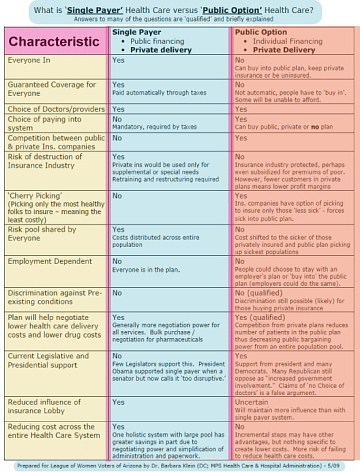
Myth: A public option will increase choice for patients. Fact: A public plan option will not increase choice of what matters for our health: choice of caregivers and choice in location of care. Patients will still have a limited choice of provider restricted by networks and will pay more to see providers outside of their network. Patients will still have to seek authorization for treatment. The public option will add one more plan to the hundreds of plans that already exist.
Myth: A public option will enable patients to keep their own doctor, regardless of changes in employment or health. Fact: A public plan option does not guarantee patients can keep their doctor regardless of employment or health because it leaves the employer based system of health care provision intact. If an employer chooses to change to a new plan, patients may have to change their doctor or pay higher fees to stay with their doctor. Insurers have strong financial incentives to enroll the healthy while avoiding the sick patients; thus if a patient becomes ill, they still risk losing their employer based insurance.
By Mark Dunlea, Executive Director
Hunger Action Network of NYS
Co-Chair, Single Payer New York (www.singlepayernewyork.org)
As Congress negotiates health care reform, Democratic leaders have put the interests of insurance companies ahead of the needs of American citizens. If Americans want an affordable, quality health care system that enables consumers to choose whom they receive health care services from, private for-profit insurance companies must be eliminated.
Michael Moore’s movie SICKO correctly highlighted the problems with insurance companies rather than the problem of the uninsured. While the lack of health insurance is estimated to kill 18,000 Americans annually, for-profit insurance companies kill far more with their unreasonable denial and delay in approving treatment as they seek to maximize their profits.
Continue reading The Democrats “Public Option” Is Designed to Protect Insurance Companies
WASHINGTON — President Barack Obama’s choice to head the federal Mine Safety and Health Administration signals a dramatic shift from his predecessor on mine safety issues.
The selection of Joseph Main, the retired longtime safety and health administrator for the United Mine Workers of America to head MSHA, drew praise from safety advocates and criticism from the coal industry.
Continue reading Mine safety advocates praise Obama’s choice to lead agency
There were no parades or fireworks Wednesday, but July 1 was the independence day that so many nurses and hospital caregivers had hoped and battled for. Among those many was Lois Cusick of Mt. Lebanon, who has worked at UPMC’s Western Psychiatric Institute & Clinic for 26 years.
She, and all other nurses and caregivers in the state, are now largely immune from management requests to work “mandatory overtime,” the extra hours, nurses say, that frequently were tacked on the end of already long hospital shifts, jeopardizing patient care and making it tough to keep quality nurses.
Continue reading Mandatory Overtime for Nurses Now Banned in PA
Click on the link below to view a very informative video about the American and Canadian healthcare systems by an affiliate of the Communications Workers of America – CWA
http://link.brightcove.com/services/player/bcpid1463312787?bctid=1463302784

by Jane Slaughter
Labor Notes Newletter
It’s no secret that the union movement is divided on health care reform. Resolutions favoring “Medicare for All,” a single-payer system, have been passed by 558 unions, central labor councils, state federations, and other union organizations. Yet in practice leaders of many of those same unions have acted as if actual single-payer legislation (Representative John Conyer’s HR 676 and Senator Bernie Sanders’ S703) didn’t exist.
Instead they’ve promoted milder changes that will leave private insurance companies in place, instead of kicking them out of the temple, as every other industrialized country-from Canada to Japan-has done. In effect, labor’s leaders are placing on the table first what logically should be their fall-back position. They’ve gone along with the D.C. consensus that the most that can be won is a plan that includes a “public option” to compete in the marketplace with private companies.
And they’re not wrong about the unwillingness of this Congress to buck the system. Conyers was asked in May, “What would it take this Congress to pass single payer?” He replied, “Nuclear weaponry.”
Even so, the staunchest single-payer advocates believe they will win most by continuing to agitate for what they really want rather than a compromise. These folks see large amounts of activists’ anger and energy wasted.
RALLY FOR?
The June 25 rally at the Capitol sponsored by the AFL-CIO and Health Care for America Now (HCAN), both of which steer clear of single payer, was attended by 7,000 people. But the organizers “didn’t know what to get them fired up about,” said Mark Dudzic of the Labor Campaign for Single Payer. “It was a good, high-spirited group of people, who want to fight, who honestly believe they’re fighting for national health care,” he said. “A lot of the focus of the rally was to mobilize anger at private insurance companies, and it’s tragic where the leaders want to leave those folks.”
Continue reading Report on AFL-CIO June 25th Rally for Healthcare Compromise
In Maryland Heights, Missouri, Chico Humes, President of Teamsters Local 6-505M, Graphic Communications Conference/IBT, reports that his local has endorsed HR 676, single payer healthcare legislation introduced by Congressman John Conyers (D-MI).
 Beaver County Blue: Voice of the 17th CD of Progressive Democrats of America