Category Archives: unemployment

Beaver County NAACP Prepares Black Workers for Employment at Proposed Shell plant


Old Horsehead Zinc, site of new Shell ‘Cracker’

By Jared Stonesifer

Beaver County Times

March 10, 2016 – MIDLAND — The Beaver County chapter of the NAACP wants to make sure the local black population isn’t left out of a potential economic explosion that would occur if Shell Chemicals builds a multibillion-dollar ethane cracker plant along the Ohio River.

The chapter is holding an event next week designed to prepare the local population for that possibility. The meeting will inform residents on what skills and qualifications they would need to be hired at the potential plant, while it will also inform them about the possibility of an array of opportunities if the plant comes here.

Shell, which continues work to remediate the old Horsehead Corp. site in Potter Township, has not made a final investment decision on the plant. But that hasn’t stopped local leaders from preparing in the event it does come here.

“There could be an (economic) explosion coming, and we want to make sure African-Americans are part of that explosion,” said Willie Sallis, president of the Beaver County NAACP.

The meeting will be held 5 p.m. Thursday at the American Legion at 800 Midland Ave. in Midland.

It will include representatives from Community College of Beaver County, Shell, Job Training for Beaver County, CareerLink and potentially a local politician, according to the NAACP.

Future meetings could be scheduled in other Beaver County locations in an attempt to galvanize as much of the population as possible.

Continue reading Beaver County NAACP Prepares Black Workers for Employment at Proposed Shell plant

Public Works: How The Clinton and Sanders Infrastructure Plans Measure Up

By Dave Johnson

Campaign for America’s Future

“Investing in infrastructure makes our economy more productive and competitive across the board.”
– Hillary Clinton

Dec 1, 2015 – Democratic presidential candidate Hillary Clinton has announced a plan for infrastructure investment. How does her plan stack up against that of her chief competitor, Bernie Sanders?

Also, how will Clinton and Sanders pay for their plans? On that question, Sen. Elizabeth Warren (D-Mass.) recently came up with a set of principles we can use to judge this.

Clinton’s Infrastructure Plan

Clinton on Monday announced a plan for investing in infrastructure improvements. Meteor Blades laid out the need for infrastructure investment at Daily Kos in “Clinton proposes $275 billion spending for infrastructure“:

… 11 percent of the nation’s bridges are structurally deficient and a fourth of them are functionally obsolete. Similar deficiencies can be found in schools, dams, levees, railroads, the electrical grid, and wastewater facilities. In its 2013 quadrennial report card on U.S. infrastructure, the American Society of Civil Engineers said the nation would need to invest an additional $1.6 trillion by 2020 to put its infrastructure into good repair. And that doesn’t include innovative infrastructure like universal broadband.

Clinton’s infrastructure plan is detailed at her website in “Hillary Clinton’s Infrastructure Plan: Building Tomorrow’s Economy Today.” Here is a distillation:

● $250 billion dollars in infrastructure investment, spread out over five years as additional spending of $50 billion each year.

● An additional one-time $25 billion to seed a national infrastructure bank. The bank will support up to an additional $225 billion in direct loans, loan guarantees, and other forms of credit enhancement. These are loans to states and cities which will require tolls, fees, etc. to pay off.

● Spending priorities include “smart investments in ports, airports, roads, and waterways”; “giving all American households access to world-class broadband and creating connected ‘smart cities’”; “building airports and air traffic control systems”; “a smart, resilient electrical grid”; “safe and reliable sources of water”; “a national freight investment program”; “upgrade our dams and levees to improve safety and generate clean energy”; safe, smart roads and highways that are ready for the connected cars of tomorrow” and “the new energy sources that will power them.”

● A promise of “a faster, safer, and higher capacity passenger rail system.” But the plan does not mention high-speed rail. (Note that a single high-speed rail system from Los Angeles to San Francisco is expected to cost up to $60 billion, which alone is almost one-fourth of Clinton’s entire five-year infrastructure investment for all infrastructure needs.)

Sanders’ Infrastructure Plan

Clinton’s $275 billion infrastructure plan offers modest spending and contains few specifics. Contrast that with candidate Bernie Sanders, who has proposed a highly detailed, $1 trillion plan.

Continue reading Public Works: How The Clinton and Sanders Infrastructure Plans Measure Up

Five Ways Wall Street Continues to Screw Up the Economy for the Rest of Us and How to Fix It

By Robert Kuttner

Beaver County Blue via Huffington Post

July 2, 2014 – The shocking thing about the financial collapse of 2008 is not that Wall Street excesses pushed us into the worst economy crisis since the Depression. It’s that the same financial system has been propped back up and that elites are getting richer than ever, while the effects of that collapse are continuing to sandbag the rest of the economy. Oh, and most of this aftermath happened while a Democrat was in the White House.

Consider:

  • The biggest banks are bigger and more concentrated than ever.
  • Subprime (subprime!) is making a comeback [2] with interest rates of 8 to 13 percent.
  • Despite Michael Lewis’s devastating expose of how high speed trading is nothing but a technological scam that allows insiders to profit at the expense of small investors, regulators are not moving to abolish it [3].
  • The usual suspects are declaring the housing crisis over, even though default and foreclosure rates in the hardest hit cities and states are upwards of 25 percent.
  • The deficit is falling, now just 2.8 percent of GDP [4], thanks to massive cuts in social spending. Isn’t that reassuring?

Meanwhile, back in the real economy, good jobs are far too scarce, incomes are stagnant, while 95 percent of the gains go to the top one percent.

Continue reading Five Ways Wall Street Continues to Screw Up the Economy for the Rest of Us and How to Fix It

Income Gap Widens as American Factories Shut Down: the Case of Reading, PA

Beaver County Blue via AP

June 15, 2014 – READING PA – In August 2008, factory workers David and Barbara Ludwig treated themselves to new cars – David a Dodge pickup, Barbara a sporty Mazda 3. With David making $22 an hour and Barbara $19, they could easily afford the payments.

A month later, Baldwin Hardware, a unit of Stanley Black & Decker Corp., announced layoffs at the Reading plant where they both worked. David was unemployed for 20 months before finding a janitor job that paid $10 an hour, less than half his previous wage. Barbara hung on, but she, too, lost her shipping-dock job of 26 years as Black & Decker shifted production to Mexico. Now she cleans houses for $10 an hour while looking for something permanent.

They still have the cars. The other trappings of their middle-class lifestyle? In the rear-view mirror.

The downfall of manufacturing in the United States has done more than displace workers and leave communities searching for ways to rebuild devastated economies. In Reading and other American factory towns, manufacturing’s decline is a key factor in the widening income gap between the rich and everyone else, as people like the Ludwigs have been forced into far lower-paying work.

It’s not that there’s a lack of jobs, but gains often come at either the highest end of the wage spectrum – or the lowest.

“A loss of manufacturing has contributed to the decline of the middle class,” said Howard Wial, an economist with the Brookings Institution and the University of Illinois at Chicago. “People who are displaced from high-paying manufacturing jobs spend a long time unemployed, and when they take other jobs, those jobs generally pay substantially less.”

Continue reading Income Gap Widens as American Factories Shut Down: the Case of Reading, PA

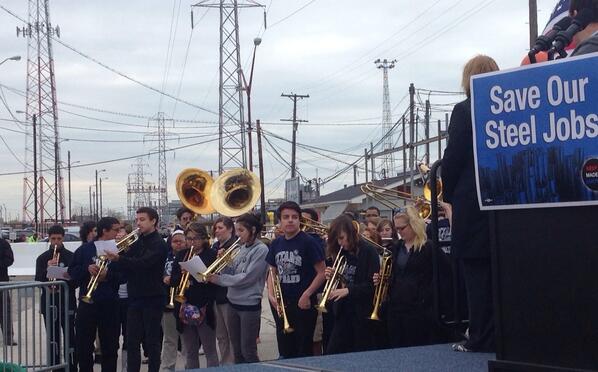
Ohio: Lorain Workers Rally to Save Our Steel Jobs

USW News

Yesterday, in Lorain Ohio, hundreds of workers and supporters joined U.S. Senator Sherrod Brown, and Rep. Marcy Kaptur to tell America that we need to Save Our Steel jobs.

The Alliance for American Manufacturing (AAM) is bringing the issue of a surge of illegally dumped oil tubular goods (OCTG) imports, primarily from South Korea, is flooding the U.S. market. These foreign steel pipes are priced below fair value and in deceptive ways are designed to circumvent international trade laws.

U.S. workers and their communities deserve a fair shot. The United States has trade remedy laws that serve as the last line of defense for American firms and workers in the face of illegal trade. But when the rules are not effectively enforced, U.S. producers lose sales and profits, workers lose their jobs and communities lose homeowners and a sustainable tax base.

Watch for future planned rallies and join us in Granite City, IL; McKeesport, PA; Longview, TX; Fairfield, AL and in the iron range in Minnesota.

Obama Pledges $600M for Job Training Programs in Oakdale Speech

Obama CCAC

April 16, 2014 — President Barack Obama talks about job training and the workforce of the future during an appearance Wednesday afternoon at the Community College of Allegheny County’s West Hills campus in Oakdale. Obama was joined by Vice President Joe Biden. (Joe Wojcik/Pittsburgh Business Times).

By Paul J. Gough
Pittsburgh Business Times

President Barack Obama and Vice President Joe Biden announced $500 million in job training and $100 million in apprenticeship programs Wednesday during a stop at the Community College of Allegheny County in Oakdale.

The programs would help train workers for the high-demand jobs of today and the future in what the president and vice president said would be high-paying, high-benefit employment to get more Americans into the middle class. Neither would require congressional approval, Obama said.

As part of the $500 million program, competitive grants will be offered to community colleges with job-driven training.

Obama said he envisioned skills-based education that "train Americans with the skills employers need, not something that looks good on paper and doesn’t give you a job."

"In today’s economy it’s never been more important to make sure that our folks are trained for the jobs that are there, and for the jobs of the future," Obama said during the speech that was also webcast on WhiteHouse.gov.

Continue reading Obama Pledges $600M for Job Training Programs in Oakdale Speech

Pittsburgh ‘New Economy’ Gathering a Success, New Projects in the Works

In addition to the account below of the points made by featured speaker Gar Alperovitz, Beaver County’s Carl Davidson joined with Rob Witherell of the United Steel Workers in leading a workshop on the Mondragon Cooperatives in Spain and their growing influence in the US, including cooperative enterprises in Cleveland, Cincinnati and Pittsburgh.

Heard off the Street: Economist touts employee-owned companies

By Len Boselovic

Pittsburgh Post-Gazette

March 23, 2014 – Political economist and historian Gar Alperovitz was in Pittsburgh last week, promoting the idea of rebuilding communities through cooperatives, employee-owned companies and other economic models that he believes would create a more democratic, equitable, sustainable economy.

“One of the things about employee-owned companies that people don’t focus on is that they don’t move,” he said. “There’s a lot of reasons why this new model makes economic and political sense.”

Mr. Alperovitz, who was the featured speaker at a three-day event celebrating Pittsburgh’s new economy, said many of the topics discussed during the event can be traced back to Youngstown, Ohio, in September 1977, when Youngstown Sheet and Tube announced it was closing its mill there. The news devastated the Mahoning Valley economy, putting 5,000 steelworkers out of work and marking the start of seismic upheavals that wrought havoc in the Mon Valley and other Rust Belt communities.

“Youngstown faced the problems other cities are facing now,” said Mr. Alperovitz, who was enlisted in an ill-fated attempt by the mill workers to buy their company.

Even though the effort failed, he said, it laid the groundwork for future employee buyouts, cooperatives and other forms of collaborative ownership that are helping to revive communities following the Great Recession.

“All of that is traceable to that fight,” he said.

Continue reading Pittsburgh ‘New Economy’ Gathering a Success, New Projects in the Works

The Top Secret Trade Deal You Need to Know About

Nov 1, 2013 – Secrets… The innocent lives lost in drone wars and the trade deal Washington and big business are trying to hide. From Bill Moyers’ show, ‘Moyers% Company’

Aug 24 March Gathering New Energy: Help Us With The Buses!

by Tina Shannon, President

PA 12th CD Chapter, Progressive Democrats of America

July 24, 2013

Friends, You’ve probably all heard about the 50th Anniversary March on Washington by now. At first it seemed the March might be a well-deserved but merely historic commemoration of Martin Luther King Jr’s magnificent I Have a Dream speech.

As time passed though, it became clear that many folks were quite aware of how relevant Dr. King’s words were to our present time. We are having our voting rights curtailed. We need jobs. The important institutions of civil society, such as schools and social services are being cut and even eliminated.

Then the incident in Florida made painfully clear to our entire nation how strongly racism still exists. Trayvon Martin is a black teen-ager cut down before his life was even launched, and he is only one of many with more to come. The whole country now must confront the truth about ALEC, the right wing think tank creating harmful & divisive legislation for corporations to foist upon Republican State lawmakers. We must also face the fact that Stand Your Ground laws are in place throughout the country allowing scared racists to confront those they perceive as different and dangerous and kill them if they feel threatened.

So, on top of all the economic and political problems we face, laws like this are being implemented that destroy the very fabric of our society.

It’s time to say, enough.

Folks all over the country are reserving buses and getting their friends & family to go to Washington to deliver this message.

We have reserved & filled 4 buses in Beaver County already. Enough people are expressing interest that we have reserved a 5th bus. We are currently raising funds to pay for it.

The cost of the 5th bus is $2400. One of you has already very generously donated $500. Only $1900 more to go. Please donate whatever you can. If everyone gives $10 or $20, we’ve got this.

Please sign up to go on the bus also. I think this March shaping up to be a historic event all on it’s own.

I often hear people ask, “When are we in this country going to get fed up & take to the streets?” Good question. It might be August 24th.

Let me know.

Tina Shannon

(724)-683-1925

The Jobs Project: Unemployed Coal Miners Install Solar Panels In West Virginia

By VICKI SMITH

Beaver County Blue via AP

July 23, 2013 – MORGANTOWN, W.Va. — A group devoted to creating alternative energy jobs in Central Appalachia is building a first for West Virginia’s southern coalfields region this week – a set of rooftop solar panels, assembled by unemployed and underemployed coal miners and contractors.

The 40- by 15-foot solar array going up on a doctor’s office in Williamson is significant not for its size but for its location: It signals to an area long reliant on mining that there can be life beyond coal.

People were skeptical when the idea was first floated about a year ago, says Nick Getzen, spokesman for The Jobs Project, which is trying to create renewable energy job opportunities in West Virginia and Kentucky. In the southern coalfields, he says, people have only ever gotten electricity one way – from coal-fired power plants.

"This is the first sign for a lot of folks that this is real, and that it’s real technology, and they can have it in their communities," Getzen says. "In no way are we against coal or trying to replace coal. There’s still going to be coal mining here. This is just something else to help the economy."

The Jobs Project teamed up about a year ago with a solar energy company from the Eastern Panhandle, Mountain View Solar & Wind of Berkeley Springs, to develop a privately funded job-training program. The 12 trainees are earning $45 an hour for three days of work, while some local laborers are earning $10 an hour helping out.

Continue reading The Jobs Project: Unemployed Coal Miners Install Solar Panels In West Virginia