Category Archives: health care

CMD’s Wendell Potter Featured on Bill Moyers Journal, Friday, July 10th

The Center for Media and Democracy’s Wendell Potter will be interviewed on the PBS TV program Bill Moyers Journal this Friday, July 10th, at 9PM Eastern time. (For exact times in your area check online).

Wendell Potter, CMD’s Senior Fellow on Health Care, spent more than 20 years as a public relations executive for two large health insurers – Cigna and Humana – but left the industry after witnessing practices he felt harmed American health care consumers. In his own words:

“I am speaking out about how big for-profit insurers have hijacked our health care system and turned it into a giant ATM for Wall Street investors, and how the industry is using its massive wealth and influence to determine what is (and is not) included in the health care reform legislation members of Congress are now writing. I was in a unique position to see not only how Wall Street analysts and investors influence decisions insurance company executives make but also how the industry has carried out behind-the-scenes PR and lobbying campaigns to kill or weaken any health care reform efforts that threatened insurers’ profitability.”

Wendell first went public as an advocate for health care reform as the lead witness at a Senate Commerce Committee hearing on June 24th. Since then he has been much in the news media. His TV interview with Bill Moyers will be his first extensive television interview in his new role as journalist and analyst on health care issues for CMD.
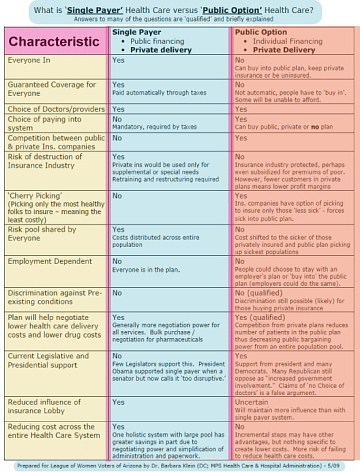
Dr. David Himmelstein & Dr. Steffie Woolhandler of PNHP Discuss the “Public Option” and Health Policy

Should Physicians for a National Health Program (PNHP) support a public Medicare-like option in a market of private plans?


PNHP should tell the truth: The “public plan option” won’t work to fix the health care system for two reasons:

1. It foregoes at least 84% of the administrative savings available through single payer. The public plan option would do nothing to streamline the administrative tasks (and costs) of hospitals, physicians offices, and nursing homes. They would still contend with multiple payers, and hence still need the complex cost tracking and billing apparatus that drives administrative costs. These unnecessary provider administrative costs account for the vast majority of bureaucratic waste. Hence, even if 95% of Americans who are currently privately insured were to join a public plan (and it had overhead costs at current Medicare levels), the savings on insurance overhead would amount to only 16% of the roughly $400 billion annually achievable through single payer.


2. A quarter century of experience with public/private competition in the Medicare program demonstrates that the private plans will not allow a level playing field. Despite strict regulation, private insurers have successfully cherry picked healthier seniors, and have exploited regional health spending differences to their advantage. They have progressively undermined the public plan – which started as the single payer for seniors and has now become a funding mechanism for HMOs, and a place for them to dump the unprofitably ill. A public plan option does not lead toward single payer, but toward the segregation of patients; with profitable ones in private plans and unprofitable ones in the public plan.


Would a public plan option stabilize the health care system, or even be a major step forward?


The evidence is strong that such reform would have at best a modest and temporary positive impact
– a view that is widely shared within PNHP. Indeed, we remain concerned that a public plan option as an element of reform might well be shaped in a manner to effectively subsidize private insurers by requiring patients to purchase coverage while relieving private insurance of the highest risk individuals, stabilizing private insurers for some time and reinforcing their control of the health care system.


Given the above, is it advisable to spend significant effort advocating for inclusion of such reform?


1. We are doctors, not politicians. We are obligated to tell the truth, and must answer for the veracity of our stance to our patients and colleagues over many years. Ours is a very different time horizon and set of responsibilities than politicians’. Falling in line with a consensus that attempts to mislead the public may gain us a seat at the debate table, but abdicates our ethical obligations.

2. The best way to gain a half a pie is to demand the whole thing.


Is fundamental reform possible?  

We remain optimistic that real reform is quite possible, but only if we and our many allies continue to insist on it.

The “Public Plan Option”: Myths and Facts

Physicians for a National Health Program
29 E. Madison St., Suite 602
Chicago, IL 60602-4404
http://www.pnhp.org

Myth: A public option will increase choice for patients. Fact: A public plan option will not increase choice of what matters for our health: choice of caregivers and choice in location of care. Patients will still have a limited choice of provider restricted by networks and will pay more to see providers outside of their network. Patients will still have to seek authorization for treatment. The public option will add one more plan to the hundreds of plans that already exist.

Myth: A public option will enable patients to keep their own doctor, regardless of changes in employment or health. Fact: A public plan option does not guarantee patients can keep their doctor regardless of employment or health because it leaves the employer based system of health care provision intact. If an employer chooses to change to a new plan, patients may have to change their doctor or pay higher fees to stay with their doctor. Insurers have strong financial incentives to enroll the healthy while avoiding the sick patients; thus if a patient becomes ill, they still risk losing their employer based insurance.

Continue reading The “Public Plan Option”: Myths and Facts

The Democrats “Public Option” Is Designed to Protect Insurance Companies

Health Care Reform: Congress Needs to Protect Americans, Not Insurance Companies

By Mark Dunlea, Executive Director

Hunger Action Network of NYS

Co-Chair, Single Payer New York (www.singlepayernewyork.org)

As Congress negotiates health care reform, Democratic leaders have put the interests of insurance companies ahead of the needs of American citizens. If Americans want an affordable, quality health care system that enables consumers to choose whom they receive health care services from, private for-profit insurance companies must be eliminated.

Michael Moore’s movie SICKO correctly highlighted the problems with insurance companies rather than the problem of the uninsured. While the lack of health insurance is estimated to kill 18,000 Americans annually, for-profit insurance companies kill far more with their unreasonable denial and delay in approving treatment as they seek to maximize their profits.

Continue reading The Democrats “Public Option” Is Designed to Protect Insurance Companies

Mine safety advocates praise Obama’s choice to lead agency

By Halimah Abdullah | McClatchy Newspapers

WASHINGTON — President Barack Obama’s choice to head the federal Mine Safety and Health Administration signals a dramatic shift from his predecessor on mine safety issues.

The selection of Joseph Main, the retired longtime safety and health administrator for the United Mine Workers of America to head MSHA, drew praise from safety advocates and criticism from the coal industry.

Continue reading Mine safety advocates praise Obama’s choice to lead agency

Mandatory Overtime for Nurses Now Banned in PA

Monday, July 06, 2009
By Bill Toland, Pittsburgh Post-Gazette

There were no parades or fireworks Wednesday, but July 1 was the independence day that so many nurses and hospital caregivers had hoped and battled for. Among those many was Lois Cusick of Mt. Lebanon, who has worked at UPMC’s Western Psychiatric Institute & Clinic for 26 years.

She, and all other nurses and caregivers in the state, are now largely immune from management requests to work “mandatory overtime,” the extra hours, nurses say, that frequently were tacked on the end of already long hospital shifts, jeopardizing patient care and making it tough to keep quality nurses.

Continue reading Mandatory Overtime for Nurses Now Banned in PA

A Tale of Two Healthcare Systems by CWA -Communications Workers of America

Click on the link below to view a very informative video about the American and Canadian healthcare systems by an affiliate of the Communications Workers of America – CWA

http://link.brightcove.com/services/player/bcpid1463312787?bctid=1463302784

Single Payer National Healthcare is the Only Affordable Solution – If the Insurance Company Public Option Compromise Passes Hold on to Your Wallet

Single Payer National Healthcare is the Only Affordable Solution
 
by Randy Shannon

A national single payer universal healthcare system is the only affordable solution to the healthcare crisis facing the nation. As embodied in HR 676, National Healthcare will require all healthcare providers to become non-profit organizations. National Healthcare, as the only source of payments to providers, will also replace all of the insurance companies.

This is a key feature of National Healthcare that saves over $400 billion in annual waste. The current “compromise” backed by the President and the wealthy US Senators actually increases the waste by forcing another 46 million Americans to buy insurance.

In order to cover those who will not meet the income level that requires them to buy insurance, the “compromise public option” will have to find the money by cutting funds that would go to healthcare providers. Now the President is publicly floating “proposals” to save money.

 A chief proposal is to cut payments to healthcare providers rather than eliminate the skimming by Wall Street and the insurance companies. This is not a solution.

Another suggestion is to tax workers healthcare benefits as income, another blow to the working class, already reeling from cuts in income, unemployment, rising taxes, and eroding public services. That is not a solution.

As the following New York Times article shows, the proposals for saving enough money to expand coverage within the current for-profit insurance industry-controlled system rely on so many “if-then” propositions that there will be no certainty except that the insurance industry remains in place to pick up the pieces.

The voices of union members and their locals in resolutions supporting single payer are becoming more powerful as the national AFL-CIO and CTW leaders see that their compromise with the bosses is going to backfire.

The voices of the voting public are becoming more and more powerful as advocates of single payer national healthcare, the only workable solution – a solution already embraced by the rest of the industrial nations.

See the New York Times coverage on the following page.

Single Payer National Healthcare Gaining Ground: an Update

The Rise of Single-Payer Health Care

Friday 12 June 2009

Rally for Single Payer Healthcare in L.A.

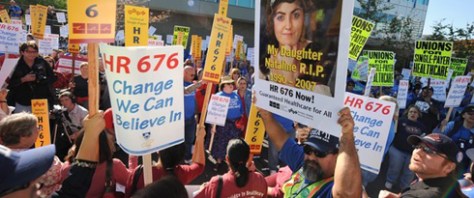
Health care reform plans are being drafted and passed around on both sides of Capitol Hill, but the plan with the greatest number of Congress members behind it was first introduced as a bill six years ago. With two new co-sponsors having just signed on, Congressman John Conyers’s single-payer health care plan, HR 676, now has 80 Congress members supporting it.

A House committee held a hearing on single-payer health coverage on Wednesday, and a Senate committee included single payer in a hearing on Thursday. Many opponents of single payer, including President Barack Obama and House Speaker Nancy Pelosi, say it would be the ideal solution if it were possible.

A single-payer or “Medicare for all” system that eliminates for-profit health insurance and simply pays for everyone’s treatment by private doctors and hospitals of their choosing is also the only solution consistently favored by a majority of Americans in polls. The proposal, already in place in most of the world’s wealthy nations, is raised at every health care town-hall forum that Congress members or President Obama speak at, including the one Obama held on Thursday in Green Bay, Wisconsin.

The president always rejects single payer on the grounds that some Americans are too fond of their health insurance companies to part with them. A report by Fairness and Accuracy in Reporting last week found that the corporate media still virtually bans coverage of single payer. A Senate bill being championed by Sen. Chris Dodd in place of ailing Sen. Edward Kennedy, does not include single payer (which is supported by only one US senator, Bernie Sanders). The Kennedy-Dodd bill, at least in its initial draft, does not even include a “public option,” that is a Medicare-like program to exist alongside the private insurance companies. The House bill is being drafted by one current and two former co-sponsors of HR 676, Congressmen George Miller, Henry Waxman and Charles Rangel, but it avoids single payer, championing a public option instead. Other competing Senate bills are expected to complicate things further.

Continue reading Single Payer National Healthcare Gaining Ground: an Update