Category Archives: Green Jobs

New Castle Firm Takes the Green High Road


Battery technology grows to meet demands of renewable energy

By Michael Sanserino
Beaver County Blue via Pittsburgh Post-Gazette

June 24, 2014 – Those skeptical of renewable energy as a viable power source often note that the wind doesn’t always blow nor does the sun always shine.

But advancements in battery technology are helping keep energy flowing on those dark, windless days.

“It’s happening at a record pace,” said Lisa Salley, vice president and general manager of energy and power technologies at Underwriter Laboratories, a Northbrook, Ill.-based independent safety consulting and certification organization.

The goal is to increase the usability of renewable energy, which currently accounts for 21 percent of all electricity generated worldwide but just 11 percent of consumption, according to the Energy Information Administration.

“One of the areas that’s been neglected in the past has been the storage component of renewable energy sources, and that includes wind and solar, of course,” said Tom Granville, CEO of Axion Power International.

That, however, is changing. Power, chemical and material science companies, locally and elsewhere, are investing heavily in battery technology. Some are improving existing technology while others are developing new chemistry to create entirely new battery structures.

Continue reading New Castle Firm Takes the Green High Road

Ohio Senate Republicans Launch Attack On State’s Renewable Energy Law

Will Pennsylvania Be Next in the ALEC Crosshairs?

Despite Fracking, PA has made some progress on renewable energy.

Wind farm in Paulding County, Ohio.

Wind farm in Paulding County, Ohio. CREDIT: Shutterstock

By Matt Kasper

Beaver county Blue via Climate Progress

March 31, 2014 – After multiple failed attempts to roll back Ohio’s clean energy and energy efficiency standards, Republicans in the state senate aren’t giving up, releasing another bill on Friday that takes aim at the law. The measure stems from a previous bill pushed by Sen. Bill Seitz (R-Cincinnati), member of the corporate-funded, anti-clean energy group the American Legislative Exchange Council (ALEC). Seitz’s legislation, S.B. 58, would have completely repealed the standards but the bill never made it out of the Senate Public Utilities Committee.

Republican leadership took the debate out of Seitz’s hands and drafted new legislation. The proposed bill, S.B. 310, sponsored by Sen. Troy Balderson (R-Zanesville), would freeze the clean energy and energy efficiency standards at 2014 levels while a committee, established by the legislation, studies how much the existing standards cost customers and what the costs would be if the state resumed the standards.

The law establishing Ohio’s renewable energy and energy efficiency standards, S.B. 221, passed both the House and Senate by a wide margin and was signed into law by Gov. Ted Strickland in 2008. The measure requires investor-owned utilities to provide 25 percent of their electricity supply from alternative energy resources by 2025. The definition of alternative energy resources includes clean coal, advanced nuclear power, distributed combined heat and power, and certain solid waste conversion technologies.

Continue reading Ohio Senate Republicans Launch Attack On State’s Renewable Energy Law

A Few Green Jobs Coming Our Way? Push The Budget Through…

Obama proposal sets aside more funds for Mon River, Olmsted lock projects

20140305Locks1 Overlooking the landside lock, U.S. Army Corps of Engineers and barge industry executives walk atop the Charleroi Lock and Dam during a tour of the Locks and Dams 2, 3, and 4 of the lower Monongahela River in June 2012.

Overlooking the landside lock, U.S. Army Corps of Engineers and barge industry executives walk atop the Charleroi Lock and Dam during a tour of the Locks and Dams 2, 3, and 4 of the lower Monongahela River in June 2012.

By Len Bolselovic

Beaver County Blue via the Pittsburgh Post-Gazette

March 4, 2014 – President Barack Obama’s proposed fiscal 2015 budget includes $9 million for continuing long-delayed work on a vital lock and dam project on the Monongahela River, more than four times the funding it received in the current fiscal year.

The White House budget proposal also includes $160 million for continuing construction at an Ohio River infrastructure project plagued by massive cost overruns. Paying for that project, located about 600 miles down the Ohio from Pittsburgh at Olmsted, Ill., has prevented the U.S. Army Corps of Engineers from providing additional funding for the Mon River work and other projects.

The barge industry and the federal government evenly split the cost of major lock and dam construction projects overseen by the Corps. The industry’s share is generated by a tax barge operators pay on the diesel fuel they use.

But river industry officials have complained about covering cost overruns at Olmsted, where the price tag has ballooned from $775 million when Congress authorized the project in 1988 to $3.1 billion.

More than half of the 200-plus locks and associated dams overseen by the Corps were built more than 50 years ago, which is how long they were expected to last.

Continue reading A Few Green Jobs Coming Our Way? Push The Budget Through…

The Jobs Project: Unemployed Coal Miners Install Solar Panels In West Virginia

By VICKI SMITH

Beaver County Blue via AP

July 23, 2013 – MORGANTOWN, W.Va. — A group devoted to creating alternative energy jobs in Central Appalachia is building a first for West Virginia’s southern coalfields region this week – a set of rooftop solar panels, assembled by unemployed and underemployed coal miners and contractors.

The 40- by 15-foot solar array going up on a doctor’s office in Williamson is significant not for its size but for its location: It signals to an area long reliant on mining that there can be life beyond coal.

People were skeptical when the idea was first floated about a year ago, says Nick Getzen, spokesman for The Jobs Project, which is trying to create renewable energy job opportunities in West Virginia and Kentucky. In the southern coalfields, he says, people have only ever gotten electricity one way – from coal-fired power plants.

"This is the first sign for a lot of folks that this is real, and that it’s real technology, and they can have it in their communities," Getzen says. "In no way are we against coal or trying to replace coal. There’s still going to be coal mining here. This is just something else to help the economy."

The Jobs Project teamed up about a year ago with a solar energy company from the Eastern Panhandle, Mountain View Solar & Wind of Berkeley Springs, to develop a privately funded job-training program. The 12 trainees are earning $45 an hour for three days of work, while some local laborers are earning $10 an hour helping out.

Continue reading The Jobs Project: Unemployed Coal Miners Install Solar Panels In West Virginia

‘Clean and Green’ Industrial Laundry Comes to Pittsburgh as a Worker Cooperative

By CUNY CED

Pittsburgh, PA is the home of a new worker cooperative, the ‘Clean and Green Laundry.’  The industrial-scale cleaning firm was brought into being by a joint effort of the United Steel Workers and the City University of New York School of Law’s Community Economic Development (CED) Clinic, both of whom are in a new partnership with the Mondragon Cooperatives, the largest worker-owned cooperative in the world, located in Spain.

Under the new partnership, the CED Clinic, in collaboration with Pennsylvania-based Regional Housing Legal Services, will help launch the job-creating effort, an eco-friendly laundry based on Mondragon’s cooperative model.

Pittsburgh Clean & Green aims to re-employ 100 primarily minority laundry workers, who were laid off when their Sodexho Corporation laundry closed. They will work in a new state-of-the-art facility in Pittsburgh’s Central District.


Photo: Industrial laundry similar to ‘Clean & Green’

CUNY’s CED Clinic will provide legal support for a new model of unionized worker cooperatives—called “union coops”—recently launched by Mondragon, the United Steelworkers union (USW), and the Ohio Employment Ownership Center (OEOC).

“Union coops can create well-paying, democratically run workplaces in communities hard hit by the economic recession,” explains Carmen Huertas-Noble, associate professor and director of the CED Clinic. “The union component of the model provides front line worker-owners with the security of a collective bargaining agreement and leverages the organizational expertise and economic power of the labor movement.”

Continue reading ‘Clean and Green’ Industrial Laundry Comes to Pittsburgh as a Worker Cooperative

Military spending is not right way to boost America’s economic security

By Michael Shank& Elizabeth Kucinich

Beaver County Blue via Fox News Opinion

May 15, 2013 – That Washington is holding defense cuts responsible for slow economic growth is a specious argument at best. War spending is unproductive and inflationary. Modern defense costs are capital intensive, not labor intensive, making the industry inefficient as a job creator.

The defense industry has a presence in congressional districts across this country, so cuts affect every member. But every district in the U.S. has pressing infrastructure, education, health and environmental needs, and the return on the taxpayer’s dollar is much higher when invested on these areas.
Instead of concentrating money on capital intensive, military hardware purposed for destruction, and causing long term economic drain, our very limited and valuable economic resources should be invested in building the true strength and capacity of our economy, our nation, and her people.

During the heightened banking crisis in 2009, Rep. James Oberstar, then Chair of House Transportation Committee, called for a massive Eisenhower-level of investment in transportation infrastructure. He was right.

The American Society of Civil Engineers estimates that the U.S. requires $3.6 trillion in infrastructure investment by 2020 to bring our grade D+ standards to safe standards.

This is exactly what we need: to put bridge-builders to work rather than funding technology and personnel to destroy bridges, and to take tank-making factories and repurpose them to build high-speed trains.
In prioritizing military spending, Congress is cutting the very programs that can actually strengthen our economy: Cutting federal assistance to the states, forcing them to lay off teachers, firefighters, and social workers; cutting opportunities for job creation, training, and placement programs; and eviscerating funding for children’s programs and assistance for seniors.

These actions make no economic sense.

Continue reading Military spending is not right way to boost America’s economic security

Green Jobs via the Smart Grid: Now The Task Is To Make It Global

monitoring.the_.gridx299.jpg

Smart power: Andrew Brown, an engineer at Florida Power & Light, monitors equipment in one of the utility’s smart grid diagnostic centers.

With Florida Project, the Smart Grid Has Arrived

Smart grid technology has been implemented in many places, but Florida’s new deployment is the first full-scale system.

By Kevin Bullis

SolidarityEconomy.net via MIT Technology Review

Why It Matters

May 2, 2013 – Conventional power grids can’t handle big storms or large-scale renewable energy.

The first comprehensive and large scale smart grid is now operating. The $800 million project, built in Florida, has made power outages shorter and less frequent, and helped some customers save money, according to the utility that operates it.

Smart grids should be far more resilient than conventional grids, which is important for surviving storms, and make it easier to install more intermittent sources of energy like solar power (see “China Tests a Small Smart Electric Grid” and “On the Smart Grid, a Watt Saved Is a Watt Earned”). The Recovery Act of 2009 gave a vital boost to the development of smart grid technology, and the Florida grid was built with $200 million from the U.S. Department of Energy made available through the Recovery Act.

Dozens of utilities are building smart grids—or at least installing some smart grid components, but no one had put together all of the pieces at a large scale. Florida Power & Light’s project incorporates a wide variety of devices for monitoring and controlling every aspect of the grid, not just, say, smart meters in people’s homes.

“What is different is the breadth of what FPL’s done,” says Eric Dresselhuys, executive vice president of global development at Silver Spring Networks, a company that’s setting up smart grids around the world, and installed the network infrastructure for Florida Power & Light (see “Headed into an IPO, Smart Grid Company Struggles for Profit”).

Continue reading Green Jobs via the Smart Grid: Now The Task Is To Make It Global

Germany Showing How to Move to Clean Energy

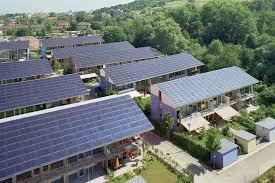
German housing producing its own electricity, and selling the excess to the grid

Is Renewable Energy’s Biggest Problem Solved?

By Paul Brown
SolidarityEconomy.net via Climate News Network

April 5, 2013 – Critics of renewables have always claimed that sun and wind are only intermittent producers of electricity and need fossil fuel plants as back-up to make them viable. But German engineers have proved this is not so.

By skillfully combining the output of a number of solar, wind and biogas plants the grid can be provided with stable energy 24 hours a day without fear of blackouts, according to the Fraunhofer Institute for Wind Energy and Energy System Technology (IWES) in Kassel.

For Germany, which has turned its back on nuclear power and is investing heavily in all forms of renewables to reduce its carbon dioxide emissions, this is an important breakthrough.

The country has a demanding industrial sector that needs a large and stable electricity supply, and some doubted that this could be achieved in the long term without retaining nuclear or large fossil fuel plants.

Solving the problem is becoming urgent. The latest figures show that on some days of the year the electricity being generated from sun, wind, biomass, water and geothermal production already accounts for more than half of the load required in the country.

The research is funded by the German Federal Ministry of the Environment and is aimed at showing that the entire electricity grid could be run on renewable energy.

Dr. Kurt Rohrig, deputy director of IWES, said: "Each source of energy – be it wind, sun or biogas – has its strengths and weaknesses. If we manage to skillfully combine the different characteristics of the regenerative energies, we can ensure the power supply for Germany.”

The idea is that many small power plant operators can feed their electricity into the grid but act as a single power plant using computers to control the level of power (see our story of 20 January, Renewables: The 99.9% solution).

Sharing the load

Scientists linked together 25 plants with a nominal power output of 120 megawatts. Surplus power could be used for charging electric vehicles and for pumped storage (pumping water uphill into a reservoir to produce hydropower later).

When many small producers work together, then regional differences when the wind blows or the sun is intermittent are balanced out in the grid and can be boosted by controllable biogas facilities.

If there is too much surplus energy then the power can also be used to create and store thermal energy to be used later.

Kasper Knorr, the project manager for the scheme, which is known as the Combined Power Plant2 research project, says the idea is to ensure that the consumer is supplied reliably with 230 volts at a frequency of 50 Hertz.

The current system of supplying the grid with electricity is geared to a few large producers. In the new system, with dozens of small producers, there will need to be extra facilities at intervals on the system to stabilize voltage. Part of the project is designed to find out how many of these the country will need.

The project has the backing of Germany’s large and increasingly important renewable companies and industrial giants like Siemans.  Researchers will be demonstrating the system at the Hanover Trade Fair from April 8 to 13.

Filling the ‘Green Jobs’ Bucket Needs More Than a Slow Dribble…

Monongahela locks and dams would get $2 million from spending plan

By Len Boselovic

Pittsburgh Post-Gazette

April 12, 2013 – President Barack Obama’s $3.8 trillion budget proposal calls for imposing annual per-vessel fees on the barge industry to pay for an $8 billion backlog in delayed and over-budget projects, including replacing aging locks and dams on the Monongahela River.

The White House proposal comes as a measure by Sen. Bob Casey, D-Pa., to bolster funding for the work and shift more of the costs to taxpayers could be taken up by the U.S. Senate as early as next week.

The budget proposal Mr. Obama submitted Wednesday includes $4.7 billion for the U.S. Army Corps of Engineers civil works program, which includes operating, maintaining and replacing more than 200 locks and related dams on the nation’s rivers. That is nearly 6 percent less than was called for in the last budget Congress approved for the fiscal year that ended in September.

The $4.7 billion includes $2 million for replacing locks and dams on the Monongahela River at Braddock, Charleroi and Elizabeth, a project that typifies the delays and cost overruns plaguing the nation’s deteriorating locks and dams.

Continue reading Filling the ‘Green Jobs’ Bucket Needs More Than a Slow Dribble…

The Next ‘American Revolution’ Already Starting in Cleveland, Cincinnati and a Few Other Places Around Here…