
Category Archives: Economy
Glenn Greenwald on Goldman Sachs “Blowout Profits”
Monday July 13, 2009 06:14 EDT
from Salon.com
The events preceding Goldman Sachs’ new “blowout profits”
http://www.salon.com/opinion/greenwald/2009/07/13/goldman/index.html
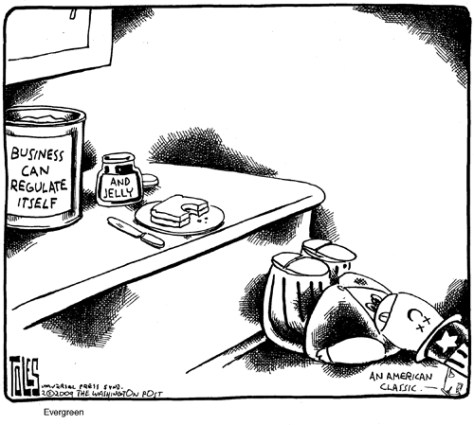
Remember all of this — the $700 billion bank bailout, the AIG scandal, dark and scary threats of imminent global meltdown if there wasn’t full-scale capitulation by the citizenry to the immense transfer of public wealth to the private investment banking sector? Such distant, hazy memories: so many exciting celebrity deaths and riveting celebrity resignations ago. If sequences of events like these don’t cause mass citizen outrage, then it’s hard to imagine what will:
Continue reading Glenn Greenwald on Goldman Sachs “Blowout Profits”
Dangerous
The Democrats “Public Option” Is Designed to Protect Insurance Companies
Health Care Reform: Congress Needs to Protect Americans, Not Insurance Companies
By Mark Dunlea, Executive Director
Hunger Action Network of NYS
Co-Chair, Single Payer New York (www.singlepayernewyork.org)
As Congress negotiates health care reform, Democratic leaders have put the interests of insurance companies ahead of the needs of American citizens. If Americans want an affordable, quality health care system that enables consumers to choose whom they receive health care services from, private for-profit insurance companies must be eliminated.
Michael Moore’s movie SICKO correctly highlighted the problems with insurance companies rather than the problem of the uninsured. While the lack of health insurance is estimated to kill 18,000 Americans annually, for-profit insurance companies kill far more with their unreasonable denial and delay in approving treatment as they seek to maximize their profits.
Continue reading The Democrats “Public Option” Is Designed to Protect Insurance Companies
Pittsburgh: 300 Union Workers Gather to Support EFCA Bill
 Angry Workers:
Sen. Arlen Specter
Receives Thousands
of Protest Letters
By Ann Belser
Pittsburgh Post-Gazette
April 15, 2009 – Dewitt Walters, of the United Steelworkers, instructs union members and supporters to march two-by-two on the sidewalk along the Boulevard of the Allies yesterday as they walk to Sen. Arlen Specter’s Pittsburgh office to deliver petitions supporting the Employee Free Choice Act. Union members rallied at the USW headquarters before the march.
Local labor organizations figured maybe 50 people would want to come along to hand-deliver thousands of letters, written in favor of pending legislation, to U.S. Sen. Arlen Specter’s office.
Continue reading Pittsburgh: 300 Union Workers Gather to Support EFCA Bill
The Massachusetts’ Plan: A Failed Model for Health Care Reform
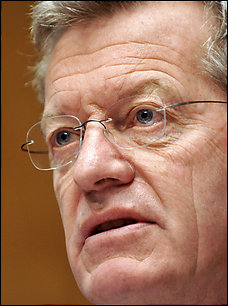
A new study shows that the Massachusetts model for national healthcare reform is a failure. Taxpayer subsidized insurance and forcing citizens to buy insurance is supported by the insurance industry and their bought politicians such as US Sen. Max Baucus.
The Massachusetts Reform:
A Rerun of Past State Reforms That Have Failed
Back in 1988, Massachusetts passed a universal health care law very similar to the 2006 reform. Since 1988, many states—Oregon, Minnesota Tennessee, Vermont, Washington and Maine—have enacted reforms aimed at achieving universal coverage. All failed.
These reforms differed in detail, but shared common elements. All offered new public subsidies or expanded Medicaid for poor and near-poor people. All left the majority of private health insurance arrangements undisturbed, although many included new insurance regulations or state purchasing pools to help make affordable coverage available to individuals or small businesses. Some (Massachusetts 1988, Oregon 1992, Washington State 1993) contained mandates on employers or self-employed individuals.
None of these reforms made more than a temporary dent in the number of uninsured. These incremental reforms failed because they did not include effective cost-control measures. As health costs rose, legislatures backed off from forcing employers and the self-employed from paying ever-rising premiums and the mandates were repealed. Relying on Medicaid was fiscally problematic for states because tax revenues fall at the same time that unemployment pushes families out of private coverage. There is little reason to think that the current Massachusetts reform, or a national plan modeled on these state reforms, would have any better long-term success.
Is there an alternative to this model?
Yes. A bill in Congress, the United States National Health Care Act, H.R. 676 (also known as “The Expanded and Improved Medicare for All Act”) would implement single-payer financing of health care while maintaining the private delivery system. A single-payer program would eliminate private insurers and use the administrative savings to provide comprehensive coverage for all. Features of the single-payer plan include:
- Comprehensive coverage for all, including doctor, hospital, long-term, mental health, dental and vision care as well as prescription drugs and medical supplies.
- No premiums, co-payments, or deductibles that inhibit access to care and unfairly burden the poor.
- Free choice of doctor and hospital and an end to insurance company and HMO dictates over patient care.
- Pays for itself by eliminating wasteful private insurance administration and profit. A progressive tax would replace what is currently paid out-of-pocket.
- Controls costs so benefits are sustainable through negotiated physician fees, global budgets for hospitals and bulk purchasing of prescription drugs and medical supplies. A single-payer system would facilitate health planning to reestablish the balance between preventive and primary care on one hand, and high-tech tertiary care on the other.
The nation must not look to Massachusetts’ health reform as a model. If we truly want to provide comprehensive health care for all of us at a price we can afford, we must adopt a single-payer plan.
Read the complete analysis here: http://www.citizen.org/hrg/articles.cfm?ID=18395
SW Alabama Labor Council and CWA Local 3372 in Lexington, KY Endorse HR 676
Mobile, Alabama. The Southwest Alabama Labor Council has endorsed HR 676, single payer healthcare legislation introduced by Congressman John Conyers (D-MI).
The Alabama Labor Council is the one hundred-and-twenty-first labor council to endorse the Conyers legislation. The resolution was forwarded to the members of congress who represent Mobile and surrounding areas.
In Lexington, Kentucky, CWA Local 3372 has also endorsed the Conyers legislation, reports Local President Joseph McCarty. The resolution was sent to Representative Ben Chandler.
Demand for Single Payer Healthcare Heard Inside and Outside Burlington Forum
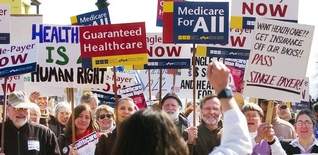
- Single Payer Rally at Burlington Healthcare Forum
Burlington Free Press
March 18, 2009
Single-payer health care system touted
150 rally in support of concept at regional forum at UVM
By Nancy Remsen, Free Press Staff Writer
Dr. John Walsh, a neuroscience researcher from Worcester, Mass., stood Tuesday with 150 other sign-carrying supporters of government-financed health care outside the building where 400 invited guests would attend a regional health care reform forum sponsored by the Obama White House.
Walsh passed out yellow fliers that denounced President Barack Obama for failing to live up to promises to consider a Canadian-style health insurance system. “Single payer is the choice in the polls,” Walsh declared.
Sandy Eaton of Quincy, Mass., and a member of the Massachusetts Nurses Association, came to the only forum scheduled for the Northeast to add his voice to those demanding that national policymakers weigh the merits of a government-financed system when they discuss reform options. “Let’s make sure there is a fair and legitimate comparison,” Eaton said.
Rebecca Elgie, a retired teacher, traveled six hours from Ithaca, N.Y., because she has made advocacy for a single-payer system her cause. Three years ago she walked 400 miles across her state to raise awareness about the need for a better way to pay for health care. Elgie said, “The employee-based system has outlived its usefulness.”
The rally greeted the invited guests as they strolled toward the Davis Center at the University of Vermont under a bright blue sky. “They need to know there is enough support for people to drop everything and come here to support single payer,” said Dr. Deb Richter, a Montpelier family physician and prime force in the single-payer movement in Vermont.
Continue reading Demand for Single Payer Healthcare Heard Inside and Outside Burlington Forum
 Beaver County Blue: Voice of the 17th CD of Progressive Democrats of America