Category Archives: Community

Justice Sotomayor Issues Challenge to a Century of Corporate Law

By JESS BRAVIN

http://online.wsj.com/article/SB125314088285517643.html

WASHINGTON — In her maiden Supreme Court appearance last week, Justice Sonia Sotomayor made a provocative comment that probed the foundations of corporate law.

During arguments in a campaign-finance case, the court’s majority conservatives seemed persuaded that corporations have broad First Amendment rights and that recent precedents upholding limits on corporate political spending should be overruled.

But Justice Sotomayor suggested the majority might have it all wrong — and that instead the court should reconsider the 19th century rulings that first afforded corporations the same rights flesh-and-blood people have.

PA Republican Senator Vogel Instransigent on State Budget Cuts to Children

Child CareBeaver County Daycare Providers Meet Republican Senator Elder Vogel: Dismayed by His Lack of Concern for Children

By Tina Shannon

September 10, 2009

Last Thursday night, five daycare providers sat down with Pennsylvania 47th District Senator Elder Vogel and his aide Joe Weider to talk over the state budget. I arrived at the Senator’s office in the hilltop neighborhood of upper Rochester about 6:30 pm, even though the meeting didn’t start until 7:00.

Charlie Hamilton, my friend who had helped set up the meeting with Senator Vogel, was waiting . Charlie is a retired postal worker who has extensive experience dealing with legislators.

Several weeks earlier I had gone on an angry rant about the budget proposed by Pennsylvania’s Republican-controlled State Senate. I wanted to have a public meeting denouncing Vogel, who is our newly elected Republican Sate Senator. Charlie counseled restraint. “First you have to give the guy a chance to do the right thing,” he said.

So Charlie graciously set up the meeting.

I contacted several of my colleagues, looking for people who understood the importance of maintaining social services in our county by funding them in the budget. A handful of wonderful women responded. I also brought an articulate impassioned young woman who is one my clients.

Continue reading PA Republican Senator Vogel Instransigent on State Budget Cuts to Children

Can the US Afford Single Payer Healthcare? Yes!

Tina Shannon
Tina Shannon

Presented to Cong. Jason Altmire at a PDA Roundtable Discussion on Healthcare on August 20, 2009


by Tina Shannon, Chairperson
PA 4th CD Chapter Progressive Democrats of America
 

Perhaps the biggest sticking point in the single payer/national healthcare argument is cost. If you look at the system of healthcare we have now, it’s hard to imagine being able to provide that to everyone in the country.

But study after study indicates that we can.

June 1991, General Accounting office: “If the US were to shift to a system of universal coverage and a single payer, as in Canada, the savings in administrative costs (10% of health spending) would be more than enough to offset the expense of universal coverage.

December 1991, Congressional Budget Office: “(a) single payer system that paid providers at Medicare’s rates, that population that is currently uninsured could be covered without dramatically increasing national spending on health.”

Continue reading Can the US Afford Single Payer Healthcare? Yes!

Does PA Senator Elder Vogel Care About Children? Ask Him!

by Randy Shannon
 
Protest Daycare Cuts in Belleview

Who Is Elder Vogel?

Elder Vogel is a farmer on the plateau above the valley of the Beaver and Ohio Rivers . He is also the freshman Republican State Senator representing the 47th Senatorial district encompassing much of Beaver and Lawrence Counties, including the cities of Ambridge, Aliquippa, Beaver Falls, and New Castle.

As his website says: “A citizen-legislator, Senator Vogel is a fourth-generation dairy farmer, operating the family farm in New Sewickley Township which was established in the late 1800s.  For many years, Senator Vogel served as president of the Beaver-Lawrence Farm Bureau, and until his election served as a New Sewickley Township Supervisor.”

Vogel defeated Jason Petrella, a Democratic Party newcomer with no political experience. Petrella was also running with the overhang of scandal. Local Democratic leader Mike Veon and other Democrats were previously ousted for stubbornly supporting a midnight pay raise despite widespread protest and criticism.

What Has Elder Vogel Done?

Continue reading Does PA Senator Elder Vogel Care About Children? Ask Him!

PA Senate Republicans Declare War on Working Families with Vicious Budget Cuts to Protect the Rich

 Pennsylvania Budget and Policy Center
Pileggi, Scarnati, Vogel Attack Children, Elderly, Vets

 www.pennbpc.org

 717-255-7156   
 
On May 6, on a party-line vote, the Pennsylvania Senate passed a budget that makes deep cuts in most state services and programs.
 

Senate Bill (SB) 850 proposes spending $24.6 billion in state general fund dollars in FY2009-10, effectively reducing state expenditures to 2005-06 levels. With the addition of $2.7 billion in federal stimulus funds, total state spending rises to $27.3 billion, $1.7 billion less than the spending plan proposed by Governor Ed Rendell in February.

Even with federal stimulus funds accounted for, every major department will be cut. Funding for the Department of Public Welfare will decline by $250 million, a 4% cut, while funding for environmental protection will decline by 40%.

The Senate plan relies on cuts to balance the budget, rejecting other options. The plan leaves the state’s $740 million Rainy Day Fund untouched and contains little new revenue. It rejects the Governor’s proposed tax on smokeless tobacco and other tobacco products, a new natural gas severance tax, and a cigarette tax rate increase. It leaves $500 million in the Health Care Provider Retention Account, a portion of which could be used to avoid service cuts.

Continue reading PA Senate Republicans Declare War on Working Families with Vicious Budget Cuts to Protect the Rich

The Crisis for Main Street Deepens: U.S. commercial mortgage delinquencies jump 585%

Dayton Business Journal – by Katherine Conrad

Delinquencies on commercial mortgage backed securities soared $10 billion in June, hitting a 12-month high of almost $29 billion, according to Realpoint Research.

California led the nation with the highest amount of delinquent loans, closely followed by Texas and Florida.

Late loans across the country are up an “astounding” 585 percent from a year ago when just $4 billion were delinquent, reported the Horsham, Pa.-based research firm. The low point for delinquency was March 2007 when $2 billion was delinquent.

Continue reading The Crisis for Main Street Deepens: U.S. commercial mortgage delinquencies jump 585%

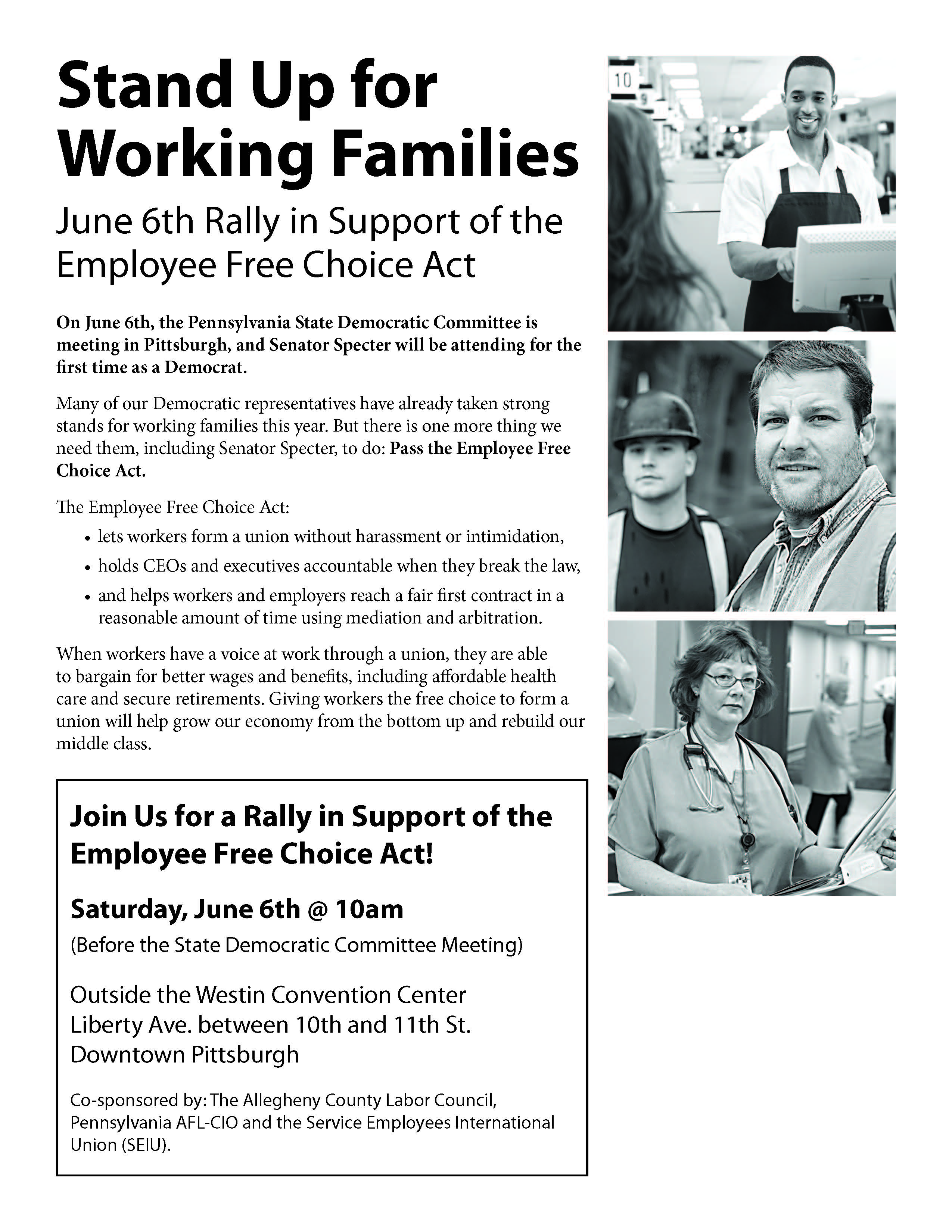
Far From Over! Join June 6 EFCA Rally!

To download a pdf file of this flyer for printing, click this line

June6_EmployeeFreeChoice

Single Payer Testimony Before Congress by Dr. Himmelstein

 Testimony of David U. Himmelstein, M.D.

Before the HELP Subcommittee    April 23, 2009


Mr. Chairman, members of the Committee. My name is David Himmelstein. I am a primary care doctor in Cambridge, Massachusetts and Associate Professor of Medicine at Harvard. I also serve as National Spokesperson for Physicians for a National Health Program. Our 15,000 physician members support non-profit, single payer national health insurance because of overwhelming evidence that lesser reforms will fail.

 Health reform must address the cost crisis for insured as well as uninsured Americans. 

Continue reading Single Payer Testimony Before Congress by Dr. Himmelstein

The Massachusetts’ Plan: A Failed Model for Health Care Reform

A new study shows that the Massachusetts model for national healthcare reform is a failure. Taxpayer subsidized insurance and forcing citizens to buy insurance is supported by the insurance industry and their bought politicians such as US Sen. Max Baucus.

The Massachusetts Reform:
A Rerun of Past State Reforms That Have Failed

Back in 1988, Massachusetts passed a universal health care law very similar to the 2006 reform.   Since 1988, many states—Oregon, Minnesota Tennessee, Vermont, Washington and Maine—have enacted reforms aimed at achieving universal coverage.  All failed.

These reforms differed in detail, but shared common elements. All offered new public subsidies or expanded Medicaid for poor and near-poor people. All left the majority of private health insurance arrangements undisturbed, although many included new insurance regulations or state purchasing pools to help make affordable coverage available to individuals or small businesses. Some (Massachusetts 1988, Oregon 1992, Washington State 1993) contained mandates on employers or self-employed individuals.

None of these reforms made more than a temporary dent in the number of uninsured.   These incremental reforms failed because they did not include effective cost-control measures. As health costs rose, legislatures backed off from forcing employers and the self-employed from paying ever-rising premiums and the mandates were repealed. Relying on Medicaid was fiscally problematic for states because tax revenues fall at the same time that unemployment pushes families out of private coverage.   There is little reason to think that the current Massachusetts reform, or a national plan modeled on these state reforms, would have any better long-term success.

Is there an alternative to this model?

Yes. A bill in Congress, the United States National Health Care Act, H.R. 676   (also known as “The Expanded and Improved Medicare for All Act”) would implement single-payer financing of health care while maintaining the private delivery system. A single-payer program would eliminate private insurers and use the administrative savings to provide comprehensive coverage for all. Features of the single-payer plan include:

  • Comprehensive coverage for all, including doctor, hospital, long-term, mental health, dental and vision care as well as prescription drugs and medical supplies.
  • No premiums, co-payments, or deductibles that inhibit access to care and unfairly burden the poor.
  • Free choice of doctor and hospital and an end to insurance company and HMO dictates over patient care.
  • Pays for itself by eliminating wasteful private insurance administration and profit. A progressive tax would replace what is currently paid out-of-pocket.
  • Controls costs so benefits are sustainable through negotiated physician fees, global budgets for hospitals and bulk purchasing of prescription drugs and medical supplies.  A single-payer system would facilitate health planning to reestablish the balance between preventive and primary care on one hand, and high-tech tertiary care on the other.

The nation must not look to Massachusetts’ health reform as a model. If we truly want to provide comprehensive health care for all of us at a price we can afford, we must adopt a single-payer plan.

Read the complete analysis here: http://www.citizen.org/hrg/articles.cfm?ID=18395

Demand for Single Payer Healthcare Heard Inside and Outside Burlington Forum

Single Payer Rally at Burlington Healthcare Forum

Burlington Free Press


March 18, 2009

Single-payer health care system touted

150 rally in support of concept at regional forum at UVM

By Nancy Remsen, Free Press Staff Writer
 

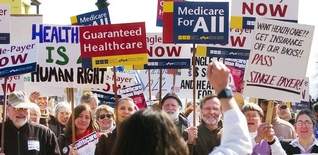
Dr. John Walsh, a neuroscience researcher from Worcester, Mass., stood Tuesday with 150 other sign-carrying supporters of government-financed health care outside the building where 400 invited guests would attend a regional health care reform forum sponsored by the Obama White House.

Walsh passed out yellow fliers that denounced President Barack Obama for failing to live up to promises to consider a Canadian-style health insurance system. “Single payer is the choice in the polls,” Walsh declared.

Sandy Eaton of Quincy, Mass., and a member of the Massachusetts Nurses Association, came to the only forum scheduled for the Northeast to add his voice to those demanding that national policymakers weigh the merits of a government-financed system when they discuss reform options. “Let’s make sure there is a fair and legitimate comparison,” Eaton said.

Rebecca Elgie, a retired teacher, traveled six hours from Ithaca, N.Y., because she has made advocacy for a single-payer system her cause. Three years ago she walked 400 miles across her state to raise awareness about the need for a better way to pay for health care. Elgie said, “The employee-based system has outlived its usefulness.”

The rally greeted the invited guests as they strolled toward the Davis Center at the University of Vermont under a bright blue sky. “They need to know there is enough support for people to drop everything and come here to support single payer,” said Dr. Deb Richter, a Montpelier family physician and prime force in the single-payer movement in Vermont.

Continue reading Demand for Single Payer Healthcare Heard Inside and Outside Burlington Forum