Pennsylvania’s Democratic governor has earned a reputation for being sure-footed in a crisis.
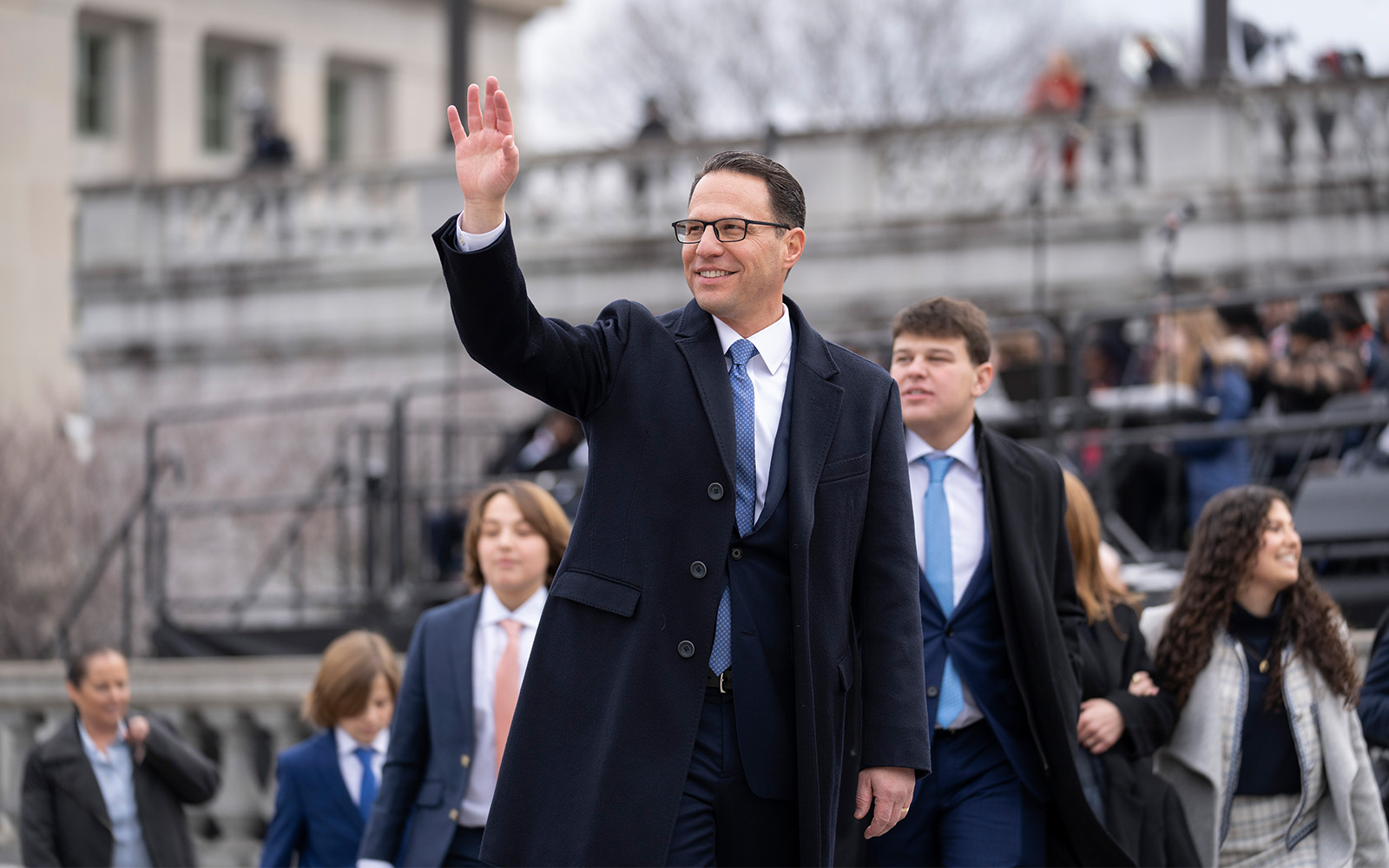
Photo: Josh Shapiro speaks during campaign event in Scranton, Pa., April 16. PHOTO: MATT ROURKE/ASSOCIATED PRESS
By Salena Zito
Wall Street Journal
April 29, 2024 – Lyndora, PA – Gov. Josh Shapiro walks down the labyrinth of narrow concrete stairs and hallways through Cleveland-Cliffs’ Butler Works steel mill in Western Pennsylvania. Reaching the podium, he raises his arm in victory when Jamie Sychak, president of United Auto Workers Local 3303, notes that a feared shutdown of the plant has been averted.
“It shows what is possible when we come together—Democrats and Republicans, union leaders, and CEOs—and go in the same direction,” Mr. Shapiro says. He praises the work the union’s members do at the only domestic mill that produces the grain-oriented electrical steel used to produce distribution transformers. The mill was set for extinction because of a proposed federal rule mandating that manufacturers use amorphous steel instead.
The union and Cleveland-Cliffs CEO Lourenco Goncalves lobbied local, state and federal elected officials, but only after Mr. Shapiro appealed to the White House did the rule change. “They heard us, loud and clear, and they worked with us to revise this final rule,” Mr. Shapiro tells the crowd. Having the president’s ear is a big advantage for a swing-state governor.
Joe Biden carried the Keystone state by 1.1 points in 2020. Four years earlier, Donald Trump won by less than a point. When Mr. Shapiro won the governor’s office in 2022, his margin was nearly 15 points. That was in part because his opponent, state Sen. Doug Mastriano was a weak candidate. But it didn’t hurt that Mr. Shapiro is “so damn talented,” as GOP strategist David Urban puts it. The latest polling by Quinnipiac University shows Mr. Shapiro has a 59% approval rating. Mr. Biden’s figure in Pennsylvania is 39%.
Mr. Shapiro has developed a reputation for being competent, pragmatic and sure-footed in a crisis. “My job is to keep people safe, and my job every day is to get s— done,” he says in an interview. “Particularly in a time of emergency, you need to take control of the scene, you need to assess the damage and what is needed to be done, and then put your team in place to go and do it.”
After the February 2023 Norfolk Southern train derailment across the state line in East Palestine, Ohio, spilled a cocktail of hazardous chemicals, the Pennsylvania governor was on the ground in Beaver and Lawrence counties, as well as in Ohio at Gov. Mike DeWine’s invitation, to see firsthand what had happened.
“I’ll never forget,” he says. “I knocked on the door of a home in Darlington Township and the woman in the home invited me in. And obviously they were scared, they were worried about their livestock, and she had also shared with me—and this has stuck with me—she had to leave her home for about two days and in the time she left, she lost a batch of eggs.”
Photo: A gun rights advocate with an “I VOTED” sticker on his holster gathers with others for an annual rally on the steps of the state Capitol in Harrisburg, Pa., Monday, May 6, 2019. (AP Photo/Matt Rourke)
Two Pennsylvania lawmakers introduced a bill in February that would prohibit guns inside a building where votes were being cast
By Matt Vasilogambros And Kim Lyons
Penn-Capital- Star
March 24, 2024 – Two Pennsylvania lawmakers introduced a bill in February that would prohibit guns inside a building where votes were being cast.
Facing increased threats to election workers and superheated political rhetoric from former President Donald Trump and his supporters, more states are considering firearm bans at polling places and ballot drop boxes ahead of November’s presidential election.
This month, New Mexico became the latest state to restrict guns where people vote or hand in ballots, joining at least 21 other states with similar laws — some banning either open or concealed carry but most banning both.
Nine of those prohibitions were enacted in the past two years, as states have sought to prevent voter intimidation or even violence at the polls driven by Trump’s false claims of election rigging. At least six states are debating bills that would ban firearms at polling places or expand existing bans to include more locations.
In Pennsylvania, state Reps. Tim Brennan (D-Bucks) and Mary Jo Daley (D-Montgomery) introduced a bill in February that would prohibit the carrying of firearms at all polling places. House Bill 2077 would not apply to law enforcement or military personnel on duty at polling places, and anyone licensed to carry a firearm could keep the firearm in their vehicle while voting, but not bring it into the building where votes are being cast.
“Over the years, we have heard more and more about voters and election workers being threatened, harassed, or intimidated at polling places,” the two write in a memo for HB 2077. “As a result, many voters have expressed concerns about voting in person at their assigned polling location, and many voting districts have struggled to find or retain volunteers to work at such locations.”
Daley told the Capital-Star that when she was a committee member in the 1990s she remembers someone coming to a polling place with a gun and it frightened the poll workers. “And we were in a much more peaceful time then,” she said. Daley added she has introduced similar legislation several times but with Democrats in the minority in the House until 2022, there was little chance of it moving forward.
HB 2077 was referred to the House State Government committee March 5. “I think it’d be great to bring it up because quite honestly, we have some members who talk about the value of life, but that doesn’t seem to bear out all lives,” Daley said.
“When you think of elections in Pennsylvania, it’s a community activity,” Daley added. “But it doesn’t mean that some communities aren’t really struggling with this issue.”
New Mexico law The New Mexico measure, which was supported entirely by Democrats, applies to within 100 feet of polling places and 50 feet of ballot drop boxes. People who violate the law are subject to a petty misdemeanor charge that could result in six months in jail.
“Our national climate is increasingly polarized,” said Democratic state Rep. Reena Szczepanski, one of the bill’s sponsors. “Anything we can do to turn the temperature down and allow for the safe operation of our very basic democratic right, voting, is critical.”
She told Stateline that she and her co-sponsors were inspired to introduce the legislation after concerned Santa Fe poll workers, who faced harassment by people openly carrying firearms during the 2020 presidential election, reached out to them.
Our national climate is increasingly polarized. Anything we can do to turn the temperature down and allow for the safe operation of our very basic democratic right, voting, is critical.
The bill carved out an exception for people with concealed carry permits and members of law enforcement. Still, every Republican in the New Mexico legislature opposed the measure; many said they worried that gun owners might get charged with a crime for accidentally bringing their firearm to the polling place.
“We have a lot of real crime problems in this state,” said House Minority Floor Leader Ryan Lane, a Republican, during a House Judiciary Committee hearing last month. “It’s puzzling to me why we’re making this a priority.”
But over the past several years, national voting rights and gun violence prevention advocates have been sounding the alarm over increased threats around elections, pointing to ballooning disinformation, looser gun laws, record firearm sales and vigilantism at polling locations and ballot tabulation centers.
In February, Pennsylvania Secretary of the Commonwealth Al Schmidt said that the that the turnover among experienced election officials in Pennsylvania counties is “a real concern” ahead of the 2024 elections. Some 70 senior directors or those directly underneath them have left, Schmidt said.
National surveys show that election officials have left the field in droves because of the threats they’re facing, and many who remain in their posts are concerned for their safety.
Add in aggressive rhetoric from Trump, the presumptive Republican presidential nominee, and it becomes “a storm” that makes it essential for states to pass laws that prohibit guns at polling places, said Robyn Sanders, a Democracy Program counsel for the Brennan Center for Justice, a voting rights group based at the New York University School of Law.
“Our democracy has come under new and unnerving pressure based on the emergence of the election denial movement, disinformation and false narratives about the integrity of our elections,” said Sanders, who co-authored a September report on how to protect elections from gun violence. The report was a partnership between the Brennan Center and the Giffords Law Center to Prevent Gun Violence.
“The presence of guns in these places presents a risk of violence,” she added.
Central Pennsylvania ‘Sundown Towns’ and the Legacy of Racism: ‘It’s Still Here’
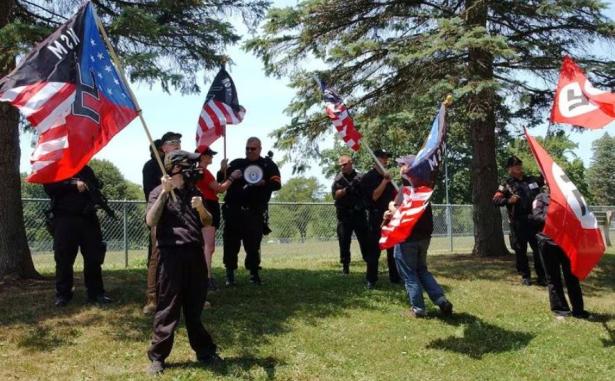
The National Socialist Movement, one of the largest and most prominent neo-Nazi groups in the United States, was one of 36 hate groups active in Pennsylvania in 2020. Members of the group gathered summer 2020 at a downtown Williamsport, PA park.,(Photo credit: PennLive)
‘Don’t get caught there,’ The legacy of sundown towns is not confined to the pages of history books – but is alive and well in 2024. Deep racial disparities are evidence that the intent of sundown towns still lingers today.
Feb 22, 2024 – Growing up in the 1960s, the Rev. Roger Dixon heard the warnings every time the William Penn High School football team was set to play Cedar Cliff.
“The older men used to say ‘don’t get caught up there after the game. You might get into trouble. They might try to arrest you,’” recalls Dixon, who is Black and graduated from William Penn in 1966.
Rafiyqa Muhammad tells of a similar experience growing up in Harrisburg.
“Our parents always told us about certain areas,” she said. “Our father would tell us don’t go here, don’t go there. Do not go over to the West Shore. I remember we would drive in and drive out. There was no going over and hanging out.”
Like Dixon, Muhammad, who is Black and came of age in the 1960s and 1970s, lived through some of the most tumultuous times in this country as the vestiges of segregation and the push for civil rights framed the lives of millions of Americans.
As the nation observes Black History Month in February, celebrating the accomplishments and contributions of Black Americans, the experiences of ordinary Americans like Dixon and Muhammad attest to the painful reality that racism was not confined to the south.
Across communities in central Pennsylvania, Black residents were made to feel unwelcome in many communities, especially after dark, and in many cases the communities were their own.
So-called “sundown towns” became a fixture across the country in the early 1900s. These were all-white communities that excluded non-whites via discriminatory laws, intimidation and violence.
These practices were at times explicit – written into statutes and charters – and other times the understanding that if you were Black, you better be out of town by sunset, hence the name. Some towns posted warning signs to Blacks not to “let the sun go down on you here.” Other towns rang a bell at the end of the workday warning Black workers to leave.
Harrisburg may have been well north of the Mason-Dixon Line, but in many ways was emblematic of the practice of sundown towns. While Dixon and Muhammad attended predominantly Black schools and spent time in mostly Black communities, sometimes they needed to cross the Susquehanna River to the mostly white west shore.
“They didn’t call it sundown town, but we know what they meant,” Dixon said. “The old men would say you never know, you never know. Don’t get caught up over there. They were very serious about it.”
Cultural documentarian Candacy Taylor has collected crowd-sources data showing that Pennsylvania was home to about 40 sundown towns, underscoring that these towns were not confined to the south or Midwest.
In her book, “Overground Railroad: The Green Book and the Roots of Black Travel in America,” Taylor mapped the prevalence of such towns in the region. They included Middletown and Camp Hill, and while Harrisburg was not named among the towns, oral histories of residents suggest that those racist attitudes in some neighborhoods prevailed.
“When I hear people say sundown town, I know what that means but I’m looking at my own backyard,” Muhammad said. “We couldn’t get more sundown than here and it’s still that way.”
Muhammad grew up with the unwritten rule that she and her friends – as they walked to and from school and across their Harrisburg community — needed to avoid areas.
“There were places we could not go to,” she recalls. “When we went to school you better not walk through Bellevue Park. You better not be caught there. Italian Lake? The same. You better not be caught in Italian Lakes or the authorities would be called on you and who knows what else.”
U.S. Rep Summer Lee participates in a Democratic candidates’ forum in Pittsburgh, Jan. 28, 2024
The three wasted no time describing their differences and why their opponents were wrong for the job.
By Kim Lyons
Penncapital-Star
JAN 28, 2024 - PITTSBURGH— The three candidates seeking the Democratic nomination for Pennsylvania’s 12th Congressional District came out swinging during a forum at Carnegie Mellon University on Sunday, not only demonstrating their differences but their willingness to criticize their fellow Democrats in areas of disagreement. And there were plenty of areas of disagreement.
U.S. Rep. Summer Lee (D-12th District), Edgewood Borough Councilmember Bhavini Patel and Laurie MacDonald, president and CEO of the Pittsburgh-based nonprofit Center for Victims, took the stage at the forum moderated by journalist Chris Potter of WESA-FM, Avalon Sueiro, president of the CMU College Democrats, and Heidi Norman, who works for the City of Pittsburgh and is a Democratic committeewoman in the city’s 14th Ward.
The first questioner asked the candidates to offer their thoughts on the role of a Congressional representative in navigating the complex situation in the Middle East. Lee has received criticism for her position supporting a ceasefire in the Israel-Hamas war.
MacDonald said her father was an immigrant from the Middle East, who wanted to “assimilate” and to have people judge him on who he was. She said she was passionate about putting together a coalition of peacemakers in the region, although recognized it would not be easy. “I think if we work together and continue with the Abraham Accords, and get that process going that we can find room for everybody in this world.”
Patel criticized Lee for not attending local rallies with the Jewish community in the days after the Oct. 7 Hamas attack on Israel, and for tweeting out information about a hospital bombing in Gaza that was later found to be erroneous. “To me that’s stoking hatred, that’s stoking antisemitism and it puts people in our communities in a tragic, dangerous position,” Patel said. “That is unacceptable.”
Bhavini Patel participates in a Democratic candidates’ forum in Pittsburgh Sunday Jan. 28, 2024 (screen capture) Lee replied that it was a subject that elicits pain in multiple communities. “The reality is, is that peace— a just and lasting peace— has to start with centering all of the folks who are impacted, and we have to be incredibly clear that there is no pathway to peace if we can only talk about security for one community, or as we continue to pit communities against each other,” she said. “Peace and justice and liberation and accountability for Israelis is not counter to peace and justice for Palestinians or Muslims or for Arabs.”
She added that “anybody who would use this issue as a political wedge is not serious and does not understand the gravity of the situation.”
The two sparred again on a question about the role and responsibility of the United States in geopolitical conflicts around the world.
Patel said as someone with a degree in international relations she has spent time “navigating these issues and getting a sense of what’s going on.” She noted that Lee had tweeted information that the president doesn’t have the authority to authorize airstrikes in the Red Sea against the Houthi rebels, who have attacked ships in the area and disrupted global commerce.
“When we’re unable to actually take these foreign policy concerns in a serious way, and engage with them in an intellectual way, and we’re just focused on posting, rather than understanding the challenges, I think that it sets us up for challenges,” Patel said. “I think it puts us in a precarious position as a country.”
Lee countered that her preference was to center American diplomacy in global conflicts. “The reality is that while an international studies degree is important, I have a law degree,” she said. “And no, the president does not have the authority to declare war or offensive strikes without the prior authorization of Congress.” Patel attempted to interrupt but Potter admonished her to respect the other candidates’ time.
Despite the best efforts by moderators to prevent delays and interruptions, the audience was fairly vocal throughout the event, alternately applauding or heckling the candidates based on their answers. At one point during a response to a question about the role of Congress in supporting gender-affirming care, MacDonald reacted directly to the audience booing her.
“My opponent — the people who live in her district have no families, they live in squalor, they don’t have…” MacDonald began, before audience members shouted back. “You think you know, right, well guess what, I worked there. I have helped those communities.”
When the heckling had died down, MacDonald added, “I don’t need to take that. My record speaks for itself. I’ve walked the walk, I’ve talked the talk, I help families. I help everybody. I don’t have a prejudiced, white, black, purple, pink bone in my body. I love everybody. And I love all of you too, even if we disagree.”
Laurie MacDonald participates in a Democratic candidates’ forum in Pittsburgh Sunday Jan. 28, 2024 (screen capture) The candidates were asked how they would engage younger voters, and in her response, Patel continued a line of criticism she has levied at Lee before: that she thinks the progressive Democrat does not fully support President Joe Biden’s agenda.
“With the Supreme Court overturning affirmative action, Roe v Wade, it really does come down to unequivocally standing with our president,” Patel said. “We really have zero room for error, and heading into the 2024 general election when we think about the future of this country, when we think about the future of our democracy, it really is all hands on deck, and it’s going to come from Western Pennsylvania. It’s going to be Pennsylvania that drives that conversation and drives that turnout and we need to start taking that seriously.”
Lee said the Democratic coalition of 2024 would include Black and brown voters, young voters and progressive voters, “precisely what Western Pennsylvania looks like,” noting that progressives had won decisive victories in recent elections in that end of the state.
“We actually need people who are going to be bold and push the president— just a little bit— so that we can get to [student] debt cancellation,” Lee said. “We need young people who are going to push the administration on climate change, because we have to meet the scope and the scale of the urgency of the moment. That energy is led by young people.”
Black Corrections Officer Alleges He Was Called the N-Word, His Co-workers Tainted His Food After He Revealed Racist Treatment of Inmates In Pennsylvania Jail
By Niko Mann
Jan. 14, 2024 – A former corrections officer at the Beaver County Jail in Aliquippa, Pennsylvania, filed a racial discrimination lawsuit against Beaver County on Jan. 8.
Titus Shields claims that he was fired after reporting the treatment of Black inmates and himself by other corrections officers.
According to the lawsuit, Shields moved to the county from California in search of a better life, only to “endure horrific racism” while employed at the Beaver County Jail. The complaint alleges that Shields was called the N-word, and his car was vandalized before he was fired in October 2022.
Shields began working at the jail in February 2022. The lawsuit states that Shields was forced to work in “a hostile environment” after he reported the racial abuse suffered by Black inmates of the jail and that the county “discriminated against him due to his race, complaints of race discrimination, and reports of wrongdoing.”
The former corrections officer said he was given “positive feedback” during his probationary period until he began reporting about the discrimination against Black inmates at the jail. Shields revealed one incident where an officer removed an inmate’s mattress and bedding during freezing weather with cold air blowing into his cell. The inmate was placed in a restraint chair without explanation and forced to sleep on a metal bed frame for approximately eight days.
Another inmate was also strapped to the restraint chair as several officers assaulted him, and after one officer questioned if the abuse was excessive force, Sgt. Decanini said, “What excessive force? It’s part of your job, dude!” the complaint describes. Shields said he was reporting the abuse, and Decanini yelled, “Do it! Do you think anybody really cares? What do you think you are going to change something? You’re not!”
Another inmate whose bedding was taken without cause for an entire month stayed awake all night to avoid the cold, which eventually “caused his legs to swell and start to burst with blood and blisters.”
Shields claims that when he made complaints about the abuse and said he no longer felt safe, Deputy Warden White told Shields to “get over it. It’s not about you.” Shields was also allegedly told by a Sgt. Harris, who is Black, “Yes, it is very racist here” and “You have got to watch your back.” Harris also told Shields, “These people do a lot of dirt and can get away with it. So just keep your head down, and you will be all right.”
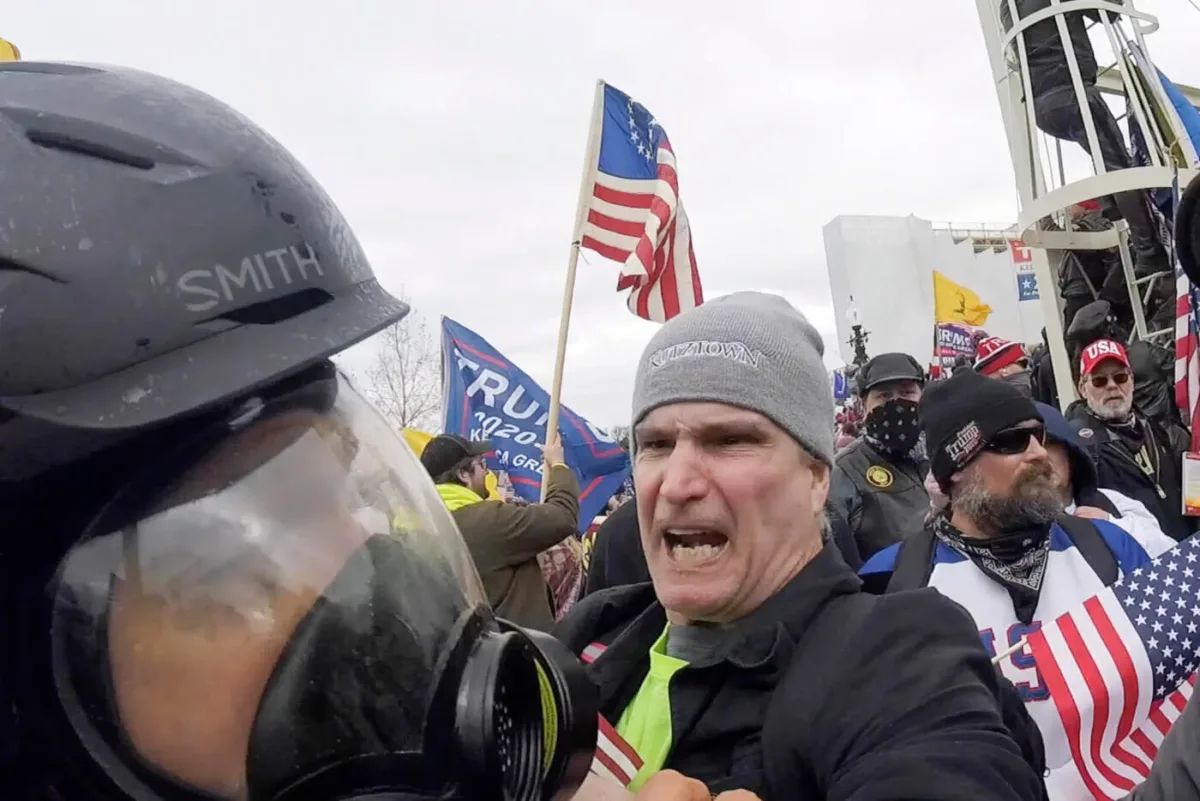
In this image from video, Alan William Byerly, center, attacks an Associated Press photographer during a riot at the U.S. Capitol in Washington, Jan. 6, 2021. On Sunday, Oct. 9, 2022, federal prosecutors recommended a prison sentence of nearly four years for Byerly, of Fleetwood, who pleaded guilty to assaulting the AP photographer and using a stun gun against police officers during a mob’s attack on the U.S. Capitol. (AP Photo/Julio Cortez, File)
By The Keystone Staff
January 4, 2024
Democracy didn’t die in Washington, D.C. on Jan. 6, 2021, despite the efforts of state Republicans like Doug Mastriano and Scott Perry, and the 85 Pennsylvanians who have been arrested to date for participating in the deadly attack on the US Capitol.
Pennsylvania is inextricably linked to the deadly Jan. 6, 2021 attack on the United States Capitol, in which five people died and dozens were seriously injured after a swarm of Donald Trump supporters — fresh from being told to “fight like hell” by the former president at a nearby “Stop the Steal” rally — descended upon the Capitol with the intent to upend democracy by any means necessary.
Major political players in the state, such as state Sen. Doug Mastriano (R-Franklin) and US Rep. Scott Perry (R-Dauphin), allegedly played significant roles in Trump’s effort to overturn the 2020 election — a failed criminal venture that led to the attack on the Capitol.
Then there is the role that Pennsylvanians played on the ground in the Jan. 6 attack. Some 85 Pennsylvania residents were arrested for taking part in the insurrection, tying the commonwealth with Texas for the second highest total among states. According to arrest records from the Department of Justice, 95 Floridians were arrested for participating in the attack, the highest total of any state.
To date, 52 Pennsylvanians have been sentenced, with others expected to be sentenced this month. Three died (two by suicide) while awaiting sentencing, and two others, a married couple, moved out of state before being sentenced.
Overall, according to the DOJ, more than 1,230 defendants have been arrested in nearly all 50 states and Washington, D.C. in connection with the attack, accused of crimes ranging from trespassing, a misdemeanor, to seditious conspiracy, a felony. More than 350 cases are still pending. Around 170 people have been convicted at trial, while only two people have been fully acquitted. Approximately 710 people have pleaded guilty and among those, around 210 pleaded guilty to felony offenses.
Here’s where things stand with each of the 85 Pennsylvanians arrested to date in the Jan. 6, 2021 attack.
Terry Allen – Spring Mills
Allen was arrested in July 2023 and faces charges including entering or remaining in any restricted building or grounds without lawful authority; disorderly and disruptive conduct in a restricted building or grounds; engaging in physical violence in restricted building or on restricted grounds; obstruction of law enforcement during civil disorder; and assaulting a federal officer.
Melanie Archer – Shaler
Archer pleaded guilty in October 2022 to parading, demonstrating, or picketing in a Capitol building. She is awaiting sentencing.
Mark Roderick Aungst – South Williamsport
Aungst pleaded guilty in June 2022 to one count of parading, demonstrating, or picketing in a Capitol building. He died by suicide in July 2022 while awaiting sentencing.
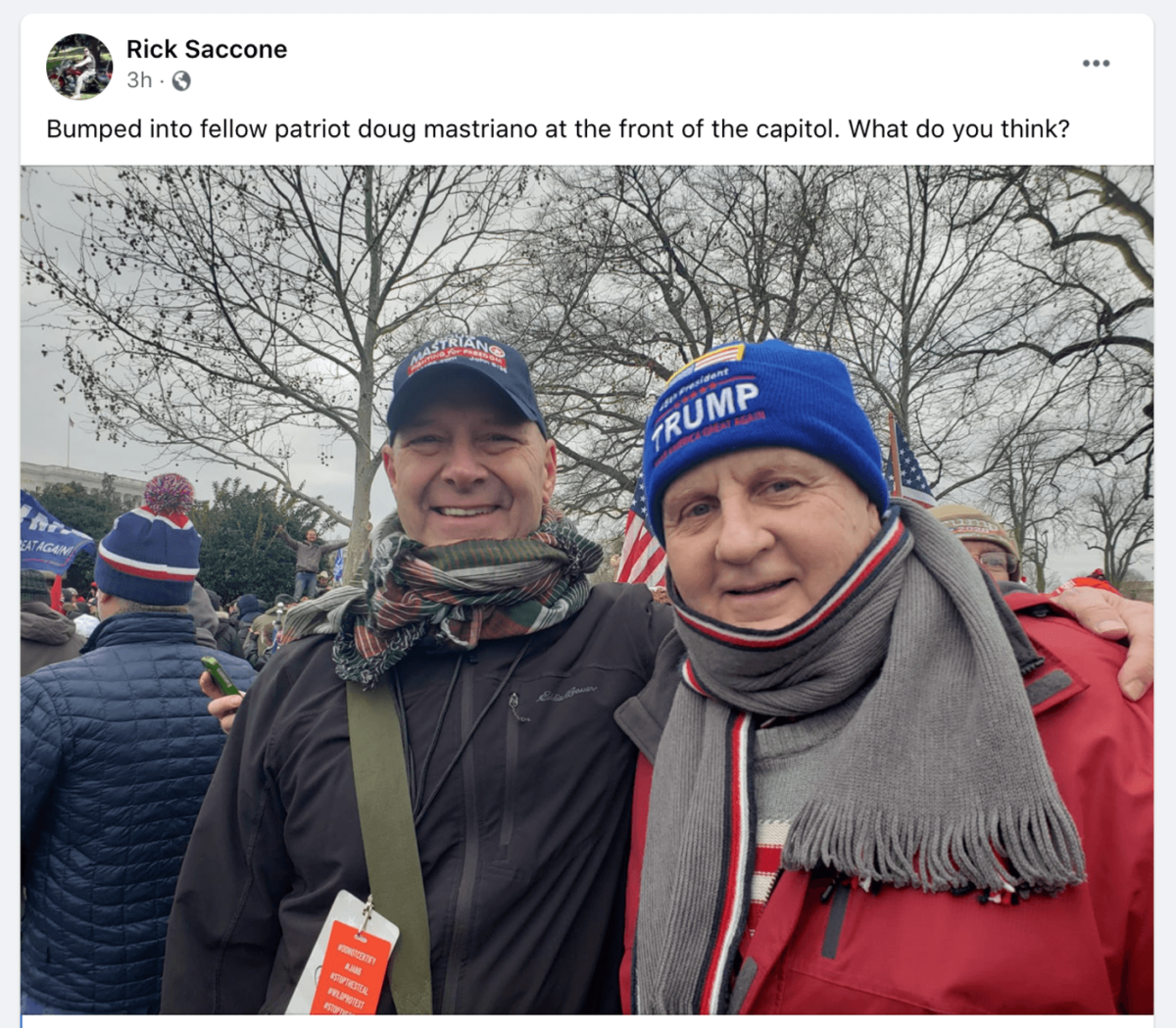
State Sen. Doug Mastriano and former state Rep. Rick Saccone, outside the US Capitol, Jan. 6, 2021 (Facebook screen grab).
Dawn Bancroft – Doylestown
Bancroft was sentenced in July 2022 to 60 days of incarceration, three years of probation, 100 hours of community service, and $500 in restitution for charges including disorderly and disruptive conduct in a restricted building or grounds.
Steven Boyd Barber – Scranton
Barber was arrested in July 2023 and faces charges including entering and remaining in a restricted building or grounds; disorderly and disruptive conduct in a restricted building or grounds; disorderly conduct in a Capitol building or grounds; and parading, demonstrating, or picketing in a Capitol building.
Pauline Bauer – Kane
Bauer pleaded not guilty in May 2021 to charges including obstruction of justice and Congress. Bauer was near then-House Speaker Nancy Pelosi’s office suite during the riot when she yelled at police officers to bring out the California Democrat so the mob of Donald Trump supporters could hang her. She was sentenced in January 2023 to more than two years in prison.
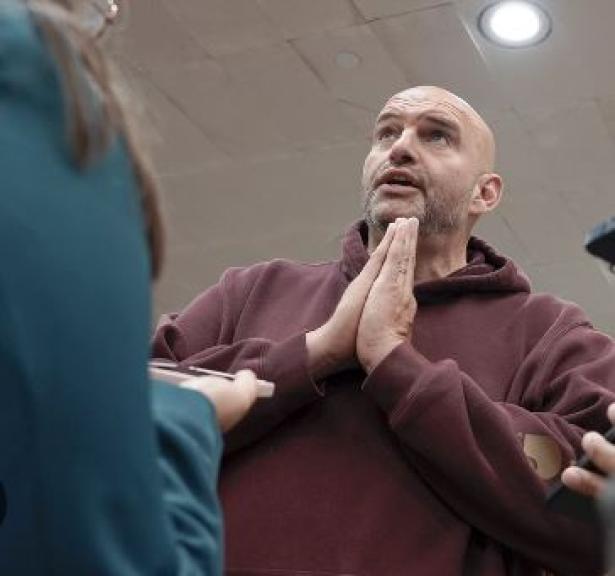
PA Democratic Senator John Fetterman on December 6 defended ‘reasonable’ border talks. This follows his staunch support for Israel’s war in Gaza, which has also befuddled some of his typical allies on the left.,(Photo credit: Politico)
“I’m not a progressive. I’m just a regular Democrat.” Fetterman is in the first year of a six-year term. He has time to repair relations with progressives or sever ties altogether. At this point, the latter is rapidly happening anyway.
By Ross Barkan
Political Currents
Dec 21, 2023 – Labels in the American political system have always been slippery. Progressive, liberal, leftist, conservative, hard-right, and hard-left can mean very different things to very different audiences. MAGA, perhaps, offers the most clarity—an unabashed supporter of Donald Trump. But even then, within the vast array of Republicans who back Trump, are disparate political views. Some want a national abortion ban. Some, like Trump himself, don’t quite know what they want.
Others strive to shed labels altogether. Many politicians, for somewhat obvious reasons, embrace them when they’re convenient—rounding up votes in primaries, appealing to activists, and raising cash—and abandoning them once they become a burden. The burden, or perceived burden, arrives when a politician has to campaign in a competitive general election. John Fetterman, the famous senator from Pennsylvania, is deep into his rebrand, and seemingly considering how to position himself when he faces voters again in 2028. His campaign proudly promoted a clip from the 2022 Democratic primary when he told a journalist who asked if he’s a progressive that “no, I’m just a Democrat that has always run on what I believe and know to be true.” Interestingly enough, Fetterman’s social media account doesn’t quote this verbatim. Instead, the post above the clip reads “I’m not a progressive, I’m just a regular Democrat.”
It’s a notable approach from a politician who has caught heat, of late, for his hawkish views on Israel. Fetterman, unlike several other Democratic senators, has not called for a ceasefire or denounced the Israeli military for slaughtering thousands of civilians in Gaza. As pressure has grown on the Biden administration to do more to curb Benjamin Netanyahu’s military ambitions, Fetterman’s rhetoric has been mostly indistinguishable from Mike Johnson or any other conservative Republican. His simultaneous embrace of tougher immigration laws has led NBC News to label him a “maverick” for breaking with progressive Democrats.
Calling Fetterman a maverick is understandable, if inaccurate. A maverick politician—few hardly exist anymore, and John McCain barely qualified—will break with their party on major policy questions. Imagine a Republican who loudly supports abortion rights or a Democrat who denounced the first or second impeachment of Trump. Strengthening the border doesn’t count; Democrats themselves have a range of views on immigration and Biden himself has pushed for more border fencing of late. Fetterman, unlike Trump, has not said immigrants are poisoning the blood of America. That would be one way, in a far darker manner, to become a maverick. And defending Israel at all costs certainly doesn’t qualify. The Democratic Party, these days, might be less hawkish on Israel than the GOP, but staunch Zionists occupy all the leadership posts. There is no daylight between Fetterman and Hakeem Jeffries, the House minority leader, or Chuck Schumer, the Senate majority leader, when it comes to Israel.
But Fetterman is punching left. There’s nothing new to this—see Sister Souljah—and Fetterman might even be earnest. His staff has certainly argued his views on Israel are decades-old, solidified in graduate school. What is more obvious, and helpfully collated on X, is that Fetterman used to happilyidentify as a progressive. He called himself one in 2016, 2018, and 2020. He inched away from the label in 2022, when he became the frontrunner in the Democratic primary for Senate, but never disavowed the movement of left-leaning activists and organizations that backed him earlier in his career. Fetterman ran unsuccessfully for the Senate in 2016 as a Bernie Sanders supporter and remained close to Sanders when he was elected lieutenant governor in 2018. He benefited from Sanders’ enormous network of online donors in all of his statewide campaigns. He took the Vermont senator’s endorsement multiple times and championed key planks of his platform: a $15 federal minimum wage, Medicare for All, and new wealth taxes. He never identified as a socialist or embraced the more confrontational flavor of leftist politics favored by the Squad, but he was, undeniably, a member of his party’s progressive wing.
It would have been plausible for Fetterman to back a higher minimum wage without calling himself a progressive. “I just want people to make more money and have cheap healthcare” would have been enough. “It’s common-sense,” he might have said, to “make the wealthy pay their fair share. There’s nothing progressive or liberal about that. It’s how we should run a country.” But that would have been less exciting to the donors and activists who were going to power Fetterman’s early campaigns. Fetterman wanted to raise cash and he wanted to win. Hence, the Sanders associations were useful. When Dr. Oz, in the 2022 general election, tried to scare moderate Democrats away, the pivot began. He hasn’t looked back.
If Fetterman were being honest, he could simply declare he is no longer a progressive. He could say he used to be one in 2016 and 2018 and 2020 but he feels differently now. He doesn’t like how progressives talk about Israel or the border or some other hot button issue that might matter to a cross-pressured Pennsylvanian and he’s decided he’s going to operate separately from them. He could say he used to believe in Bernie Sanders and now he’s less sure. But doing that would permanently alienate the activist infrastructure that lifted him to prominence in the first place. Fetterman probably believes this is the safer route: to state, against all available evidence, he was never a progressive. This is dishonest and, in the long run, may not even be good politics. It’s not like Trump, when he was first running for president, ever sought to hide that he used to be a Democrat or pal around with the Clintons. If anything, he used his unscrupulousness to his advantage, boasting about how easy it was for him, as a well-heeled donor, to buy Democrats off. Fetterman needn’t be so venal, but he could acknowledge the past and point the way forward.
Politically, all of this can only matter so much. Fetterman is in the first year of a six-year term. He has time to repair relations with progressives or sever ties altogether. At this point, the latter is rapidly happening anyway. For the Pennsylvania activist class, Fetterman is increasingly persona non grata. Since he also needs to appeal to centrists and Israel-supporting Jews in the Philadelphia and Pittsburgh metropolitan areas, he might not care at all. If he does go down this path, though, he’ll have to find a new way to raise cash and wrangle volunteers. There are many young people who showed up to canvass for Fetterman 2022 that will not bother for Fetterman 2028. They’ll have long memories—and other heroes by then.
Dem Governor Josh Shapiro campaigning in Beaver County
By less than 100 voters, but Dems need to get busy with new registrations.
By Chrissy Suttles Beaver County Times
BEAVER — County Republicans hit a milestone decades in the making this week.
Beaver County now has more registered Republican voters than Democrats – an inflection point in a county considered a Democratic stronghold for the better part of a century.
Pennsylvania Department of State data shows that among Beaver County’s 111,725 registered voters, 48,170 are registered Republicans and 48,079 are registered Democrats – a difference of 91 registrations. That’s 43.1% Republican voters, 43% Democratic voters and 13.9% third party or unaffiliated voters.
Beaver County has steadily grown more supportive of Republican candidates and conservative principles in recent years.
As a traditionally blue-collar county once grounded in steel and a unionized workforce, Beaver has long had more registered Democrats than Republicans. A portion of those Democrats started voting Republican in the 1980s for former President Ronald Reagan, but kept their Democratic party affiliation. Still, Beaver County voters supported Democratic presidential candidates for much of the 20th century.
That changed in 2008, when Republican John McCain outperformed former President Barack Obama in the county. In 2012, Mitt Romney bested the former president again. Former President Donald Trump beat Hillary Clinton 58% to 39% in 2016 and President Joe Biden 57.9% to 40.3% in 2020 – despite Beaver County holding a clear but shrinking Democratic majority among registrations.
The county marked another clear shift in 2016, when Republicans took the Beaver County Board of Commissioners for the first time since 1958.
Beaver County Republican Chairman Roman Kozak said Tuesday the emergent Republican majority is “validation of the hard work of our Republican elected county team.”
“Ten to 20 years ago, most of us could never imagine this happening,” he said. “From our judiciary to our county commissioners and row offices, and down to our municipal offices and school directors, Republican-led government continues to represent true Beaver County values. The people of Beaver County are telling us they want a government that is responsive to them as well as one that is professionally and responsibly managed.”
Beaver County Democratic Chairwoman Erin Gabriel said the Democratic Party is “always excited to see more folks register to vote, and will continue our efforts to register voters across the county.
“Certainly, there will be ebbs and flows in which party has the majority of registrations in a tightly contested county like Beaver, and the margins really couldn’t be tighter in terms of registration,” she said. “I think that’s part of what makes us such an interesting county for politicos, but it also presents us with the necessary opportunity for bipartisan discussions.”
Gabriel noted Democrat Nate Bible’s win over two-term Republican incumbent David Lozier in this year’s Beaver County District Attorney race and shared enthusiasm for Gov. Josh Shapiro’s automatic voter registration initiative, adding that the party is focused on protecting voters’ rights “instead of trying to make it more difficult to vote,” because “this country works best when more people participate.”
The Democratic party will “continue to be a welcoming, safe and supportive space for all of our community members, regardless of the color of your skin, where you came from, how you worship or who you love,” she added. “In too many cases this year, with significant encouragement from the Republican party, we saw the politics of racism, bigotry and hate on full display through divisive rhetoric, race-baiting mailers coming from both the Republican party as well as directly from their candidates for county offices.”
Spotlight PA | Dec. 12, 2023 – HARRISBURG — In his first year as Pennsylvania’s governor, Josh Shapiro won praise as a literal bridge builder, signed a state spending plan that included long-sought Democratic priorities, and helped expand a relief program for older homeowners.
The Democrat, a former state lawmaker who touts himself as a dealmaker, has nonetheless struggled at times to advance priorities through Harrisburg’s ideologically divided legislature. His record will depend on how well he can find middle ground, and he will be watched not just here in Pennsylvania but in national political circles as well.
His first major attempt at a deal blew up in his face. Shapiro negotiated a budget with the Republicans who control the state Senate, and according to the GOP, agreed to a package that would have funded private school vouchers with public dollars.
Amid widespread opposition from state House Democrats and organized labor, Shapiro vetoed the provision from the budget, throwing unfinished business into a tailspin and prompting Republican outcry that he had reneged.
“A lot of first-time governors, myself included, make this mistake,” said Ed Rendell, a Democrat who was Pennsylvania’s governor from 2003 to 2011 and has known Shapiro for decades. “We assume that our own party is going to support us, and not buck us on something that’s very important to us.”
“Always count heads,” Rendell said. “I don’t think he’ll make that mistake again.”
Shapiro also had to weather a series of events outside of his control beginning in the early months of his administration.
A little more than two weeks after his inauguration, the governor had to respond to the East Palestine train derailment less than a mile from Pennsylvania’s border, which released thousands of tons of toxic chemicals. And amid budget talks, the sudden collapse of an overpass on I-95, used by tens of thousands of Philadelphia commuters every day, required Shapiro to coordinate a temporary replacement in less than two weeks while under national scrutiny.
“There almost wasn’t a quote-unquote normal,” Shapiro spokesperson Manuel Bonder told Spotlight PA of those early emergencies. “We were still figuring out, you know, where the lights were.”
Other unexpected bumps in the road came from the courts.
About a month into Shapiro’s governorship, Commonwealth Court found that the state’s education system was unconstitutionally underfunded, a ruling that presented Harrisburg with a mandate to take action on a thorny, far-reaching, and politically charged policy issue.
“I wonder if he had unpacked all his clothing before the courts made the ruling,” quipped state Rep. Peter Schweyer (D., Lehigh), who heads his chamber’s Education Committee.
But perhaps the thorniest problems of all came from within Harrisburg.
It will be only the second-ever judicial endorsement for the organization formerly known as NARAL
BY KIM LYONS
Penn-Capitol Star
OCT 6, 2023 – Reproductive Freedom for All, the organization formerly known as NARAL Pro-Choice America, told the Capital-Star on Friday that it is endorsing Judge Daniel McCaffery for Pennsylvania Supreme Court, only its second-ever endorsement in a judicial race.
Republican candidate Carolyn Carluccio, a judge on the Montgomery County Court of Common Pleas, is running against Democrat McCaffery, a judge on the Pennsylvania Superior Court. The two are vying for the seat left vacant on the state Supreme Court after the death of Justice Max Baer last year.
Reproductive Freedom for All, founded as NARAL in 1969, hasn’t historically been involved in judicial races, but after Roe v. Wade was overturned last year, state judges are now more likely to decide cases involving reproductive rights, which has drawn its attention.
Abortion is legal in Pennsylvania up until 24 weeks, but the Pennsylvania Supreme Court is currently weighing a case involving Medicaid coverage for abortion, which Reproductive Freedom for All noted in a news release shared Friday morning with the Capital-Star. The group accused Carluccio of scrubbing her website of her anti-abortion stances, and pointed to Carluccio’s endorsement by the PA Pro-Life Federation.
“State courts are the front line in the fight for reproductive freedom, and it’s critical that we elect fair-minded judges who value our fundamental rights,” Reproductive Freedom for All President and CEO Mini Timmaraju said. “Our more than 159,000 members in the Commonwealth are ready to mobilize to elect Judge McCaffery.”
Democrats currently have a 4-2 majority on Pennsylvania’s Supreme Court, and justices serve 10-year terms. Three of the four Democratic justices — Christine Donohue, David N. Wecht, and Kevin M. Dougherty — will be up for reelection when their terms end in 2026.
The current race for the state Supreme Court has drawn significant funding for both candidates, putting it on track to be one of the most expensive judicial elections ever in Pennsylvania. SpotlightPA reported this week that McCaffery has raised $2 million since the beginning of 2023, and Carluccio has raised $3.4 million, of which $2.1 million came from the Commonwealth Leaders Fund, an organization that has received funding from conservative Pennsylvania billionaire Jeffrey Yass.
Earlier this week, the Democratic Legislative Campaign Committee (DLCC) announced it would make a “six-figure investment” in the race, calling it an election that will have “long-term consequences, not just for the court, but for the state Legislature as well.” Planned Parenthood Votes, the political arm of reproductive rights organization Planned Parenthood, has poured money into a state ad campaign — the largest investment it’s ever made in a state supreme court race. The ads criticized Carluccio’s stance on reproductive rights, also claiming she wiped references to her previous position against abortion from her website.
Carluccio received the Republican Party endorsement in the primary, and is endorsed by the PA Pro-Life Federation and Pro-Life Coalition of Pennsylvania, both of which oppose abortion.
Her campaign spokesperson previously told the Capital-Star that Carluccio was not an activist judge and that her website had undergone a redesign, but that Carluccio would not attempt to legislate from the bench.
The general election in Pennsylvania is Nov. 7. The deadline to register to vote in the election is Oct. 23.