John Fetterman Exits the Progressive Coalition

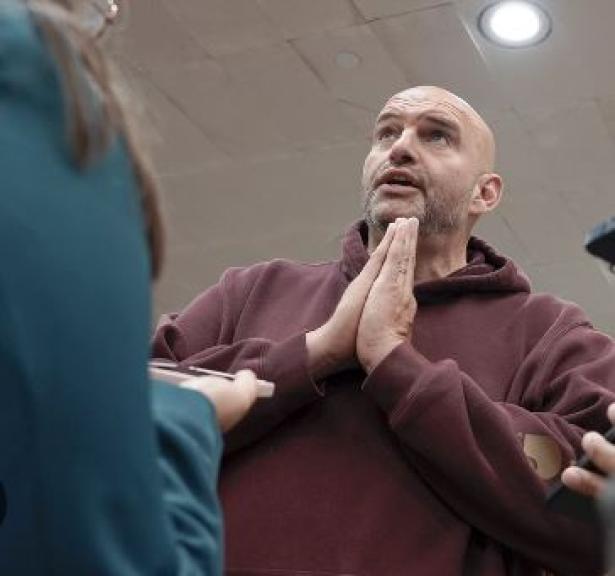
PA Democratic Senator John Fetterman on December 6 defended ‘reasonable’ border talks. This follows his staunch support for Israel’s war in Gaza, which has also befuddled some of his typical allies on the left.,(Photo credit: Politico)

“I’m not a progressive. I’m just a regular Democrat.” Fetterman is in the first year of a six-year term. He has time to repair relations with progressives or sever ties altogether. At this point, the latter is rapidly happening anyway.

By Ross Barkan  

Political Currents

Dec 21, 2023  – Labels in the American political system have always been slippery. Progressive, liberal, leftist, conservative, hard-right, and hard-left can mean very different things to very different audiences. MAGA, perhaps, offers the most clarity—an unabashed supporter of Donald Trump. But even then, within the vast array of Republicans who back Trump, are disparate political views. Some want a national abortion ban. Some, like Trump himself, don’t quite know what they want.

Others strive to shed labels altogether. Many politicians, for somewhat obvious reasons, embrace them when they’re convenient—rounding up votes in primaries, appealing to activists, and raising cash—and abandoning them once they become a burden. The burden, or perceived burden, arrives when a politician has to campaign in a competitive general election. John Fetterman, the famous senator from Pennsylvania, is deep into his rebrand, and seemingly considering how to position himself when he faces voters again in 2028. His campaign proudly promoted a clip from the 2022 Democratic primary when he told a journalist who asked if he’s a progressive that “no, I’m just a Democrat that has always run on what I believe and know to be true.” Interestingly enough, Fetterman’s social media account doesn’t quote this verbatim. Instead, the post above the clip reads “I’m not a progressive, I’m just a regular Democrat.”

It’s a notable approach from a politician who has caught heat, of late, for his hawkish views on Israel. Fetterman, unlike several other Democratic senators, has not called for a ceasefire or denounced the Israeli military for slaughtering thousands of civilians in Gaza. As pressure has grown on the Biden administration to do more to curb Benjamin Netanyahu’s military ambitions, Fetterman’s rhetoric has been mostly indistinguishable from Mike Johnson or any other conservative Republican. His simultaneous embrace of tougher immigration laws has led NBC News to label him a “maverick” for breaking with progressive Democrats.

Calling Fetterman a maverick is understandable, if inaccurate. A maverick politician—few hardly exist anymore, and John McCain barely qualified—will break with their party on major policy questions. Imagine a Republican who loudly supports abortion rights or a Democrat who denounced the first or second impeachment of Trump. Strengthening the border doesn’t count; Democrats themselves have a range of views on immigration and Biden himself has pushed for more border fencing of late. Fetterman, unlike Trump, has not said immigrants are poisoning the blood of America. That would be one way, in a far darker manner, to become a maverick. And defending Israel at all costs certainly doesn’t qualify. The Democratic Party, these days, might be less hawkish on Israel than the GOP, but staunch Zionists occupy all the leadership posts. There is no daylight between Fetterman and Hakeem Jeffries, the House minority leader, or Chuck Schumer, the Senate majority leader, when it comes to Israel.

But Fetterman is punching left. There’s nothing new to this—see Sister Souljah—and Fetterman might even be earnest. His staff has certainly argued his views on Israel are decades-old, solidified in graduate school. What is more obvious, and helpfully collated on X, is that Fetterman used to happily identify as a progressive. He called himself one in 2016, 2018, and 2020. He inched away from the label in 2022, when he became the frontrunner in the Democratic primary for Senate, but never disavowed the movement of left-leaning activists and organizations that backed him earlier in his career. Fetterman ran unsuccessfully for the Senate in 2016 as a Bernie Sanders supporter and remained close to Sanders when he was elected lieutenant governor in 2018. He benefited from Sanders’ enormous network of online donors in all of his statewide campaigns. He took the Vermont senator’s endorsement multiple times and championed key planks of his platform: a $15 federal minimum wage, Medicare for All, and new wealth taxes. He never identified as a socialist or embraced the more confrontational flavor of leftist politics favored by the Squad, but he was, undeniably, a member of his party’s progressive wing.

It would have been plausible for Fetterman to back a higher minimum wage without calling himself a progressive. “I just want people to make more money and have cheap healthcare” would have been enough. “It’s common-sense,” he might have said, to “make the wealthy pay their fair share. There’s nothing progressive or liberal about that. It’s how we should run a country.” But that would have been less exciting to the donors and activists who were going to power Fetterman’s early campaigns. Fetterman wanted to raise cash and he wanted to win. Hence, the Sanders associations were useful. When Dr. Oz, in the 2022 general election, tried to scare moderate Democrats away, the pivot began. He hasn’t looked back.

If Fetterman were being honest, he could simply declare he is no longer a progressive. He could say he used to be one in 2016 and 2018 and 2020 but he feels differently now. He doesn’t like how progressives talk about Israel or the border or some other hot button issue that might matter to a cross-pressured Pennsylvanian and he’s decided he’s going to operate separately from them. He could say he used to believe in Bernie Sanders and now he’s less sure. But doing that would permanently alienate the activist infrastructure that lifted him to prominence in the first place. Fetterman probably believes this is the safer route: to state, against all available evidence, he was never a progressive. This is dishonest and, in the long run, may not even be good politics. It’s not like Trump, when he was first running for president, ever sought to hide that he used to be a Democrat or pal around with the Clintons. If anything, he used his unscrupulousness to his advantage, boasting about how easy it was for him, as a well-heeled donor, to buy Democrats off. Fetterman needn’t be so venal, but he could acknowledge the past and point the way forward.

Politically, all of this can only matter so much. Fetterman is in the first year of a six-year term. He has time to repair relations with progressives or sever ties altogether. At this point, the latter is rapidly happening anyway. For the Pennsylvania activist class, Fetterman is increasingly persona non grata. Since he also needs to appeal to centrists and Israel-supporting Jews in the Philadelphia and Pittsburgh metropolitan areas, he might not care at all. If he does go down this path, though, he’ll have to find a new way to raise cash and wrangle volunteers. There are many young people who showed up to canvass for Fetterman 2022 that will not bother for Fetterman 2028. They’ll have long memories—and other heroes by then.
[Ross Barkan is a contributing writer to the New York Times Magazine. His reporting and essays have appeared in New York Magazine, the Nation, and elsewhere. He is the author of three books, including the novel The Night Burns Bright.]

Warning: Beaver County now has more registered Republicans than Democrats

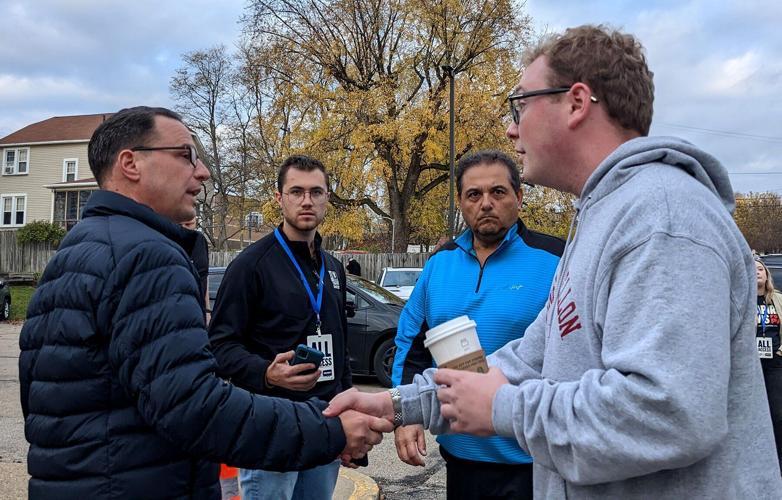
Dem Governor Josh Shapiro campaigning in Beaver County

By less than 100 voters, but Dems need to get busy with new registrations.

By Chrissy Suttles
Beaver County Times

BEAVER — County Republicans hit a milestone decades in the making this week.

Beaver County now has more registered Republican voters than Democrats – an inflection point in a county considered a Democratic stronghold for the better part of a century.

Pennsylvania Department of State data shows that among Beaver County’s 111,725 registered voters, 48,170 are registered Republicans and 48,079 are registered Democrats – a difference of 91 registrations. That’s 43.1% Republican voters, 43% Democratic voters and 13.9% third party or unaffiliated voters.

Beaver County has steadily grown more supportive of Republican candidates and conservative principles in recent years.

As a traditionally blue-collar county once grounded in steel and a unionized workforce, Beaver has long had more registered Democrats than Republicans. A portion of those Democrats started voting Republican in the 1980s for former President Ronald Reagan, but kept their Democratic party affiliation. Still, Beaver County voters supported Democratic presidential candidates for much of the 20th century.

That changed in 2008, when Republican John McCain outperformed former President Barack Obama in the county. In 2012, Mitt Romney bested the former president again. Former President Donald Trump beat Hillary Clinton 58% to 39% in 2016 and President Joe Biden 57.9% to 40.3% in 2020 – despite Beaver County holding a clear but shrinking Democratic majority among registrations.

The county marked another clear shift in 2016, when Republicans took the Beaver County Board of Commissioners for the first time since 1958.

Beaver County Republican Chairman Roman Kozak said Tuesday the emergent Republican majority is “validation of the hard work of our Republican elected county team.”

“Ten to 20 years ago, most of us could never imagine this happening,” he said. “From our judiciary to our county commissioners and row offices, and down to our municipal offices and school directors, Republican-led government continues to represent true Beaver County values. The people of Beaver County are telling us they want a government that is responsive to them as well as one that is professionally and responsibly managed.”

Beaver County Democratic Chairwoman Erin Gabriel said the Democratic Party is “always excited to see more folks register to vote, and will continue our efforts to register voters across the county.

“Certainly, there will be ebbs and flows in which party has the majority of registrations in a tightly contested county like Beaver, and the margins really couldn’t be tighter in terms of registration,” she said. “I think that’s part of what makes us such an interesting county for politicos, but it also presents us with the necessary opportunity for bipartisan discussions.”

Gabriel noted Democrat Nate Bible’s win over two-term Republican incumbent David Lozier in this year’s Beaver County District Attorney race and shared enthusiasm for Gov. Josh Shapiro’s automatic voter registration initiative, adding that the party is focused on protecting voters’ rights “instead of trying to make it more difficult to vote,” because “this country works best when more people participate.”

The Democratic party will “continue to be a welcoming, safe and supportive space for all of our community members, regardless of the color of your skin, where you came from, how you worship or who you love,” she added. “In too many cases this year, with significant encouragement from the Republican party, we saw the politics of racism, bigotry and hate on full display through divisive rhetoric, race-baiting mailers coming from both the Republican party as well as directly from their candidates for county offices.”

Gov. Josh Shapiro Rebuilt a Bridge, Weathered a Messy Budget, And Walked Fine Partisan Lines in 2023


By Stephen Caruso and Katie Meyer

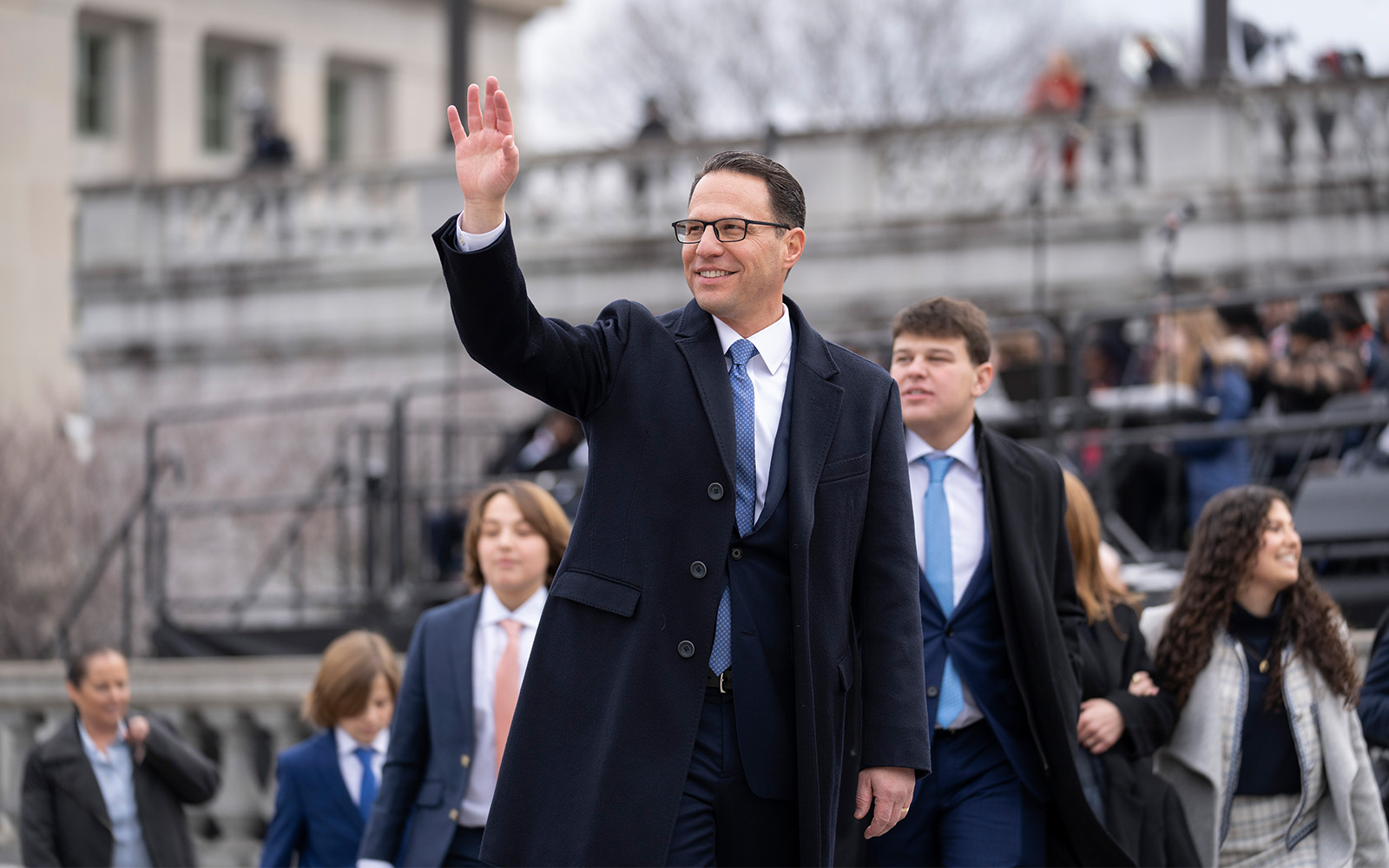
Spotlight PA | Dec. 12, 2023 – HARRISBURG — In his first year as Pennsylvania’s governor, Josh Shapiro won praise as a literal bridge builder, signed a state spending plan that included long-sought Democratic priorities, and helped expand a relief program for older homeowners.

The Democrat, a former state lawmaker who touts himself as a dealmaker, has nonetheless struggled at times to advance priorities through Harrisburg’s ideologically divided legislature. His record will depend on how well he can find middle ground, and he will be watched not just here in Pennsylvania but in national political circles as well.

His first major attempt at a deal blew up in his face. Shapiro negotiated a budget with the Republicans who control the state Senate, and according to the GOP, agreed to a package that would have funded private school vouchers with public dollars.

Amid widespread opposition from state House Democrats and organized labor, Shapiro vetoed the provision from the budget, throwing unfinished business into a tailspin and prompting Republican outcry that he had reneged.

“A lot of first-time governors, myself included, make this mistake,” said Ed Rendell, a Democrat who was Pennsylvania’s governor from 2003 to 2011 and has known Shapiro for decades. “We assume that our own party is going to support us, and not buck us on something that’s very important to us.”

“Always count heads,” Rendell said. “I don’t think he’ll make that mistake again.”

Shapiro also had to weather a series of events outside of his control beginning in the early months of his administration.

A little more than two weeks after his inauguration, the governor had to respond to the East Palestine train derailment less than a mile from Pennsylvania’s border, which released thousands of tons of toxic chemicals. And amid budget talks, the sudden collapse of an overpass on I-95, used by tens of thousands of Philadelphia commuters every day, required Shapiro to coordinate a temporary replacement in less than two weeks while under national scrutiny.

“There almost wasn’t a quote-unquote normal,” Shapiro spokesperson Manuel Bonder told Spotlight PA of those early emergencies. “We were still figuring out, you know, where the lights were.”

Other unexpected bumps in the road came from the courts.

About a month into Shapiro’s governorship, Commonwealth Court found that the state’s education system was unconstitutionally underfunded, a ruling that presented Harrisburg with a mandate to take action on a thorny, far-reaching, and politically charged policy issue.

“I wonder if he had unpacked all his clothing before the courts made the ruling,” quipped state Rep. Peter Schweyer (D., Lehigh), who heads his chamber’s Education Committee.

But perhaps the thorniest problems of all came from within Harrisburg.

Continue reading Gov. Josh Shapiro Rebuilt a Bridge, Weathered a Messy Budget, And Walked Fine Partisan Lines in 2023