
Don’t Wait For
Slow-Motion
River Wrecks
By Randy Shannon
Progressive Democrats of America
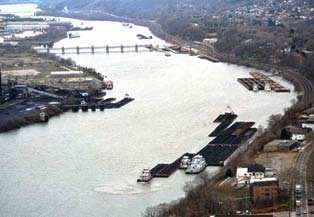
“As the region’s federal engineer, it is my responsibility to report that the Lower Mon Project is facing a perfect storm. Inefficient funding; the insolvency of the IWTF; an aging and crumbling infrastructure; an increase in unscheduled, unexpected repairs; and a flat-lined operations and maintenance budget coupled with rising costs…threaten the reliability of the sytem.” – Colonel Michael P. Crall, U.S. Army Corps of Engineers, July 3, 2008
Our new President and Congress need to act with urgency to address the critical state of this artery of the regional economy. Don’t watch the slow motion wreck. Take action to get the word out and up the chain to Washington! The US Army Corps of Engineers is not a lobbying organization. The people of western Pennsylvania must lobby for their share of any new funds allocated to infrastructure upgrading.
Click on this link gx-dam-jl-10-26 to view a map of the US Army Corps of Engineers Pittsburgh District facilities. See the location of the fourteen of twenty-three locks and dams that are rated at high risk of breakdown.
For more information read the US Army Corps of Engineers Pittsburgh District 2008 State of the Infrastructure report at this link corpsinfrastructure.
Click on this link comparetransport-modes to view a graphic comparison of river, rail, and ground transport efficiency.
 Beaver County Blue: Voice of the 17th CD of Progressive Democrats of America
Live and Learn. Then take action.
I’m at the very least intrigued.
I am reading this with interest punctuated or perhaps
focused around the question: Why did we build railroads
at all if barge transportation along rivers and likely canals
is so efficient? Why bother
with trucks either? Perhaps that’s bias and prejudice rather than a question. Still I remember hearing that canals say in the state of N.Y. like the Erie Canal started going big time about the time trains came in.
My impression was that as the first half of the nineteenth century came to the close, trains had taken over so much of the load the Erie Canal bore that it became very secondary, a real backwater.
Yet certainly the Mississippi is very important and not just the focus of flood control.
And many cities grow or cluster around prominent bodies of water.
So is it that the rivers and lakes transport the really heavy duty
supplies to urban centers while freight trains and trucks are good for dispersing relatively modest quantities over a wide range of destinations? That is, highways and railroads are more flexibly
directed to different destinations than are bodies of water?
I guess I have my googling and Wikepedia reading cut out for me on
this subject.
Peter Deutsch