Zero Presidential Pardons by Obama: Shameful

Dan Froomkin froomkin@huffingtonpost.com | HuffPost Reporting Become a Fan

Turkey Spared — But Obama’s Compassion For Humans Comes Up Short

First Posted: 11-24-10 12:26 PM | Updated: 11-24-10 12:26 PM

In one of the White House’s sillier annual rituals, Barack Obama on Wednesday pardoned the second Thanksgiving turkey of his presidency.

He has, however, yet to pardon a single human.

A president’s power to grant clemency is broad, unilateral and absolute. Obama, a constitutional lawyer by training, and the first African-American president, could issue pardons and commutations that make a powerful statement about the justice system past and present.

Indeed, presidents have a responsibility to use their pardon power to correct the excesses and errors of a system that is inevitably imperfect, often overloaded, and especially in this era of mandatory sentences, overly rigid.

Continue reading Zero Presidential Pardons by Obama: Shameful

Banks Plan 6.5 million Home Foreclosures by 2012

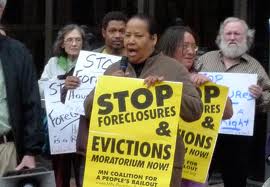
“The number of foreclosures initiated on residential properties has soared from about 1 million in 2006, the year that house prices peaked, to 2.8 million last year.

Over the first half of this year, we have seen a further 1.2 million foreclosure filings, and an additional 2.4 million homes were somewhere in the foreclosure pipeline at the end of June.

All told, we expect about 2.25 million foreclosure filings this year and again next year, and about 2 million more in 2012.

While our outlook is for filings to decline in coming years, they will remain extremely high by historical standards.

Currently, almost 5 million mortgage loans are 90 days or more past due or in foreclosure.”

Testimony

Governor Elizabeth A. Duke

Foreclosure documentation issues

Before the Financial Services Subcommittee on Housing and Community Opportunity, U.S. House of Representatives, Washington, D.C.

November 18, 2010

http://www.federalreserve.gov/newsevents/testimony/duke20101118a.htm

Military Spending Costs Opportunity – Pres. Dwight D. Eisenhower

Eisenhower on the Opportunity Cost of Defense Spending

[Image] 

Gen. Eisenhower speaks with soldiers of the 101st Airborne on the eve of D-Day

Every gun that is made, every warship launched, every rocket fired signifies, in the final sense, a theft from those who hunger and are not fed, those who are cold and are not clothed.

This world in arms is not spending money alone. It is spending the sweat of its laborers, the genius of its scientists, the hopes of its children.

The cost of one modern heavy bomber is this: a modern brick school in more than 30 cities. It is two electric power plants, each serving a town of 60,000 population. It is two fine, fully equipped hospitals. It is some fifty miles of concrete pavement.

We pay for a single fighter plane with a half million bushels of wheat. We pay for a single destroyer with new homes that could have housed more than 8,000 people.

… This is not a way of life at all, in any true sense. Under the cloud of threatening war, it is humanity hanging from a cross of iron…

Is there no other way the world may live?

Dwight David Eisenhower, “The Chance for Peace,” speech given to the American Society of Newspaper Editors, Apr. 16, 1953.

Cost of US Empire Is Unsustainable

US Military Spending Far Outpaces Rest of the World


By Amanda Bransford

The United States continues to lead the world in defense spending, according to a new report released Thursday by the Center for Arms Control and Non-Proliferation, a U.S.-based non-partisan research organization.

In fact, the U.S. outspends Russia, the next highest spender, by more than 800 percent.

In 2008, the most recent year for which figures are available, the U.S. expenditure was 696.3 billion dollars, followed by Russia’s 86 billion and China’s 83.5 billion.

The U.S. defense budget is 15 times that of Japan, 47 times that of Israel, and nearly 73 times that of Iran.

Not only does U.S. spending dwarf that of other nations, but it has also grown in recent years.

Continue reading Cost of US Empire Is Unsustainable

Pennsylvania Hunting Season Opens with 4,500 Gas Drilling Sites in 2010

Hunters may be surprised by level of Marcellus Shale gas activities

Wednesday, November 17, 2010

DCNR has vowed to limit heavy truck traffic on forest roads during bear season and key days of deer season. Credit: DCNR has vowed to limit heavy truck traffic on forest roads during bear season and key days of deer season.

University Park, Pa. — Pennsylvania hunters venturing out this fall may be surprised by the level of disturbance and activity on public lands in the northcentral, northeastern and southwestern regions of the state, according to a wildlife expert in Penn State’s College of Agricultural Sciences.

Natural-gas exploration and development associated with the Marcellus Shale formation have increased exponentially over the past year.

“As a hunter, you may be shocked by the level of natural-gas drilling and production activity associated with Marcellus Shale on public lands in Pennsylvania,” said Margaret Brittingham, professor of wildlife resources and extension wildlife specialist.

“As of Oct. 1, there were 4,510 active Marcellus permits. Compare this with Oct. 1, 2009, when there were 1,970 permits.”

Accompanying the drilling activity, hunters will find new or modified roads in many areas and may encounter large volumes of truck traffic in areas where active drilling is occurring.

Continue reading Pennsylvania Hunting Season Opens with 4,500 Gas Drilling Sites in 2010

Saving Jobs Costs Less than Losing Jobs

The cost to taxpayers to save, lose jobs

To save a job — $750 To lose a job — $25,000

Wednesday, November 17, 2010
By Len Boselovic, Pittsburgh Post-Gazette
Pam Panchak/Post-Gazette
Tom Croft, executive director of the Steel Valley Authority, says state funding to help save manufacturing jobs works out to a cost of $750 per job saved vs. the $25,000 he conservatively estimates a jobless person costs taxpayers in employment taxes, lost taxes and other costs.

Here is Tom Croft’s economic proposition in a nutshell: It costs the government considerably more to lose a job than it costs to save a job.

Mr. Croft, 59, is the executive director of the Steel Valley Authority, an organization founded in the 1980s to resuscitate the region’s crumbling manufacturing industry. After several high-profile rescue attempts, including the failed effort to resurrect LTV’s South Side Works, Mr. Croft started focusing on small and midsize companies where jobs were in jeopardy.

Continue reading Saving Jobs Costs Less than Losing Jobs

Pittsburgh Bans Drilling of Marcellus Shale

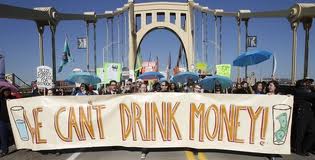
Pittsburgh Drilling Protesters Cross Rachel Carson Bridge

Pittsburgh Bans Natural Gas Drilling

http://www.commondreams.org/newswire/2010/11/16-7

PITTSBURGH, PA – November 16 – Today, the Pittsburgh City Council unanimously adopted an ordinance banning corporations from conducting natural gas drilling in the city.

The ordinance was drafted by the Community Environmental Legal Defense Fund (CELDF) at the invitation of Councilman Bill Peduto, and was introduced by Councilman Doug Shields.

Pittsburgh’s first-in-the-nation ordinance confronts the threat of Marcellus Shale drilling – an activity permitted by the state which allows corporations to site drilling activities over the wishes of a community.

Energy corporations are setting up shop in communities across Pennsylvania, to drill for natural gas in the Marcellus Shale formation. The gas extraction technique known as “fracking” has been cited as a threat to surface and groundwater, and has been blamed for fatal explosions, the contamination of drinking water, local rivers, and streams. Collateral damage includes lost property value, ingestion of toxins by livestock, drying up of mortgage loans for prospective home buyers, and threatened loss of organic certification for farmers in affected communities.

Continue reading Pittsburgh Bans Drilling of Marcellus Shale

Where Do Jobs Come From? Hint: Not A Simple Answer

Businesses Do Not Create Jobs

By Dave Johnson
Beaver County Blue
via Campaign for America’s Future

Nov 11, 2010

Businesses do not create jobs. In fact, the way our economy is structured the incentive is for businesses to get rid of as many jobs as they can.

Demand Creates Jobs

A job is created when demand for goods or services is greater than the existing ability to provide them. When there is a demand, people will see the need and fill it. Either someone will start filling the demand alone, or form a new business to fill it or an existing provider of the good or service will add employees as needed. (Actually a job can be created by a business, a government, a non-profit organization or just a person doing the job, depending on the nature of the good or service that is required.)

Continue reading Where Do Jobs Come From? Hint: Not A Simple Answer