AFL-CIO Resolves to Organize the South

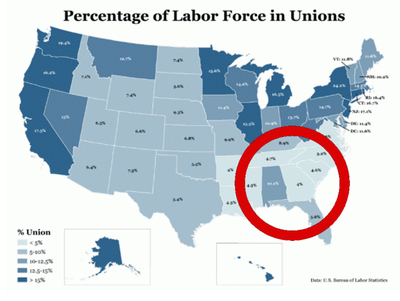
Union density is lowest in the South

AFL-CIO resolves to organize the South

By Joe Atkins, Labor South

Delegates at the 2013 convention of the AFL-CIO in Los Angeles this week adopted a a resolution proposed by the Savannah (Ga.) Regional Central Council “to develop a Southern organizing strategy” as “one of its top priorities” and one that will “include a long-term commitment to organize the South.”

Resolution 26 decries the fact that the U.S. labor movement “has never successfully developed a concerted and coordinated effort to organize workers in the 11 Southern states” of the Southern Region, thus “allowing the most conservative political forces in the South to operate without effectively being challenged by organized workers.”

The South today is “a major player in the new global economy,” the resolution says, “and has become a haven for US manufacturing, foreign investments and finance capital, and because of this reemergence is now playing an integral role in shaping US labor and social policies.”

Yet “corporations in the South have not only exploited Southern workers but have also been responsible for the negative environmental impact on many working class families, especially the African American, Latino, Native American, Asian and poor white communities.”

Conservative Southern politicians have okayed “billions of dollars in tax breaks and incentives” to corporations “at the expense of these struggling communities.”

Continue reading AFL-CIO Resolves to Organize the South

Labor Embraces the New America

Labor Embraces the New America

Harold Meyerson
Tuesday, September 10, 2013
The Washington Post

 LOS ANGELES–Having banged its head against a wall for years with nothing to show for it but a headache, the American labor movement is devising a plan to bypass the wall altogether. During its quadrennial convention here this week, the AFL-CIO has acknowledged that the laws protecting employees who seek to join a union have been rendered so ineffectual that labor must come up with new ways to advance workers’ interests

With just 6.6 percent of the private-sector workforce enrolled in unions in 2012, traditional collective bargaining has all but vanished from the economic landscape — taking raises, benefits, job security and much of the American middle class with it as it goes.
“We are a small part of the 150 million Americans who work for a living,” AFL-CIO President Richard Trumka said in his keynote address Monday. “We cannot win economic justice only for ourselves, for union members alone. It would not be right and it’s not possible. All working people will rise together, or we will keep falling together.”
There was a time when labor activists believed that the union movement would be the vehicle through which working people rose. For the time being, however, most labor activists don’t believe that’s possible. While they’re not abandoning traditional workplace organizing, they’re proclaiming a strategic shift.
Sen. Elizabeth Warren Addresses AFL-CIO Convention

“We are going to expand the idea of collective bargaining,” said Tim Paulson, executive director of the San Francisco AFL-CIO. “You can have collective bargaining through legislation. You can have collective bargaining through ballot measures.”

Working in a coalition with community organizations, labor prevailed on San Francisco’s city government in 2008 to mandate that employers provide health insurance to their workers or pay the city to subsidize low-income residents’ purchase of coverage. This year, the coalition also persuaded a hospital chain seeking to build a new facility to staff it with union jobs and to provide affordable housing — in a city where such housing grows scarcer by the minute — as a condition for winning city approval to go ahead with its expansion.
By itself, labor could not have won these and kindred battles. “Even if all we cared about was our own contracts, we can’t even get those anymore without community assistance,” said Larry Cohen, president of the Communications Workers of America.

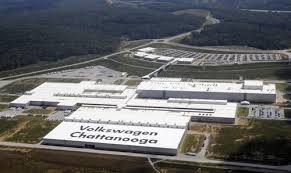
Majority Sign UAW Cards at Chattanooga VW Plant

VW Chattanooga Plant

UAW: Majority at Tennessee VW plant have signed union cards

  • Bryce G. Hoffman
  • The Detroit News

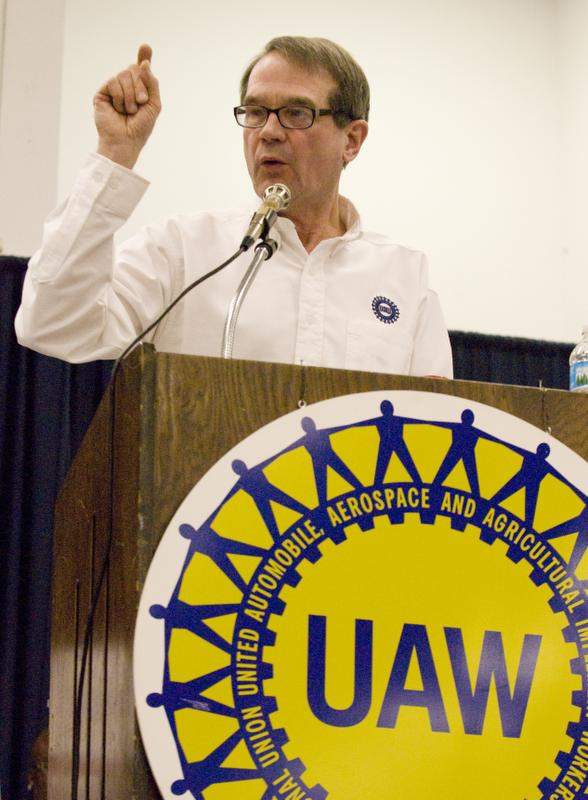
Frankfurt, GermanyA majority of workers at Volkswagen AG’s Chattanooga Assembly Plant in Tennessee have signed cards in support of union representation in creating a German-style works council, according to United Auto Workers President Bob King.

“We’ve gone through a very positive organizing campaign down there. Now, we’re going to work through the recognition process with Volkswagen,” King told The Detroit News on Wednesday, praising the German automaker for having “as much integrity as I’ve ever seen a global company have.”

UAW Pres. Bob King
UAW Pres. Bob King

A Volkswagen spokesman at the plant declined to comment on the UAW claim of having signed up a majority of workers, referring instead to a letter issued by the company last week that confirmed it is in talks with the union and stated: “Volkswagen values the rights of its employees in all locations to an operational representation of interests.”

If the UAW succeeds in winning recognition from VW, it would be a major victory for the union, which has tried with little success to organize foreign automakers’ factories in the South. Labor experts say it could also offer an important new paradigm for union-management relations — not just in the auto industry, but for other industries as well.

“It is a major achievement on two levels,” said labor expert Harley Shaiken, a professor at the University of California, Berkeley. “First, this really sets the stage for a Chattanooga model — a highly competitive, pro-union model that has implications for other non-union automakers in the U.S. Second we’re seeing the introduction of a new model that is highly successful in Germany that has implications for other industries.”

In Germany, unions negotiate wages and benefits for their members just like their counterparts in the United States. But German “co-determination” laws require the establishment of elected work councils to handle plant-specific issues, such as work rules and job security. Those same laws give labor half the seats on each company’s governing supervisory board.

Continue reading Majority Sign UAW Cards at Chattanooga VW Plant

AFL-CIO Convention Call for Improvements to Affordable Care Act

Resolution 54: AFL-CIO Convention Resolution on the Affordable Care Act

Submitted by the Building and Construction Trades Department, the International Union of Operating Engineers and the American Federation of Teachers

Referred to the Resolutions Committee
Referred to the Executive Council by the Resolutions Committee with the Recommendation that It Be Sent to the Convention for Adoption
Referred to the Convention by the Executive Council with a Recommendation for Adoption

WHEREAS, in 2009, the AFL-CIO Convention passed two health care resolutions – Health Care Reform Now and the Social Insurance Model for Health Care Reform – which reaffirmed the labor movement’s commitment to health care for all, ultimately through a single-payer system. In 2010, Congress passed the Affordable Care Act (ACA);

WHEREAS, the AFL-CIO continues to support the ACA’s goal of securing high-quality, affordable health coverage for all Americans; three years after the passage of the Affordable Care Act, we reaffirm our commitment to the goal of affordable, quality health care for all but recognize that the ACA remains a work in progress;

WHEREAS, the ACA’s expansion of comprehensive health insurance to 25 million more Americans, support for affordability through expanded Medicaid eligibility and premium subsidies and insurance market reforms are clear gains for working families. The new law also has eliminated some of the worst insurance company abuses, cut costs for seniors, and appears to be contributing to lower rates for individual coverage in states like California and New York;

WHEREAS, the federal agencies administering the ACA have interpreted the Act in ways that are threatening the ability of workers to keep health care coverage through some collectively bargained, non-profit health care funds. Republican governors in many states have refused to participate in implementing the Act and are even actively blocking efforts to provide health care to all through Medicaid expansion;

WHEREAS, for decades before the enactment of the Affordable Care Act, such quality, affordable health coverage has been provided to workers and their families through non-profit multiemployer health plans negotiated between unions and participating employers, including the approximately 20 million individuals covered by such plans today;

WHEREAS, the health coverage provided through multiemployer plans has met the goals of the Affordable Care Act by providing portable, affordable, high-quality coverage for workers who would otherwise be left out of typical employer plans, including participants in industries where employment is mobile or part-time;

WHEREAS, multiemployer health plans have been attractive to employers because they provide predictable, consistent and cost-effective long-term health coverage for workers;

WHEREAS, multiemployer health plans have been attractive to employees because they provide a consumer-oriented plan design, portability, stability and flexibility;

Continue reading AFL-CIO Convention Call for Improvements to Affordable Care Act

Sec’y Kerry Rejects Syria Offer to Surrender Chemical Weapons

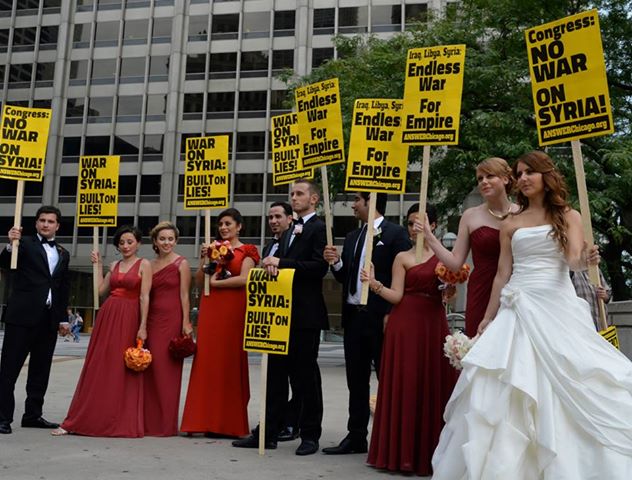
Wedding Party in Chicago borrows anti-war signs for photo

Kerry Couldn’t Sell a Used Car

By davidswanson – Posted on 09 September 2013

After Secretary of State John Kerry suggested that President Bashar al-Assad avoid a war by handing over any chemical weapons his government possesses, Russia quickly seconded the motion, and Assad agreed to it.  Just as quickly, aparently panicked by the possible delay or prevention of missile strikes, Kerry’s staff put out this statement:

“Secretary Kerry was making a rhetorical argument about the impossibility and unlikelihood of Assad turning over chemical weapons he has denied he used.  His point was that this brutal dictator with a history of playing fast and loose with the facts cannot be trusted to turn over chemical weapons, otherwise he would have done so long ago. That’s why the world faces this moment.”

Could Assad be lying?  Could he hope to stash away a hidden weapons stockpile? Yes, and then at least a U.S. attack would have been delayed and more time gained to work on preventing it.  But that’s not likely.  Inspectors are very good.  That’s why Prsident George W. Bush wanted them pulled out of Iraq, where they had done a stellar job and the weaponry been eliminated.  That could conceivably also be why President Barack Obama wanted them kept away from the site of the August 21st attack and wanted to send missiles into Syria before the inspectors reached any results.

So, to all appearances, Assad has immediately done what Kerry just declared impossible.  How reliable, then, are other assertions of which Kerry professes to be certain?

Is it really an important international norm that one nation should bomb another in support of fanatical terrorists and on the stated basis that people had been killed with the wrong variety of weapon?

Continue reading Sec’y Kerry Rejects Syria Offer to Surrender Chemical Weapons

Obama Plans ‘Shock and Awe’ in Syria

Obama Plans ‘Shock and Awe’ in Syria

Bob Dreyfuss on September 9, 2013 – 10:35 AM ET

President Barack Obama talks with bipartisan congressional leaders in the Cabinet Room at the White House. (Reuters/Larry Downing)
President Obama’s plan to have Congress approve his ill-considered war on behalf of Al Qaeda in Syria will shock everyone, when it happens, with its sheer intensity. Those expecting a “limited” strike against a handful of Syrian military installations, including those involved in delivering chemical weapons, are in for a rude awakening. Instead, what the president will order will be a lot closer to President George W. Bush’s “shock and awe” bombardment of Baghdad before the US invasion of Iraq in 2003.

That isn’t to say that Obama is planning an invasion of Syria. He’s not. (Although if the state collapses, and Syria descends into chaos, the United States may very well end up with “boots on the ground” and body bags for American soldiers.)

In trying to market his war plans to Congress and the American public, Obama has repeatedly stated that he’s seeking authority for a limited war, and some officials have suggested—especially at the beginning of Obama’s war push—that “the strike,” as the belligerent Secretary of State John Kerry calls it, might involve only a couple of dozen cruise missiles. Don’t believe that for a second.

Even the drafts of resolutions being circulated in Congress suggest that Obama will get the “authority” to wage war against Syria for up to sixty days, with the possibility of an extension. That’s war, folks, not a “strike.”

Continue reading Obama Plans ‘Shock and Awe’ in Syria

Frack Waste Injection Wells Blamed for Earthquakes in OH & PA

Confirmed: Fracking practices to blame for Ohio earthquakes

Charles Q. Choi LiveScience

Sep. 4, 2013 at 3:54 PM ET

Fracking

USGS
This map shows the intensity of shaking in the area of a magnitude-3.9 earthquake that struck near Youngstown, Ohio, on Dec. 31, 2011. Research has linked this earthquake to the underground injection of wastewater from fracking.

Wastewater from the controversial practice of fracking appears to be linked to all the earthquakes in a town in Ohio that had no known past quakes, research now reveals.

The practice of hydraulic fracturing, or fracking, involves injecting water, sand and other materials under high pressures into a well to fracture rock. This opens up fissures that help oil and natural gas flow out more freely. This process generates wastewater that is often pumped underground as well, in order to get rid of it.

A furious debate has erupted over the safety of the practice. Advocates claim fracking is a safe, economical source of clean energy, while critics argue that it can taint drinking water supplies, among other problems.

One of the most profitable areas for fracking lies over the geological formation known as the Marcellus Shale, which reaches deep underground from Ohio and West Virginia northeast into Pennsylvania and southern New York. The Marcellus Shale is rich in natural gas; geologists estimate it may contain up to 489 trillion cubic feet (13.8 trillion cubic meters) of natural gas, more than 440 times the amount New York State uses annually. Many of the rural communities living over the formation face economic challenges and want to attract money from the energy industry.

Youngstown quakes
Before January 2011, Youngstown, Ohio, which is located on the Marcellus Shale, had never experienced an earthquake, at least not since researchers began observations in 1776. However, in December 2010, the Northstar 1 injection well came online to pump wastewater from fracking projects in Pennsylvania into storage deep underground. In the year that followed, seismometers in and around Youngstown recorded 109 earthquakes, the strongest registering a magnitude-3.9 earthquake on Dec. 31, 2011. The well was shut down after the quake.

Scientists have known for decades that fracking and wastewater injection can trigger earthquakes. For instance, it appears linked with Oklahoma’s strongest recorded quake in 2011, as well as a rash of more than 180 minor tremors in Texas between Oct. 30, 2008, and May 31, 2009.

The new investigation of the Youngstown earthquakes, detailed in the July issue of the journal Geophysical Research Letters, reveals that their onset, end and even temporary dips in activity were apparently all tied to activity at the Northstar 1 well.

Continue reading Frack Waste Injection Wells Blamed for Earthquakes in OH & PA

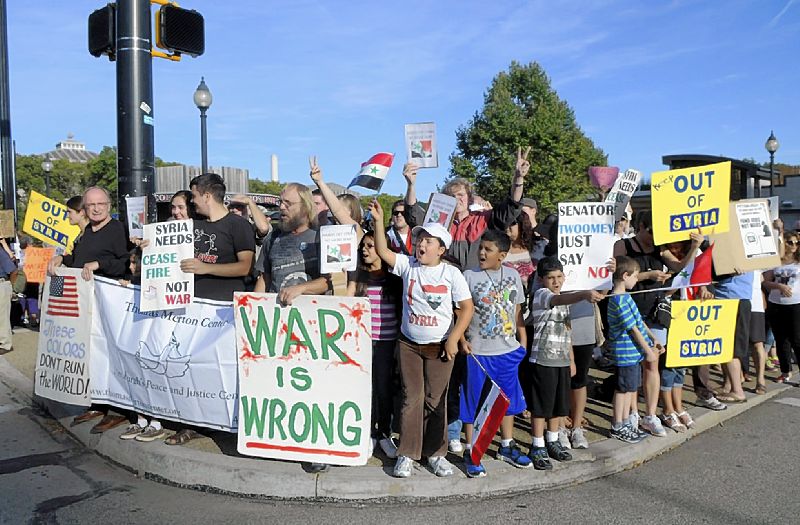
Obama Plan to Bomb Syria Protested in Pittsburgh

Robin Rombach/Post-Gazette: Protesters gather Friday on the corner of Bigelow Boulevard and Forbes Avenue in Oakland in disapproval of possible U.S. military action against Syria.

By Amy McConnell Schaarsmith

Beaver County Peace Links via Pittsburgh Post-Gazette

Sept 7, 2013 – Weary of nearly two decades of intermittent wars in the Middle East and Afghanistan, protesters met in Oakland on Friday to tell the Obama administration not to bomb Syria in retaliation for its apparent use of chemical weapons in a Damascus suburb last month.

Chanting slogans such as "more money for jobs, not for war!" and waving signs with slogans such as "Obushma" and "These Colors Don’t Run the World," the group of approximately 100 demonstrators organized by the Thomas Merton Center Antiwar Committee clogged the intersection of Forbes Avenue and Bigelow Boulevard and repeatedly crossed the streets in front of stopped vehicles.

Among them, Syrian native Elaine Khalil, 47, said the United States — and all the other countries trying to influence the outcome of the conflict between Syrian President Bashir Assad and the rebels trying to oust him — should stop meddling and let the Syrian people make their own peace.

"With [President Barack] Obama supporting this war, our fear is it would actually explode into World War III," Ms. Khalil said, citing the possibility that military strikes might incite retribution by other countries in the region. "If they would pull their hands out of it, the Syrian people would resolve their own problems."

Continue reading Obama Plan to Bomb Syria Protested in Pittsburgh

Major US Churches to Obama: Do Not Attack Syria

July 31, 2013
President Barack Obama
The White House
Washington, DC 20500
Dear Mr. President,
As leaders of Christian communions and organizations throughout the United States, we are compelled to write to you out of our grief for the crisis within Syria. We feel deeply the pain of all who are caught in the midst of war. We pay heed to the reminder of our Christian brothers and sisters that they are part of the fabric of Syrian history and society, with a desire to live in peace with all their neighbors. The rich religious and ethnic tapestry that has characterized Syria for centuries is at risk of fraying beyond repair.
Already more than 100,000 Syrians have been killed as a result of the war. More than 4 million people have been displaced from their homes within Syria, and an additional 1.7 million Syrians have sought refuge in neighboring countries, placing a great strain upon local economies.
Churches within the region and many of our own churches, congregations and organizations have responded generously to the needs of Syrians who are suffering as a result of the war. But the needs are enormous and they continue to grow.
We are grateful for the humanitarian assistance provided thus far by the U.S. government and encourage an ongoing and robust response. These funds must be used in an impartial manner, in keeping with international standards. Furthermore, these monies must be in addition to, and not instead of, funding for the ongoing needs of refugees and internally displaced people in other countries. In addition, all parties to the conflict must allow immediate access to all persons in need.

Continue reading Major US Churches to Obama: Do Not Attack Syria

Presbyterians: No Military Attack on Syria

Stated Clerk issues statement in the wake of the escalating violence in Syria

August 30, 2013

Office of the General Assembly

Gradye Parsons

Stated Clerk

Louisville

The Rev. Gradye Parsons, Stated Clerk of the General Assembly of the Presbyterian Church (U.S.A.) issued a statement today (August 30) in the wake of the escalating violence in Syria, calling upon U.S. and world leaders to refrain from military action.

“For everything there is a season, and a time for every matter under heaven.” (Ecclesiastes 3:1)

We are deeply concerned about events in Syria. We grieve for our brothers and sisters who have suffered so deeply for so long. We yearn for an end to the bloodshed and renew our call for a cease-fire and a mediated process involving all parties to provide new choices for all Syrians.

We condemn the use of chemical weapons. Regardless of who perpetrated the attack, such a usage violates a longstanding international norm.  We recognize the authority and the responsibility of the United Nations Security Council to deal with this violation of international law. We call all nations to encourage the Security Council to address this illegal and immoral act. We do not doubt that justice is needed, but question the unilateral and inevitably selective role the United States has too often played, too often leading to greater violence, terrorism, and instability.

We call upon the President and the members of Congress to follow the example of other strong leaders in the past by exercising the courage and wisdom to refrain from military action that is likely to escalate the conflict further, and to bring our country directly into another war in the Middle East.

Continue reading Presbyterians: No Military Attack on Syria