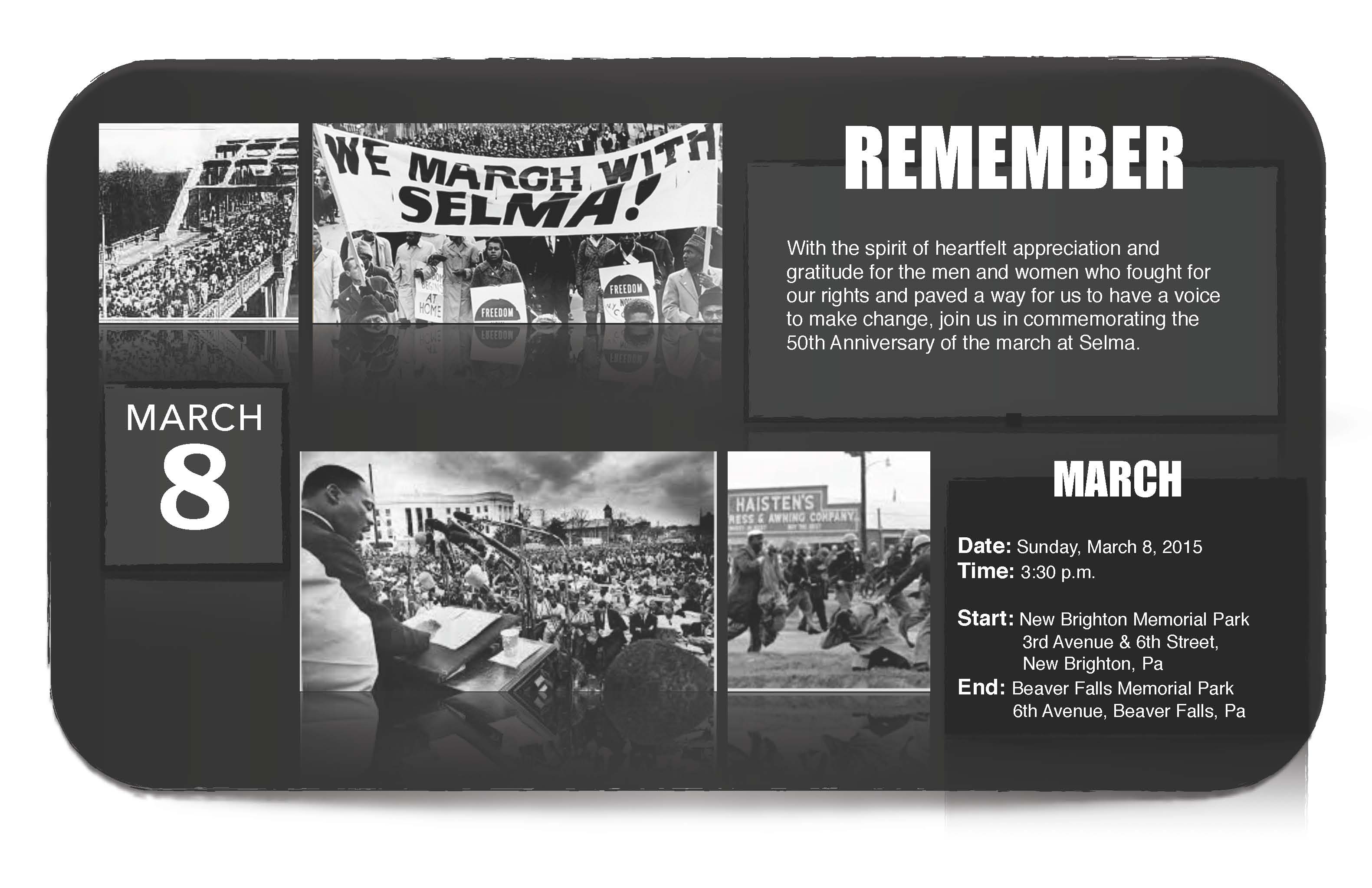
March 9, 2015 – BEAVER FALLS — Upwards of 100 people marched from New Brighton to Beaver Falls on Sunday afternoon to commemorate the 50th anniversary of "Bloody Sunday," which took place March 7, 1965, in Selma, Ala., as civil rights activists marched to the state capital of Montgomery for voting rights.
"Things like this sparks into the people to get out there and vote, and that we have a chance to get out there and make a difference," said Abe Askew, of Aliquippa.
Askew believed that Sunday’s march and similar acts of empowerment can have positive impacts on people and communities alike, saying he will spread the word regarding the importance of voting.
"(I’ll tell) all the people that I know from Aliquippa and it’ll go from here to there," Askew said. "It goes into a stream and a stream into a river."
The march began at New Brighton’s Townsend Park, across from the borough building at Third Avenue and Sixth Street, and crossed the bridge over the Beaver River to Beaver Falls, before concluding at Beaver Falls Memorial Park at Sixth Avenue and 11th Street, where several guest speakers addressed the crowd, including event organizer Olivia Ryan.
Ryan, a graduate of Beaver Falls High School and Kent State University, decided to organize the event after a panel discussion on law, race and the community last weekend at Geneva College. (Continued)
Feb 23, 2015 – The U.S. Geological Survey has backed-up what scientists have been suggesting for years–that deep injection of wastewater is the primary cause of the dramatic rise in detected earthquakes:
Large areas of the United States that used to experience few or no earthquakes have, in recent years, experienced a remarkable increase in earthquake activity that has caused considerable public concern as well as damage to structures. This rise in seismic activity, especially in the central United States, is not the result of natural processes.
Instead, the increased seismicity is due to fluid injection associated with new technologies that enable the extraction of oil and gas from previously unproductive reservoirs. These modern extraction techniques result in large quantities of wastewater produced along with the oil and gas. The disposal of this wastewater by deep injection occasionally results in earthquakes that are large enough to be felt, and sometimes damaging. Deep injection of wastewater is the primary cause of the dramatic rise in detected earthquakes and the corresponding increase in seismic hazard in the central U.S.
“The science of induced earthquakes is ready for application, and a main goal of our study was to motivate more cooperation among the stakeholders — including the energy resources industry, government agencies, the earth science community, and the public at large — for the common purpose of reducing the consequences of earthquakes induced by fluid injection,” said coauthor Dr. William Ellsworth, a USGS geophysicist.
Emphasis added. In the last five years alone, Oklahoma has detected a staggering 2500 earthquakes. Scientists involved in the study are calling for a dramatic increase in transparency and cooperation:
“In addition to determining the hazard from induced earthquakes, there are other questions that need to be answered in the course of coping with fluid-induced seismicity,” said lead author of the study, USGS geophysicist Dr. Art McGarr. “In contrast to natural earthquake hazard, over which humans have no control, the hazard from induced seismicity can be reduced. Improved seismic networks and public access to fluid injection data will allow us to detect induced earthquake problems at an early stage, when seismic events are typically very small, so as to avoid larger and potentially more damaging earthquakes later on.”
In one year, the underbanked and unbanked pay out more in financial service charges than the federal government spends on all domestic food aid.
American Postal Workers Union (APWU) president Mark Dimondstein has an offer that should be hard to refuse, especially for the 10 million American households, mostly low-income, that do not have a checking account or other basic banking services.
Through its network of 30,000 post offices and other outlets, the United States Postal Service (USPS) could readily and cheaply provide many banking services (just as it now provides money orders), no matter where you live or what you earn. This could save people without bank access from paying the exorbitant interest and fees at currency exchanges, payday lenders, rent-to-own dealers, pawn shops and other subprime financial institutions.
Postal workers would also win: Expanding postal services would create more jobs. Moreover, the additional revenue would strengthen USPS’s finances, bolstering the four major postal unions’ ongoing fight against management’s austerity measures. Although the postal service earned a surplus on operations in 2014, it ran a deficit overall because of perverse requirementsCongress imposed in 2006 that retiree healthcare benefits for the next 75 years be fully pre-funded within a decade, a standard far more demanding than those required by any other retirement systems. Much more than the decline in first class mail, that manufactured budget crisis has fueled USPS management’s campaign of job cuts. The postal workforce dropped from about 700,000 in 2006 to less than 500,000 last year, and management hopes to reduce it by as many as 15,000 more this year. USPS management’s campaign of job cuts also involves service degradation, post office closings and privatization—such as delivering postal services at the office-supply store Staples, where jobs are low-wage and non-union. If postal unions can implement banking and roll back the retiree pre-pay requirement, they will return the postal service to solvency while expanding the public sector to address private market shortcomings.
When talks for a new APWU contract start in February, Dimondstein intends to make establishing postal banking a major demand, even though it falls outside the bread-and-butter issues unions typically bring up in bargaining. He plans to argue that creation of the bank would profoundly affect the mandatory bargaining issues of wages, hours and working conditions.
The negotiations come on the heels of a new campaign, launched this week by the postal unions—in partnership with community groups such as National People’s Action, Public Citizen, USAction and Interfaith Worker Justice—to mobilize the public in favor of a postal bank.
Feb 8, 2015, Harrisburg, PA. If the vote were taken for the Democratic presidential candidate at the Harrisburg Hilton on Saturday, Feb. 7, Senator Bernie Sanders, Independent of Vermont, would likely have won by a landslide.
That was the spirit in the hotel ballroom as Sanders addressed the 800 people gathered for the PA Progressive Summit. The annual meeting, sponsored by Keystone Progress, brought together progressive activists—community and trade union organizers, women’s right and civil rights groups, hopeful candidates and door knockers—all of whom made up the democratic wing of the Democratic Party, from all across the Keystone State.
“I’m going to try something a little different this morning,” said Sanders to start things rolling, “I’m going to tell you the truth.” He got a wave of laughter and cheers from people who often got something else from politicians.
Sanders with Tina Shannon
Sanders started off with the ‘Citizen United’ Supreme Court decision taking limits off the superrich in funding elections and candidates. “It will go down is history as one of the worse ever made in modern times” Sanders said by way of description. “By a five-to-four vote, it undermined the very foundations of democracy. I know you think the situation is bad, believe me, it’s worse than you think it is.” Billionaires are not satisfied with owning the economy, he explained. They were buying government as well.”
The Koch Brothers, with 85 billion in wealth, were taken as the case in point. Sanders explained that they alone intended to spend over 900 million dollars on the 2016 election—more than the combined total of Obama and Romney in 2012. This meant these “counter-revolutionaries with a far right agenda” would wield more power than both political parties in the recent past.
Turning to the economy, Sanders said while the economy was clearly in better shape than when Obama, first took office, it was still clearly in bad shape. He explained the different meanings of official unemployment figures, with 5.8 percent being the most common number cited, but double that, near 12%, was more accurate.
Then he broke it down further: “We talk a lot about Ferguson, as we should. But we also need to talk more about Black youth unemployment, which is 30 percent. Nobody should be satisfied with where we are today. We have 45 million people living in poverty, another word we need to talk more about today.”
For those worried about deficits, Sanders noted that they had been reduced under Obama. But he also insisted that if they were truly concerned about deficits, they would have stood up against the Iraq war. This remark got wild cheers and everyone out of their seats.
Unfair Impact of Technological Change
Sanders went on to examine ‘the explosion in technology,’ not only i-Phones and i-Pads, but robotics in factories. “All of this has led to a tremendous growth in productivity on the part of American workers.” Such changes logically might suggest workers were paid more or worked shorter hours, he added, “but all of you know, tens of millions of Americans today are working longer hours for less pay.”
This meant anger and stress among workers—impacting both men and women, even if in slightly different ways—needed discussion as a national issue. There was a time, “ancient history” said Sanders, when one worker could work 40 hours and support a family reasonably well. Now women were working along with men, sometimes at two or three jobs, at long hours and low pay, to hobble together enough to support a family. “This causes a lot of anger, and often it’s being angry at the wrong people for the wrong reasons,” he added. “The average male worker, right in the center of the economy, now makes $800 a year less in inflation adjusted dollars than he did 40 years ago. The average female worker in the center makes $1300 a year, even less. They have a lot to be angry about. They want to know why, and our job is to explain it to them.”
Gov. Wolf to ditch Healthy PA, institute straight Medicaid expansion
By HEATHER STAUFFER | Staff Writer | Updated just now
Pennsylvania Gov. Tom Wolf, long a critic of his predecessor’s version of Medicaid expansion under the Affordable Care Act, on Monday took the first step toward replacing it.
That step was directing the state Department of Human Services to withdraw a pending piece of the Healthy PA program from further federal consideration. Wolf proposes to replace Healthy PA’s three benefit plans with a single one that the DHS is working with the federal government to develop.
“Today is the first step toward simplifying a complicated process and ensuring hundreds of thousands of Pennsylvanians have greater access to the health insurance they need,” Wolf said in a news release.
Former Gov. Tom Corbett billed Healthy PA, which took effect Jan. 1, as a simplification of the state’s 14 existing Medicaid plans.
Wolf disagreed, with his release citing “people not receiving important treatment, confusion among recipients, and special populations being placed into the wrong plans” as examples of “complications under Healthy PA.”
“Our approach will alleviate confusion, remove unnecessary red tape, and streamline the system so that people can see a doctor when they are sick and health care professionals have more time to concentrate on providing quality care,” Wolf said.
Montgomery Locks and Dam on Beaver County: Army Corps of Engineers spokesman Dan Jones said locks and dams funding on the Ohio River in Pennsylvania and West Virginia will receive nearly $47.97 million based on President Barack Obama’s proposed numbers. The Montgomery Locks and Dam in Potter Township could be among those receiving funding.
Locks and dams funding increases for southwestern Pennsylvania
By David Taube
Beaver County Times
Feb 3 , 2015 – WASHINGTON, D.C. – An Army Corps of Engineers spokesman said the president’s proposed budget calls for significant increased spending on the Ohio River.
Spokesman Dan Jones said locks and dams funding on the Ohio River in Pennsylvania and West Virginia will receive nearly $47.97 million based on President Barack Obama’s proposed numbers. Typically, Jones added, those figures do not change drastically from what’s approved by Congress.
That compares to a previous budget of $30.8 million, he said.
The federal government also will invest $58 million in unallocated dollars to locks and dams in western Pennsylvania, which involves funding already approved by Congress and the administration, U.S. Sen. Bob Casey, D-Pa., said in a statement Monday.
The unallocated money relates to the current 2015 federal fiscal year, which began Oct. 1 and ends Sept. 30. The president’s budget is for the upcoming 2016 federal fiscal year, which begins this fall.
Casey had asked federal staff for that other investment so a lower Monongahela River project could begin constructing a river chamber portion and support existing contracts, he wrote in a letter to Jo-Ellen Darcy, assistant secretary of the Army for civil works.
It was not immediately clear if or how that $58 million change could benefit other locks and dams projects in the state as Casey’s press office stated it would.
Disturbing data: Pittsburgh must get to work on racial disparities
By the Post Gazette Editorial Board
Jan 18, 2015 – When Larry E. Davis says there are wide racial disparities in Pittsburgh that translate into broad and significant disadvantages for local African-Americans, he’s not giving an opinion. He is summarizing 137 pages of alarming statistics.
The report, “Pittsburgh’s Racial Demographics 2015: Differences and Disparities,” was released Tuesday by the University of Pittsburgh’s Center on Race and Social Problems, where Mr. Davis is both director of the center and dean of the university’s School of Social Work.
The compilation paints a bleak picture of the economic, educational, health and social realities conspiring to limit opportunities for black residents. Perhaps even worse, it demonstrates — based on a comparable 2007 report — that circumstances of black Pittsburghers have not improved.
Some key findings:
• The household income for black families in Pittsburgh was just 49 percent of white families between 2007 and 2011 — $21,800 versus $44,600. That far exceeds the gap nationwide.
‘Hostage-Takers’: Republicans Go After Social Security on Very First Day
Advocacy groups vow to fight back against what they believe is a preliminary “stealth attack” that portends a wider assault on a program that makes survival possible for millions of vulnerable Americans
Defenders of Social Security worry that if history is a guide, this latest “stealth attack” on the program’s solvency signals the “groundwork is being laid in advance” by the Republican Party for a larger attack on the program as a whole. (Photo: File)
As Los Angeles Times columnist Michael Hiltzik immediately remarked: “Well, that didn’t take long.”
An attack by the Republican Party on the nation’s Social Security program took less than one full working day. Included in a new set of rules passed by the House of Representatives on Tuesday was a new measure making it more difficult to move funds between separate accounts maintained by the Social Security Administration. A seemingly technical provision on the surface, critics says it puts millions of disabled and elderly Americans at risk and sets the stage for further attacks aimed at the wider program.
“The GOP is inventing a Social Security crisis that will threaten benefits for millions and put our most vulnerable at risk.” —Sen. Elizabeth WarrenAccording to Hiltzik:
The rule hampers an otherwise routine reallocation of Social Security payroll tax income from the old-age program to the disability program. Such a reallocation, in either direction, has taken place 11 times since 1968, according to Kathy Ruffing of the Center on Budget and Policy Priorities.
But it’s especially urgent now, because the disability program’s trust fund is expected to run dry as early as next year. At that point, disability benefits for 11 million beneficiaries would have to be cut 20%. Reallocating the income, however, would keep both the old-age and disability programs solvent until at least 2033, giving Congress plenty of time to assess the programs’ needs and work out a long-term fix.
The procedural rule enacted by the House Republican caucus prohibits the reallocation unless it’s accompanied by “benefit cuts or tax increases that improve the solvency of the combined trust funds,” as paraphrased by the National Committee to Preserve Social Security and Medicare.In practical terms, the advocacy committee says, that makes the reallocation impossible; it mandates either benefit cuts across the board, which aren’t politically palatable, or a payroll tax increase, which isn’t palatable to the GOP.
In response to approval of the new rule, Sen. Elizabeth Warren (D-Mass.) chastised Republicans in the House.
“The GOP is inventing a Social Security crisis that will threaten benefits for millions and put our most vulnerable at risk,” Warren fumed via her Twitter account. “This is ridiculous. 233k people in MA receive Social Security disability benefits that could be threatened by these political games.”
“All of these divide-and-conquer strategies are intended to turn Americans against each other so that all of their benefits can be cut.” —Nancy Altman & Eric Kingson, Social Security Works
Advocacy groups like AARP and the National Committee to Preserve Social Security and Medicare expressed outrage.
“It is difficult to believe that there is any purpose to this unprecedented change to House rules other than to cut benefits for Americans who have worked hard all their lives, paid into Social Security, and rely on their Social Security benefits, including disability, in order to survive,” said Max Richtman, president of the NCPSSM, who also sent a letter to Congress expressing his concerns.
According to Nancy Altman and Eric Kingson, authors of the book Social Security Works! and members of the advocacy group of the same name, what would otherwise have been the “dry, mundane exercise” of adopting new rules in the House was “turned into a stealth attack on America’s working families.”
Like previous “stealth attacks” on Social Security, write Altman and Kingson, the small rule change shows “the groundwork is being laid in advance” for a larger attack on the program as a whole and described the tactics of Republicans determined to destroy the program, regardless of the costs, as “hostage-taking.” In their analysis, the GOP ploy involves playing disparate groups within the system off one another with the ultimate goal of drastically reducing the program for everyone—current and future beneficiaries alike. They write:
One of the strengths of Social Security is its universality. It is based on the principle that we are stronger together. It is an old tactic of the program’s opponents to seek to divide and conquer. They seek to turn young against old by falsely claiming that too much is being spent on the old. They seek to turn African Americans against whites with the preposterous claim that Social Security is unfair to blacks. (We document and refute these and many other claims in our new book). This time they seek to drive a wedge between retired workers and disabled workers by claiming that reallocation helps the disabled at the expense of the old – another preposterous claim. All of these divide-and-conquer strategies are intended to turn Americans against each other so that all of their benefits can be cut.
Sen. Sherrod Brown (D-Ohio) also condemned the rule, calling it not only contentious, but dangerous. “Re-allocation has never been controversial, but detractors working to privatize Social Security will do anything to manufacture a crisis out of a routine administrative function,” Brown said in a statement. “Re-allocation is a routine housekeeping matter that has been used 11 times, including four times under Ronald Reagan. Modest re-allocation of payroll taxes would ensure solvency of both trust funds until 2033. But if House Republicans block reallocation, insurance for disabled Americans, veterans, and children could face severe cuts once the trust fund is exhausted in 2016.”
For their part, Altman and Kingson said groups like Social Security Works and their allies will take this signal from the Republican Party and use it to re-energize their campaign to strengthen, not destroy, what they consider the single most successful social program in the nation’s history.
“If senior, disability, workers, women’s, veterans, civil rights, faith-based and other groups stand together – as they have in opposition to privatization and recent benefit cut proposals,” they concluded, “this stealth effort to pull apart our Social Security will be defeated. And if citizens from around the country let their representatives know that it’s time to expand Social Security to address the nation’s retirement income crisis, not cut it, all of us will be better off.”




 Beaver County Blue: Voice of the 17th CD of Progressive Democrats of America