Fight for 15 and Black Lives Matter Join Forces on Anniversary of MLK’s Death

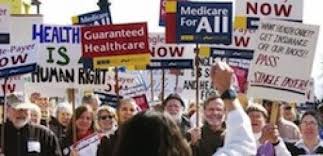
Christopher Smith, right, leads chants during a protest for higher wages for fast food workers outside a McDonald’s in Memphis, Tenn., Thursday, April 14, 2016.

Forty-nine years after King was assassinated, the left’s organizing vanguards seek to continue his work. 

By Justin Miller

American Prospect

April 4, 2017 – On the April 4, 1968, Reverend Dr. Martin Luther King Jr. was gunned down on the balcony of the Lorraine Motel in Memphis, Tennessee, where he had come to support the city’s striking sanitation workers, virtually all of them African American. The workers were embroiled in a heated labor dispute with the city government over low wages, dangerous working conditions, and its unyielding opposition to recognizing their union.

Forty-nine years later, much has changed, yet much more has stayed the same. Despite landmark advancements in civil rights, black Americans still face staggering levels of systemic social and economic inequities and rampant state-sanctioned violence and discrimination. Black men are three times more likely to be killed by police than white men, and are incarcerated at a rate five times higher than white men. Meanwhile, black men make 22 percent less in wages compared with white men who live in the same areas, with the same levels of education and work experience. Black women make 11.6 percent less than their white counterparts. On average, white households hold 16 times the wealth of black households. Today, 54 percent of African American workers make less than $15 an hour.

And 49 years later, black activists are still leading large-scale movements to address these injustices. On the anniversary of King’s assassination, Fight for 15 workers and Black Lives Matter activists—many already involved in both movements—are joining together for a series of protests across the country to elevate their intersecting demands for racial justice and economic justice. The actions today not only seek to emphasize and build upon African Americans’ inextricable and intertwined struggle for both civil rights and economic justice of the 1960s, but create a broader front of intersectional progressive power to face off against the Trump administration’s attempt to roll back both.

Activists in 24 cities will be mounting demonstrations and teach-ins under the banner of “Fight Racism, Raise Pay.” They plan to call attention to the systematic targeting of communities of color—ranging from abusive local police departments that harass people of color, to Republicans in the states advancing anti-protest legislation in response to Black Lives Matter and Fight for 15 while at the same time stifling local minimum-wage hikes through state legislation. Activists will also call out the Trump administration for advancing an anti-worker agenda, supporting voter suppression, and threatening immigrant communities.

“Our two movements have a common bond in fighting the racism that keeps down people of color everywhere,” said Latierika Blair, a 23-year-old McDonald’s worker in Memphis, in a statement.

The actions center on Memphis, Tennessee, where thousands of workers, activists, and civil rights leaders will march to and hold a memorial outside the Lorraine Motel. In the mid-South city, Fight for 15 activists have encountered aggressive resistance as fast-food workers organized for higher wages and union rights. As The Guardian reported, organizers alleged in an a lawsuit filed in March that, with the “authorization from the president of McDonald’s,” the Memphis police department was authorized to arrest McDonald’s employees and engaged in a “widespread and illegal campaign of surveillance and intimidation.” Last November, the suit states, police officers allegedly followed organizers home after meetings, banned activists from entering city hall, and in one instance even stepped behind a McDonald’s counter to stop workers from signing a petition demanding better working conditions. Based on these and other allegations, the lawsuit argues that the police department was acting in concert with McDonald’s. 

“White supremacy and corporate greed have always been linked in America,” said Chelsea Fuller, an organizer with the Movement for Black Lives, in a statement. “The fast-food workers who are going on strike for $15 an hour and the right to a union are resisting the same institutional racism and oppression that fuels police violence across the country. We are stronger when we stand together, and so our movements are going to keep fighting back against the twin evils of racial and economic inequality that continue to hold back black and brown people.”

Less than 250 miles southeast, in Alabama, the state legislature, dominated by white lawmakers, passed a law prohibiting localities from instituting their own minimum-wage laws after the city council in majority-black Birmingham had passed legislation in 2015 to phase in a $10.10 hourly minimum wage. The NAACP promptly responded with a lawsuit claiming that the GOP super-majorities in the statehouse and the Republican governor rammed through the legislation in 16 days in order to block Birmingham’s ordinance—which would have largely benefited black low-wage workers—from going into effect, a move that the lawsuit claims was tainted with “racial animus” and undermines the power of the city’s black electorate. A judge has since thrown out the case. (Continued)

Continue reading Fight for 15 and Black Lives Matter Join Forces on Anniversary of MLK’s Death

Casey to White House: Action, Not Studies, Needed for Western PA Locks And Dams


Montgomery Locks in Beaver County

By Tom Fontaine

Tribonline

March 31, 2017 – The Army Corps of Engineers has spent more than $17 million over the past 15 years studying what to do about crumbling locks on Western Pennsylvania’s portion of the Ohio River.

Now the White House’s Office of Management and Budget wants it to spend more, according to U.S. Sen. Bob Casey, D-Scranton.

“We don’t have time for any more studies, nor are they needed or justified,” Casey said Friday during a stop at the Emsworth Locks and Dams, about six miles downstream of Pittsburgh.

Separately, in a letter to the Office of Management and Budget, Casey said a proposed $2.7 billion project to build new, larger lock chambers at the Ohio River’s Emsworth, Dashields and Montgomery facilities is being “unnecessarily delayed” by the office’s request for additional study and economic analysis “to determine whether the proposed project is consistent with the policy and programs of the president.”

The Office of Management and Budget did not return a message.

The three Ohio River facilities began operating between 1921 and 1936. They were built to last 50 years. Beaver County’s Montgomery is in the worst shape. Its two locks share a wall that is cracked. If the crack gets bad enough, authorities could be forced to close both locks in a move that would halt river traffic in both directions, said Col. John P. Lloyd, commander of the Army Corps’ Pittsburgh District.

“Surely, maintaining the health of this significant commercial inland waterways corridor, saving project costs and using taxpayer dollars wisely, and protecting and creating thousands of jobs are more than consistent with the president’s policies,” Casey said in his letter.

Tom Fontaine is a Tribune-Review staff writer. Reach him at 412-320-7847 or tfontaine@tribweb.com.

Clearing the Air on Islam through ‘Spread Hummus, Not Hate’ events in Beaver

Interfaith meeting with Muslims in Pittsburgh

By J.D. Prose

Beaver County Times

March 31, 2017 – BEAVER — If any two things bring Beaver Countians together, it’s food and religion, and Center Township resident Toni Ashfaq will incorporate both to educate residents about Islam during events in Beaver.

“There are a lot of misunderstandings, a lot of false information floating around,” said Ashfaq, a Muslim and the organizer of two Spread Hummus, Not Hate: Meet Your Muslim Neighbor gatherings Wednesday and Saturday at Beaver Area Memorial Library. “We just want people to meet us and see that we’re just like everybody else.”

A Wisconsin native and convert from Catholicism, Ashfaq said she and two friends — Julia Chaney, a Christian, and fellow Muslim Dr. Raniah Khairy, an OB/GYN specialist at Heritage Valley Beaver hospital in Brighton Township — began brainstorming ideas “just to kind of build bridges and promote understanding” because of the “current political climate.”

That brainstorming has resulted in the Spread Hummus, Not Hate gatherings at the library from 6 to 8 p.m. Wednesday and 2 to 4 p.m. Saturday. Ashfaq said they got the idea after learning of a group in Australia doing meetings.

“We thought it was a pretty catchy title,” Ashfaq said with a laugh. Just one gathering was initially planned, but after receiving an “overwhelming” response, she said a second one was added.

Islam has been distorted by politicians and certain media, she said, not naming anyone specifically. Regardless, Ashfaq said Muslims are “not in denial” about Muslims committing violence, but the media too often focuses solely on Islam.

“People get the wrong idea that those people represent the whole faith, and they don’t,” Ashfaq said, recalling a recent conversation in which she told a woman that equating terrorists with Islam would be akin to equating the Ku Klux Klan with Christianity.

Continue reading Clearing the Air on Islam through ‘Spread Hummus, Not Hate’ events in Beaver

Workers Rally to Resist Anti-Union Legislation

carpenters

By Tom Davidson

Beaver County Times

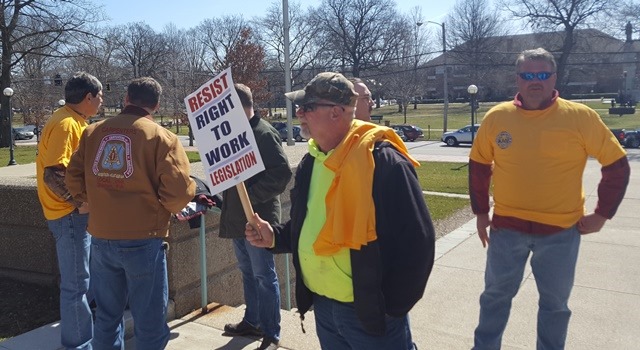
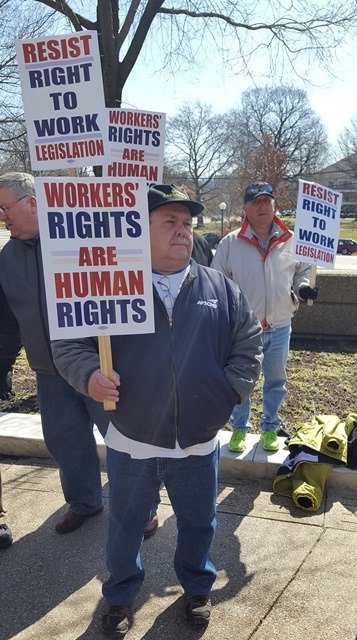
picketsMarch 23, 2017 -BEAVER — About 75 union supporters rallied at noon Thursday in front of the Beaver County Courthouse to rail against legislation they say moves Pennsylvania toward becoming a right-to-work state.

The legislation, Senate Bill 166, is called the Public Employee Protection Act, and it recently passed the state Senate.

"I like to call it ‘paycheck deception,’" is how Steve Kochanowski of Potter Township described the legislation.

He’s on the executive board of the Beaver County Democratic Party and is active with its young Democrats group.

Kochanowski, 32, is looking for a job now and is a former corporate trainer.

He opposed the law because "I believe it’s the first step to trying to make Pennsylvania a right-to-work state," he said.

He and other Democratic leaders, along with Beaver County’s labor union leadership, organized the rally to marshal opposition to the law before it passes the state House.

About 75 people turned out for the rally, wielding signs that said things such as "Workers’ Rights are Human Rights" and "Resist Right to Work Legislation."

The legislation would "hurt everybody here," according to Mitch Kates, political director of the Pennsylvania Democratic Party.

"We’re having organizing events like this all around the state," Kates said. "We want to help raise awareness."

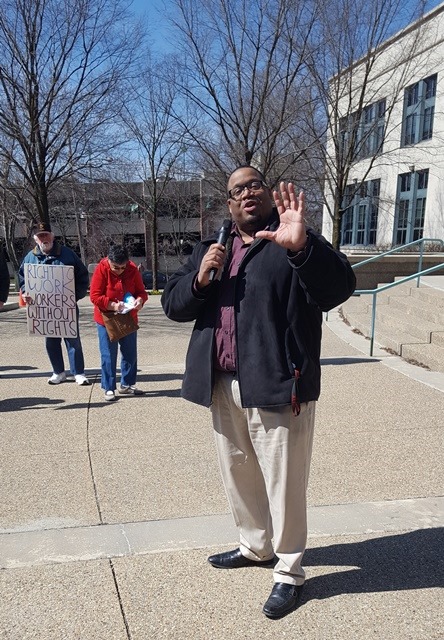
MayorWalkerThe law would prohibit unions from allowing payroll deductions for union dues that are used for political activities, and it’s a step toward stopping union members "from being able to donate to causes that are dear to your heart," Aliquippa Mayor Dwan Walker said.

Walker is the son of a union worker and said his father appreciated that union dues were deducted from his paycheck. Otherwise, with other bills to pay, the dues might not get paid, Walker said.

"These are matters of the heart," Walker said. "I stand for workers’ rights. You must resist."

All of the speakers at the rally urged people to call their state legislators to voice opposition to the law.

People who live in so-called right-to-work states, where union power is limited, make less money under worse conditions, Denise Cox of Ohioville said.

She’s an organizer for the Service Employees International Union and said laws like the one proposed "weaken our workforce."

"Government should … let us work together," Cox said. "(The law) is wrong for our future."

She called it "big government’s intrusion into our workplace."

Continue reading Workers Rally to Resist Anti-Union Legislation

We Are Patients

No Politico Wants to Know: We Are Patients

“Democrats must stop simply pushing back against the repeal of the ACA/Obamacare as a strategy to make the Republicans look bad leading into yet another campaign cycle for 2018,” writes Donna Smith. (Photo: www.GlynLowe.com/flickr/cc)

It is hell out here for patients right now in America.  There may be a swampy, dirty-flash flood going on in D.C. right now, but there are precious few elected officials who see patients as patients.  We are health industry consumers.  We are political props for both sides of another ridiculous, costly and futile battle over who will please the industry and its political champions enough — who will grow profits across the board.  Patients are on the losing end of this upheaval.

Patients haven’t had access to our doctors without the elephant in the room for a very long time now, and that elephant is greed, plain and simple.  Until we decide that healthcare access through the expansion of Medicare is the best way to finally re-engage around healthcare for patients who need it, we will fail. Until we move away from greed-driven, winner-takes-all motivation for measuring health system success, we will not break the cycle of going from one dysfunctional model to another.

Greed in the systems — health and political — is nothing new.  But in 2017, that greed has reached epic levels.  Republicans are smirking and smiling their collective way toward making sure the wealthy are happy and the health industry dollars keep flowing into their coffers.  Democrats must stop simply pushing back against the repeal of the ACA/Obamacare as a strategy to make the Republicans look bad leading into yet another campaign cycle for 2018.  Patients are not stupid people.  Patients know when they are being worked.  Patients are angry and worried and even scared in some cases.  Taking advantage of that anger, worry and fear for political gain is among the greediest things going on in this period.

The greed that is harming patients in the U.S. healthcare system is growing exponentially.  Greedy insurance companies.  Greedy providers — including greedy doctors (say it isn’t true), dentists, hospital systems, etc.  Greedy pharmaceutical companies.  Patients are never allowed to forget the greedy demands — premiums, co-pays and deductibles are calculated and collected from us before any healthcare is delivered.  Most patients take that into account before submitting to the embarrassment and sadness of not being able to pay and the disgust about paying so much and in advance of any services actually rendered.  Patients are so reviled by the entire system that the system works to protect itself from us.  Patients ought never to forget our current place in the U.S. healthcare industry.  Widgets.  Patients are widgets.  Broken widgets, damaged widgets and imperfect widgets interrupt profit flow.

The greed that is harming patients in the U.S. political system is at least as insidious as that shown by industry behavior.  Our politicians calculate their own political outcomes first and foremost over anything patients may need.  Political greed is driving even those politicians and political advocacy groups who espouse a position of caring about health and patients to first calculate if they will prosper under any given course of action — will their latest campaign, photo op, town hall meeting, event/rally, or other carefully scripted plan benefit their own positions?  This political greed is at work on both sides of the aisle.  Patients are useful, sometimes, and patients sometimes allow ourselves to be used if we believe telling our stories will make a difference.  As a patient who has spent the past decade watching the political maneuverings around healthcare reform, I know the good and the bad parts about being a patient who speaks the truth openly.  It still boggles my mind that so many people in so many ways just do not want to be bothered hearing from patients.  If the current moves by the Democrats to hear how fearful many of us are about losing our coverage prove genuine, those Democrats will swiftly offer up not just a defense of a few provisions of the ACA/Obamacare but a real healthcare transformation.  I heard former Michigan Governor Jennifer Granholm ponder this week why we wouldn’t move to expand Medicare to cover more people.  Why not, indeed?

Just in case anyone wonders any more how this turmoil is playing in living rooms across America, let me tell you how the post election period has gone in my home.  Almost immediately after November 8, 2016, I knew I would be in trouble.  As a 62 year-old cancer survivor who was seriously harmed by a 2015 hospital-acquired MRSA infection that caused sepsis and pulmonary embolisms and also required surgery to remove an infected vein from my wrist to my chest wall, I must use supplemental oxygen and multiple medications just to stay functional and working to pay our bills.  We live in a modest, two-bedroom, 950 sq. ft. apartment in a working class area of Denver.  I purchase my health insurance coverage on the Connect for Health Colorado ACA exchange.  I work three jobs.  My husband is retired and relies on his Medicare coverage and a supplemental plan for his healthcare access.  His sole source of income is Social Security.  Try as we might, we cannot figure out any other way to do this.  We have talked divorce to find a way to affordable coverage.  But to stay afloat, I can never allow us to have so little income that we would qualify for Medicaid benefits.  We are, like so many working class people, caught between the rock and the hard place that was designed for us by those in the greedy class.

Unless we move to a Medicare For All system, millions of Americans will face more intense greed and higher costs.  Hospitals and doctors with fewer “customers” will need to charge more to continue making big profits, and insurance companies will really watch what is a covered benefit once they lose millions of people who once sought coverage.  Costs will not go down.  So, what will happen to patients under the “Deplorable Healthcare Act” that the Trump-Ryan-McConnell cabal loves so much?  And what will happen to patients should the Dems prevail and retain parts of the ACA/Obamacare without the ability to pass any improvements to that law?  The organization for which I work, Progressive Democrats of America, is calling on all who call themselves progressives to support a real solution and not just a push back on the ACA.  We are asking one of our progressive champions, Sen. Elizabeth Warren, to stand with us.

Well, in the interest of honesty, some patients are already planning for the eventuality of various scenarios.  Some patients are writing and calling their governors and their Congressional members and showing up to express outrage and worry.  I sent the message below to my doctor last evening, to Colorado Governor John Hickenlooper and Congresswoman Diana DeGette, D-CO1, this morning, and now through this piece, to a broader audience.  I believe the only way we will make it through any of this is giving one another the gift of being honest about it.  It is too critical to do otherwise.

______

Good evening,

1. I am due to get a B12 blood test when I drop by the lab, and I wondered if you might be willing for me to have a CBC as well. I have swollen glands or something along my jawline on the left, and I feel a bit puny. I’m guessing it is some sort of virus thing but the gland hurts a bit and it is not changing in size one way or the other over the 10 days I have noticed it there and felt a bit “off.”

2. This is a longer term, more difficult question. I would like to know what Kaiser’s policy (and yours) is around Colorado’s “right to die” law. Because I am a cancer survivor and because this darned COPD/chronic bronchitis and asthma stuff combined with the back/hip/wrist issues and pain are my baseline in my health world, and because there is a possibility I will lose access to any health coverage or care under the political conditions, I am deeply worried about suffering without access to care or alternatively burdening my family with costs that will be overwhelming. If at some point I were to face diminished health that will likely become life-threatening without meds/inhalers/oxygen or other needed care and the inability to afford further care without coverage, would Kaiser allow prescribing of the drugs that would allow me to die? I am really sorry to even ask this, but it is weighing on my mind, and I want to know I have options. I understand that so long as I have coverage and access to my medication and oxygen this is unnecessary to consider, but things may not stay this way for me. I worry about it and my husband gets angry if I even mention the subject.

In any case, thank you for reading this.

Peace, your patient,

Donna

_______

Final note: some patients have absolutely no confidence that the greedy in the healthcare industry and in politics can or will be stopped unless and until we get wiser and pass an expansion of the well loved, all-American Medicare to cover everyone.  Politicos may want to consider that a strong majority of the Democratic base supports such a model, and an overall majority of Americans of all political persuasions do too.  Medicare For All stops all of this trauma and uncertainty.  For good.  Patients can be patients.

Donna Smith
Donna Smith is the executive director of Progressive Democrats of America.  PDA’s mission is to strengthen the voice of progressive ideas inside and outside the Democratic Party by using “inside/outside” and “grassroots fusion” models of working both in the Democratic Party as well as working with other progressive organizations both inside and outside the Party.

Beaver Rally for Jobs, Peace, Justice Jan. 21st

img_0782

By Tina Shannon

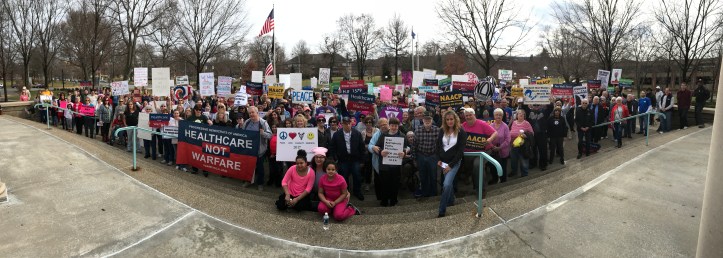
We had 275 people at our Courthouse. Speakers were Don Siegel, an Intl VP from IBEW, our Central Labor Council president, our NAACP president, our PDA president (me), our peace group president, our NOW president (who is also a CLUW coordinator), and a local African American teacher who also wrote a hit song in the early 70s .

The event was MC’d by the chairperson of the Labor Council’s Community Services Committee & me(he is also chair of out Moral Mondays Coalition, which sponsored the event). The picture was taken by the newly elected secretary of our newly reconstituted Young Dems chapter.

Our event was pretty much a big love fest, creating a real feeling of community. 30 people followed us to a local restaurant to break bread together & get to know us. It’s one of the best things we’ve ever done.

I just wanted you all to know.

Love & solidarity forever

SPEAKERS LIST

Don Siegel, Intl VP IBEW

Rick Galiano, President Beaver-Lawrence Central Labor Council, AFL-CIO

Will Sallis, President Beaver County NAACP

Tina B Shannon, president 12th Congressional District Chapter Progressive Democrats of America

Melvin Steals, local retired educator & community leader

Janet Hill, president Beaver County NOW

Nancy O’Leary, president Beaver County Peacelinks

Mark Benkart, chairperson Moral Mondays Coalition of Beaver County & Chairperson of Beaver-Lawrence Labor Council’s Community Services Committee

Our event was pretty much a big love fest, creating a real feeling of community. 30 people moved to a local restaurant to break bread together. It’s one of the best things we’ve ever done.

Republicans Have No Replacement for Affordable Care Act

Letter:

This is why Republicans can’t find a replacement for Obamacare

 A key reason the Republican Party is having such a hard time with the replacement part of “repeal and replace” is that Obamacare is virtually the same privatized mandate plan it pushed for since President Richard Nixon first proposed the National Health Strategy in 1971 then again in 1974. Then the GOP revived its privatized mandate plan again in 1993 with then-Senate Minority Leader Bob Dole helping to propose the Health Equity and Access Reform Today act or HEART as the alternative to the proposed single-payer plan Health Security Act of 1993 — commonly known as “Hillarycare“ — and then again when then-Gov. Mitt Romney proposed — and succeeded in implementing — the Patient Protection and Affordable Care Act of 2006 in Massachusetts.

Today’s Affordable Care Act is very similar to the privatized mandate plan the Republicans pushed for 40 years. President Barack Obama — as a compromise to have basic health reform passed — used this same GOP blueprint with one significant change: adding a public option alongside the GOP’s privatized mandate plan (basically, Obama proposed adding an option to join a form of Medicare).

Eventually the public option was stripped out of the 2010 ACA bill in further compromise to attract bipartisan support for the bill, leaving in its place the very plan that the GOP wanted and pushed for decades. Unfortunately, the ACA did not receive a single vote from the Republican Party that created the plan’s primary concepts as alternative to a single-payer — “Medicare for all” — type of system.

As a result, the GOP’s repeal and replace position backs it into a challenging corner. It has no real replacement plan because the ACA is essentially the privatized mandate it has pursued for so many years. The only possible alternative to a 40-year-old GOP plan would be reverting to the old system, leaving millions of people without full coverage or proper health care. Even those with coverage — perhaps through their employers — could then once again have a cap on lifesaving treatments, such as those for cancer, and thereby reinstating the privatized insurance “panels” deciding the profitability of patient treatment versus patient outcomes.

Since the Republicans will not likely propose a single-payer program, that only leaves tweaking the current Obamacare plan. However, if they instead repeal with no replacement they risk a collapse of the system as insurers pull out of the program with a result that could worsen the health of millions of Americans, dramatically raise health care costs and move America further away from the patient-centric health system that is so much more successful at a lower cost than those of 36 other countries.

— Michael Buxbaum, Chicago

Rep. Rothfus Votes to Allow Cuts to Social Security, Medicare, Medicaid


Congressional Progressive Caucus: House GOP Vote Twice Within 24 Hours to Allow Cuts to Medicare, Medicaid and Social Security


January 13, 2017

WASHINGTON, D.C.– Congressional Progressive Caucus Co-Chairs Rep. Raúl M. Grijalva (D-AZ) and Rep. Keith Ellison (D-MN), and First Vice Chair Rep. Mark Pocan (D-WI) issued the following statement after the House GOP Majority voted twice against CPC’s amendment to block cuts to Medicare, Medicaid, and Social Security benefits.

“House Republicans voted not once, but twice to block the CPC amendment to prevent cuts to Medicare, Medicaid, and Social Security. President-elect Trump promised at least 13 times during his campaign he would not cut Social Security, Medicare, or Medicaid benefits. The President-elect vowed to support these programs that American families depend on, so why won’t House Republicans vote to protect these earned benefits?”

Last night, the House GOP Majority Republicans blocked the amendment for consideration in Rules Committee. Today, the House GOP Majority also defeated an attempt to bring up the amendment for a vote in the full House. A copy of the CPC “No Benefit Cuts” amendment can be found here.

List of Groups Supporting this Amendment: AARP, Alliance for Retired Americans, AFL-CIO, International Union, United Automobile, Aerospace & Agricultural Implement Workers of America (UAW), American Federation of State, County and Municipal Employees (AFSCME), Social Security Works, Paralyzed Veterans of America, Economic Opportunity Institute, Progressive Democrats of America, People Demanding Action, Progressive Change Campaign Committee, CREDO Action, National Nurses United, Latinos for a Secure Retirement

Cosponsors (48): Pocan, Ellison, Grijalva, Lee, SchakowskyTonko, Nadler, Wilson, Cummings, Wasserman Schultz, Carson, Holmes Norton, Cohen, Garamendi, Watson Coleman, Huffman, Nolan, Raskin, Espaillat, Foster, Pingree, Meng, McGovern, Pascrell, Bonamici, Clark, Lieu, Cicilline, O’Halleran, Beatty, Boyle, DeFazio, Green, Jeffries, Moore, Kildee, Sánchez, Takano, Frankel, McCollum, Robert A. Brady, John Conyers, JR., John Lewis, Michelle Lujan Grisham, Serrano, Carolyn Maloney, Sean Patrick Maloney, Judy Chu, Ted Deutch, Tim Walz and Dina Titus.

rothfus-grin

The Congressional Progressive Caucus (CPC) is the largest values-based caucus within the House Democratic Caucus, with over 70 members standing up for progressive ideals in Washington and throughout the country. Since 1991, the CPC has advocated for progressive policies that prioritize working Americans over corporate interests, fight economic and social inequality, and promote civil liberties. The CPC champions progressive policy solutions like comprehensive immigration reform, a $15 national minimum wage, fair trade, gun violence reform, debt-free college, and making the federal government a Model Employer.

###

Rep. Rothfus Votes to End Rules Protecting Water, Air, and Workers

water-protectionJUST HOURS AFTER passing the very first bill of the new Congress on Wednesday — one designed to roll back a range of environmental and consumer regulations — House Speaker Paul Ryan, R-Wisc., celebrated with a corporate lobbying firm at a fundraiser for his campaign committee.

The vote on the Midnight Rules Relief Act of 2017 took place at 4:48 p.m. on Wednesday. The fundraiser, at the offices of the BGR Group, a major lobbying firm, started at 7 p.m.

The bill would amend existing law to allow Congress to repeal en masse multiple regulations finalized since the end of May last year. The law is believed to be aimed at rolling back a rule designed to deter mining companies from polluting drinking water sources, rules designed to curb hazardous methane emissions from fracking sites, and a rule that extends the threshold for overtime pay to workers, among others.

BGR Group represents Chevron, Celgene Corp, the Consumer Technology Association, Eli Lilly & Co., Gilead Sciences, Johnson & Johnson, Raytheon, Southern Company, and Xerox, among many other clients, and has helped a number of clients work on regulatory policy.

The high-dollar event had a $10,000 price tag for each sponsor of the event, $2,500 for each political action committee, and $1,500 per individual, according to an invitation obtained by the Center for Media and Democracy and shared with The Intercept.

Bridget Gribbin, a fundraiser for Speaker Ryan who helped organize the event, declined to comment, but a representative of the BGR Group confirmed that Ryan  attended.

Lobbyists are particularly eager to use the newly empowered Republican Congress to sweep away the environmental, financial, labor and consumer-oriented rules implemented by the Obama administration.

The U.S Chamber of Commerce, the lobbying trade group for large firms like Google and Goldman Sachs, made the Midnight Rules Relief legislation a top priority. Other trade groups representing a wide swath of business interests, such as the National Federation of Independent Businesses, have also lobbied in support of the measure.

The first week of legislative action for the 115th Congress began with a thwarted attempt by Republicans to gut the Office of Congressional Ethics, an independent body that investigates misconduct, in particular between lawmakers and lobbyists. After a public outcry, the GOP dropped the attempt to weaken the office.

rothfus-grin

The link to the Roll Call on this vote is here: http://clerk.house.gov/evs/2017/roll008.xml

Wilkes Barre Labor Council and Two USW Locals Endorse Medicare for All

medicareforallWilkes Barre Labor Council and Two USW Locals Endorse HR 676

The Greater Wilkes Barre Labor Council and two United Steelworkers locals in Wilkes Barre, Pennsylvania, have endorsed Congressman John Conyers’ HR 676, national single payer health care legislation, Expanded and Improved Medicare for All.

The Labor Council, comprised of 47 locals from 28 unions representing 10,000 members, endorsed HR 676 at their monthly meeting on December 22, 2016, becoming the 152nd central labor council to take this action.

The two USW locals together have more than 1,650 members.  USW Local 5652, an amalgamated local, represents workers in a variety of jobs including making shelving and heating cabinets for restaurants, manufacturing gears for airplanes, repairing utility trucks, and working at a correspondence school.

USW Local 15253 represents workers who do heavy highway construction from the Maryland border to the New York border and from the New Jersey border to the middle of Pennsylvania.

William Herbert, Treasurer of Local 5652 said “We’ve been getting ripped off by insurance companies.”  He told of the crises faced by even heart attack patients who are confronted with demands for up front payments as high as $1,700.  Herbert worked successfully to get his Congressperson, Matt Cartwright, to sign on to HR 676.

Herbert made the following statement on behalf of his local:

“USW Local 5652 passed a resolution calling on Congress to pass H.R. 676. For too long the insurance and pharmaceutical industries have been charging outrageous prices for their products. The bill would extend Medicare to everyone and eliminate co-pays and deductibles. We feel that this is the only way to insure health care for all Americans. If this bill passed, we would no longer need to negotiate for health care in our contracts. If an employee gets laid off his insurance would continue at the same level. We urge all Americans to call their Representatives in Congress and the Senate and ask them to pass H.R. 676.”

The HR 676 endorsement resolutions were signed by President Dave Brandt of Local 5652 and President Joseph M. Padavan of Local 15253.  Padavan is also president of the Greater Wilkes Barre Labor Council.

Issued by:
Kay Tillow, Coordinator

All Unions Committee for Single Payer Health Care–HR 676
c/o Nurses Professional Organization (NPO)
1169 Eastern Parkway, Suite 2218
Louisville, KY 40217
(502) 636 1551