All posts by randyshannon

PA-12 Democratic Primary Debate in Johnstown

Democratic PA-12 Candidates McClelland and Hugya Face Off in Debate
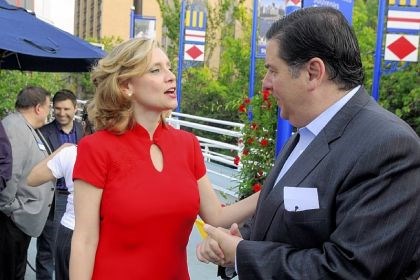
PA-12 Democrat candidate Erin McClelland with Pittsburgh Mayor Bill Peduto

With just over a week left until the primary election, the 12th Congressional District’s Democratic candidates Erin McClelland and John Hugya took the stage at The University of Pittsburgh-Johnstown to debate the issues and try to set themselves apart from each other.

And boy, did they.

McClelland, a healthcare professional specializing in orthomolecular addiction treatment, quickly established her bona fides as a policy wonk and portrayed herself as forward-looking problem-solver from the private sector.

Hugya, a retired Marine Colonel and former district director for the late Congressman Jack Murtha, spoke solemnly about veterans issues and proudly promised to put his Murtha-modeled pork prowess to work for voters.

These two different perspectives led to two varying lines of answering the questions put to them by the moderator and the audience.

Job Creation and Economic Development

Hugya explained his jobs platform as following the example set by Congressman John Murtha, who Hugya said was unfairly chastised for his earmarks. “All the jobs we have in Johnstown came from earmarks,” Hugya said. “Look at China, they’re building everything. Ten years ago, you look at a picture of Peking, you saw a rickshaw and a bicycle. They have pulled ahead and we have not done anything in 20 years.”

McClelland said that the number one thing she would want to do in Congress is vote for a jobs bill, explaining that we currently have “policies that support free trade but not fair trade,” and “we need to change that so we can bring jobs back home.” And, McClelland added, when you bring jobs back home, you expand our tax base and begin to solve a lot of our economic issues in that way.”

Both candidates said that infrastructure maintenance and construction were crucial to economic development. McClelland said that currently “we are neglecting [our infrastructure] to the point of complete disrepair, and if it keeps deteriorating, rebuilding will cost more down the road and affect my son’s generation.”

Hugya, however, explained that in his view, “we need money disbursed from commercial banks to get our infrastructure going,” namely by passing a 21st century Glass-Steagall Act to keep traditional banks separate from investment banks and hedge funds.

Natural Gas

McClelland began her discussion by saying that “the biggest issue we have [at the federal level] is closing the Halliburton loophole.” The Halliburton loophole allows hydraulic fracturing companies to withhold details about the makeup of their fracking fluid.

“You know what’s in your pastry at Giant Eagle, but doctors don’t know how to treat health issues related to fracking because they don’t know the chemicals,” McClelland explained.

Hugya focused on the need to create more jobs in the district because “they don’t have coal mines anymore in the western part of the state.” Hugya said that people in Beaver County need a commitment from the drillers as much as they need health protections.


Coal and the EPA

McClelland began her answering by saying that “I have a 13 year old boy with asthma, and one of the most terrifying moments of my life was watching my son grasp for air.” And according to McClelland, the incumbent Congressman, Keith Rothfus, is a “climate change denier.”

McClelland proposed incentivizing companies who innovate on pollution reduction, and pointed out that America’s trade partners are “literally dumping garbage into the air.”

“We have to implement CO2 regulations based on a process of continuous improvement… not incentivize our trading partners to keep polluting,” McClelland said.

Hugya responded to the question by attacking the regulations on emissions from new power plants.

“The rules and regulations are done within the EPA,” said Hugya. “That’s not the law. They can work out any kind of deal they need to make jobs happen. They got to be able to work out a deal not to hurt the people and not to hurt the atmosphere.”

Reforming Social Security and Medicare

According to McClelland, “this is our biggest issue.”

“Medicaid and Medicare costs are exploding at twice the rate of our GDP,” McClelland said. “If you want to solve that problem, that solution is error reduction. We have 300 million medical errors every year,” which McClelland said is a massive part of the cost problem.

“Keith Rothfus says the only answer to not killing patients is tort reform,” McClelland said. “He wants to change the way you can sue after a medical error. I taught hospitals how to reduce medical errors and save lives.”

Hugya said that his “proposal to keep the fund perpetuated is to lower the percentage that we’re all paying, but pay the whole year through.” That way, Hugya said, “the system would not run out of money. And we need to eliminate fraud.”

How to Keep People in the District

For Hugya, the best solution to the district’s brain drain is simple: “earmarks.”

“We have to have the jobs here for them to come back to,” he said.

McClelland said that her solution would be the same thing that kept people in the district for decades: “a good reasonable wage, good schools, and a good home life with maybe enough left over for a ball game.”

McClelland added that Pennsylvania has “zero Congressmen and zero Senators who are female in a state that is 52% female,” and she hoped to be an inspiring example for Keystone State women.

Minimum Wage Bill

Hugya said that he finds the $10.10 minimum wage bill to be “questionable,” adding that “I remember being paid $1.37 when I got out of the military.”

“If you give them the $10 dollars, and they’re living in public housing, the public housing goes up,” Hugya said. “It’s a good thing to say it, but it’s not going to increase the economic welfare of people.”

McClelland said that raising the minimum wage “is an issue of being a human being.”

“I own a business and the lowest paid employee makes $13.25 an hour,” McClelland said. “When people go to work and put in a hard day’s work, they should have enough money to live off of.”

Affordable Care Act

When asked if she was in favor of keeping, reforming, or repealing Obamacare, McClelland said she “absolutely support[s] maintaining the Affordable Care Act.”

“There are now 8 million more people in this country that can live their life knowing they can rely on the security of health insurance,” McClelland said, adding that health security is “a fundamental human right.”

Hugya spent most of his answer comparing Obamacare to TriCare, the health care program for military personnel and dependents. As to Obamacare generally, Hugya said that at this point “we have to have it, but we have to get into certain sections of it, test it out like we did Tricare, [and] if it’s no good fix it.”

Veterans

The veterans portion of the debate got heated quickly.

Hugya began by saying that “Mr. Rothfus doesn’t understand the difference between a corporal and a colonel.”

He then demanded to know how many members of McClelland’s family were in the military. McClelland said that her two grandfathers had served.

Hugya awkwardly responded with, simply, “okay,” and the moderator, Ray Wrabley, broke in after a few awkward seconds of silence, saying “moving on…”

Improving Education

Hugya began by saying that “from my past experience, I can tell you that in the 12th Congressional District we had before, it’s where the best schools were,” but he wasn’t sure if it was due to “smarter kids or teachers.”

“I know teachers don’t like to get evaluated, but I know that I had to get evaluated in a fitness report all my life,” Hugya said. “They worry about making jocks out of them and not making them technically qualified. You get a job because you’re damn qualified.”

McClelland took on the way we currently analyze schools, and what she sees as the perverse incentives of federal funding.

“We test our students to try and ascertain how they are working, and then bureaucrats in D.C. use that data to punish schools and teachers and take money away, and who suffers? It’s our children,” she said.

“We need to use the data to make improvements,” McClelland added. “When we use testing, we should ask whether student has shown continuous improvement.”

Foreign Policy

McClelland said that we are currently “in a pattern of reactionary foreign policy, which is a dangerous place to be because it allows our enemies to dictate our decisions.” McClelland also criticized the manner in which Congress handles defense spending.

According to McClelland, Congress fails to do defense spending “in a modular fashion, which is what businesses use.” Instead, McClelland said we are spending in a way that asks for “a bunch of this and a bunch of that, but not what our people need.”

Hugya began his response by talking about his former boss, saying “Mr. Murtha was right about Iraq,” and that after Murtha criticized President Bush’s decision, “you have no idea the hell that happened on him. They came after him, me, and our whole staff.”

Hugya was referencing the various ethics investigations that we brought against Murtha. He also added that “I carried a top secret clearance in the Marine Corps and on the Hill, and I can tell you that you have no idea what went on, but Mr. Murtha was not happy.”

Finally, Hugya went on a tirade against the incumbent 12th District Congressman, Keith Rothfus, saying he “isn’t smart, his staff is,” and that Rothfus “pretends he’s a military guy, but he is not.”

“Keith has never had his hands dirty,” Hugya said. “I worked in a coal furnace. I know what it’s like to work hard.”

Best Concluding Remarks

Each candidate gave a conclusion summarizing their experience, and each candidate had a memorable one-liner.

Hugya ended by saying that “I’ve fought with some of you before, and I’ve drank with some of you before. What you see is what you get.”

McCelland said that “we need to mobilize the greatest weapon in our economic arsenal, and that is the American middle class.”

Post-Debate Conspiracy Theory

After the debate, I was walking toward McClelland’s campaign manager, Adam Stokes, when Colonel Hugya approached him and accused McClelland of wearing an “ear bud” during the debate. Hugya said to him that her answers were too quick and cited too many statistics.

While I did not hear the entirety of the conversation, McClelland’s campaign manager confirmed to me that Hugya was not at all kidding around, but was making a serious accusation.

McClelland’s campaign manager said the accusation was “ridiculous.” A quick scan of McClelland’s ear revealed no ear bud.

Continue reading PA-12 Democratic Primary Debate in Johnstown

April Jobs Report: Bitter Sweet

April Jobs Report: Bitter Sweet

May 2, 2014

Robert Borosage

The topline of the April BLS jobs report – a better than expected 288,000 jobs added, with the unemployment rate plummeting to 6.3% – will be celebrated, particularly in contrast to the collapse of growth in the first quarter (initially estimated at 0.1% but likely negative ).   The economy has now added private sector jobs for 50 straight months.

But under the topline, the news is less cheery. The sharp decline in the unemployment rate reflects a decline of the civilian labor force of 806,000 in April. The employment-population ratio (58.9%) shows no change over the month – and has changed little over the year, remaining at levels last since in the early 1980s.

20 million Americans remain in need of full-time work. Five years into the recovery, the US has still not recovered all of the jobs lost in the recession, even as its population has grown significantly.

The good news is that the number of long-term unemployed dropped by 287,000 in April. But the long-term unemployed remain a high 35.3% of the unemployed (up from pre-recession levels of 18%).

Job growth was widespread across the economy, suggesting the recovery is taking root. But the new jobs continue to be disproportionately in lower wage industries – retail clerks, restaurants, bars, temporary help. Construction jobs rose, in part buoyed by the end of the bad weather of the first quarter. Government employed remained essentially flat.

Democrats will cheer the continuing jobs growth. Republicans will continue to rail about jobs, while blocking any measures that would put people back to work. But if this is the new normal, the young will continue to face a miserable jobs market. African-Americans will continue to suffer double-digit unemployment. Families will continue to struggle with stagnant wages. Inequality will get worse. The middle class will continue to sink.  And America will suffer a lost decade.

This is not inevitable. It is the result of a perverse failure of Congress to act. Our decrepit infrastructure is a clear and present danger to the lives of Americans and the competitiveness of our economy. (See video of Baltimore street collapsing earlier this week in a rain storm here.)

Interest rates remain near record lows. Construction workers continue to need work. There is still not a better time to rebuild the country. Yet, Republicans in the Congress continue to block every initiative to add jobs. Indeed, the Congress now must scramble simply to keep the Highway Trust Fund from going broke at the end of August. They are not only refusing to throw lifelines to those who are drowning; they are cutting the lines that exist.

Continue reading April Jobs Report: Bitter Sweet

Moral March on Raleigh Draws 100,000

Thousands March in Downtown Raleigh

Thomasi McDonald
News Observer
February 8, 2014

Moral March on Raleigh Feb. 8 th

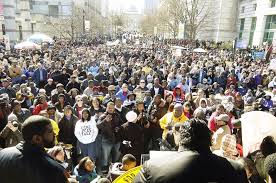
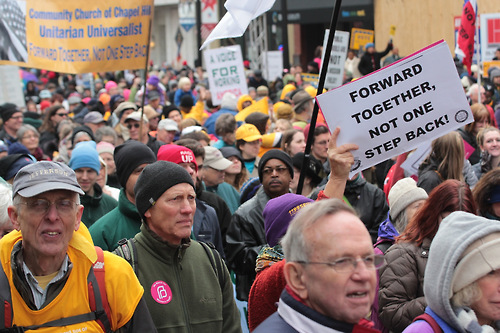
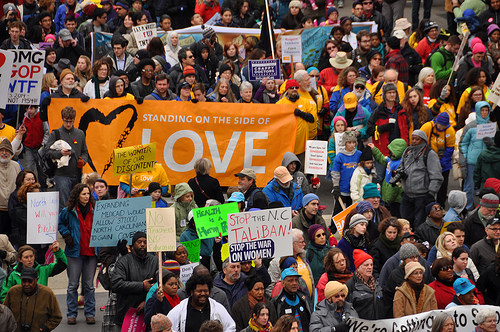
RALEIGH — State NAACP President William J. Barber II laid out goals for a diverse coalition of groups Saturday afternoon at a rally attended by thousands of people from all over the state and the nation who marched, sang, chanted, cheered and even danced through downtown Raleigh.

Organizers said the “Mass Moral March” was intended to push back against last year’s Republican-led legislation in North Carolina.

Barber called for well-funded public education, anti-poverty policies, affordable health care for all that includes the expansion of Medicaid, an end to disparities in the criminal justice system on the basis of class and race, the expansion of voting rights and “the fundamental principle of equality under the law for all people.”

Rev. Barber (back) addresses Moral March

“We will become the ‘trumpet of conscience’ that Rev. Dr. Martin Luther King Jr. called upon us to be, echoing the God of our mothers and fathers in the faith,” he said. “Now is the time. Here is the place. We are the people. And we will be heard.”

The mammoth crowd that gathered in downtown Raleigh represented a variety of causes that joined last year’s Moral Monday protests, but the event also brought in groups and individuals usually on the fringes of state politics.

Susan Fariss of Mocksville drove three and a half hours to hold up a sign supporting the legalization of medical marijuana.

“I have several health problems that cause me pain,” Fariss said. “I have tried Vicodin and different muscle relaxers, but no matter what I’ve tried, I’m in pain. My doctor told me he could not prescribe it, but he recommended medical marijuana.”

Holiday Clinkscale, 60, of Raleigh climbed atop a big potted plant on Fayetteville Street and twirled an American flag above his head. He wore a leather jacket decorated with red, white and blue stars and stripes. Clinkscale wore the regalia on behalf of “depressed” African-American men.

“Black men in Raleigh couldn’t wear red, white and blue after the Civil War when we were freed, or they would have been executed,” he said. “You see a lot of black men here today looking depressed.”

mm9Wake County attorney Daryl Atkinson was at the march, but the look on his face was one of purpose.

Atkinson, who volunteered to represent some of the people arrested at last year’s Moral Monday protests, said he had a long list of reasons for attending the rally.

“Everything from trampling on our voting rights, to the repeal of the Racial Justice Act, not extending unemployment benefits and not expanding Medicaid. The list goes on,” he said.

Hannah Osborne, a student at N.C. State University, said she came to the rally Saturday morning to “promote women’s rights and a woman’s right to choose.” She and her father, Dale Osborne, a pastor at Binkley Baptist Church in Chapel Hill, held purple signs that read “Stop the war on women.”

mm3The march, known as the Historic Thousands on Jones Street, or HKonJ, was organized by the state NAACP and Barber. He and his group drew national attention last year for organizing the Moral Monday demonstrations to protest what they called “immoral” legislation enacted by Republican leaders including Gov. Pat McCrory and House Speaker Thom Tillis. Those policies included new abortion restrictions, an election-law overhaul that will require voter ID and cuts to unemployment benefits.

The McCrory administration tried to block previous Moral Monday events. In late December, a Wake County District Court judge overturned a decision by the administration to keep demonstrators off state Capitol grounds and confine the events to Halifax Mall, a big grassy area enclosed by the state office and legislative buildings.

Continue reading Moral March on Raleigh Draws 100,000

Beaver County MLK Coalition to Join Moral March in Raleigh

Moral March On Raleigh Expected To Be One Of The Largest Southern Marches Since Selma In 1965

Moral Monday Rally at NC Capitol in Raleigh

Posted: February 4, 2014 by laborradio

Link to article

By Doug Cunningham

One of the biggest southern marches against state policies since Selma in 1965. That’s how North Carolina NAACP President Rev. Dr. William J. Barber the Third describes the Moral March On Raleigh this coming Saturday.

[Rev. Dr. William J. Barber III]: “The Moral March on Raleigh is part of the anti-racism, anti-poverty, pro-labor deeply moral Forward Together movement. And with diversity and solidarity, thousands will stand against what we believe are morally indefensible, constitutionally inconsistent and economically insane policies being passed by our North Carolina General Assembly and signed by the governor of this state.”

Saturday’s march is part of the Moral Mondays Forward Together Movement, which last year resulted on a thousand civil disobedience arrests at its Moral Mondays protests a the North Carolina capitol.

Beaver County MLK Coalition to Join Moral March in Raleigh

Beaver County Protest Vigil against PA voter ID law

A coalition of activists from the Beaver-Lawrence Central Labor Council, the NAACP, and the 12th CD Chapter of Progressive Democrats of America will travel to Raleigh, NC this Friday for a march and rally. They will march in solidarity with the people of NC who are pushing back against the anti-democratic and austere laws passed by the right-wing NC legislature.

The Moral March on Raleigh will mark a new high point in the Moral Monday’s movement that has seen thousands of civil disobedience arrests in protest of extremist legislation passed by the Tea Party controlled legislature.

The Beaver County MLK 50th Anniversary Coalition organized buses to the Washington DC march and rally this past August.

For more information on the Moral March in Raleigh go HERE.

Harrisburg Rally Protests anti-Union Bill

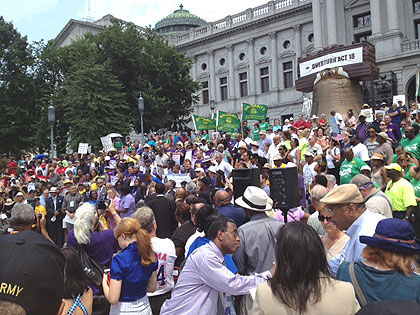
Thousands jam Pennsylvania’s capital to protest union-killing bill

january 28 2014pennCapitolProtest520x313

HARRISBURG, Pa.– Thousands jammed the streets around the State Capitol building here today to protest the latest in a sting of attempts by state Republicans to kill union rights for public workers and eventually all workers in Pennsylvania.

Busload after busload of workers arrived from around the state, filled the streets and marched into the Capitol building itself where, reminiscent of the historic Wisconsin protests, they packed the rotunda in the center of the building.

They protested House Bill 1507, what the right wing American Legislative Exchange Council (ALEC) and theKoch brothers call a “Paycheck Protection” bill. They have already been targeting direct mail into the state to spread lies in support of this bill, claiming that taxpayers are paying for union dues collection for public employees, and that teachers and state workers are forced to contribute to political and legislative activism.

The facts are clear, the Pennsylvania AFL-CIO says, even though you won’t hear them in the commercials that the Koch brothers are financing. Automatic payroll deduction of dues is not mandated by any law, rather it is bargained for during contract negotiations. This deduction does not cost taxpayers money. Unions already agreed to reimburse the state for costs associated with deductions of PAC funds, but according to the State of Pennsylvania, there is no measurable cost to be reimbursed.

The Republican goal is obvious, unions say. The legislation would force unions to spend resources to collect union dues, and make it nearly impossible to collect the fair share fees that non-members must pay to cover their union representation. At the end of the day that means unions will be weakened, and have less ability to advocate for employees in the workplace and in the legislature. This would open the floodgates for a wide range of anti-worker legislation that would be sure to follow.

“There is no doubt that the passage of HB 1507 would mean that Pennsylvania would become the next right to work state” the Pennsylvania AFL-CIO said in a statement it issued. ” Don’t be silent on this issue. We expect this bill to move very quickly, with significant resources flooding into Pennsylvania to back this latest attack on the middle class.”

Photo: Frank Snyder, Pennsylvania AFL-CIO