Pennsylvania’s Democratic governor has earned a reputation for being sure-footed in a crisis.
Photo: Josh Shapiro speaks during campaign event in Scranton, Pa., April 16. PHOTO: MATT ROURKE/ASSOCIATED PRESS
By Salena Zito
Wall Street Journal
April 29, 2024 – Lyndora, PA – Gov. Josh Shapiro walks down the labyrinth of narrow concrete stairs and hallways through Cleveland-Cliffs’ Butler Works steel mill in Western Pennsylvania. Reaching the podium, he raises his arm in victory when Jamie Sychak, president of United Auto Workers Local 3303, notes that a feared shutdown of the plant has been averted.
“It shows what is possible when we come together—Democrats and Republicans, union leaders, and CEOs—and go in the same direction,” Mr. Shapiro says. He praises the work the union’s members do at the only domestic mill that produces the grain-oriented electrical steel used to produce distribution transformers. The mill was set for extinction because of a proposed federal rule mandating that manufacturers use amorphous steel instead.
The union and Cleveland-Cliffs CEO Lourenco Goncalves lobbied local, state and federal elected officials, but only after Mr. Shapiro appealed to the White House did the rule change. “They heard us, loud and clear, and they worked with us to revise this final rule,” Mr. Shapiro tells the crowd. Having the president’s ear is a big advantage for a swing-state governor.
Joe Biden carried the Keystone state by 1.1 points in 2020. Four years earlier, Donald Trump won by less than a point. When Mr. Shapiro won the governor’s office in 2022, his margin was nearly 15 points. That was in part because his opponent, state Sen. Doug Mastriano was a weak candidate. But it didn’t hurt that Mr. Shapiro is “so damn talented,” as GOP strategist David Urban puts it. The latest polling by Quinnipiac University shows Mr. Shapiro has a 59% approval rating. Mr. Biden’s figure in Pennsylvania is 39%.
Mr. Shapiro has developed a reputation for being competent, pragmatic and sure-footed in a crisis. “My job is to keep people safe, and my job every day is to get s— done,” he says in an interview. “Particularly in a time of emergency, you need to take control of the scene, you need to assess the damage and what is needed to be done, and then put your team in place to go and do it.”
After the February 2023 Norfolk Southern train derailment across the state line in East Palestine, Ohio, spilled a cocktail of hazardous chemicals, the Pennsylvania governor was on the ground in Beaver and Lawrence counties, as well as in Ohio at Gov. Mike DeWine’s invitation, to see firsthand what had happened.
“I’ll never forget,” he says. “I knocked on the door of a home in Darlington Township and the woman in the home invited me in. And obviously they were scared, they were worried about their livestock, and she had also shared with me—and this has stuck with me—she had to leave her home for about two days and in the time she left, she lost a batch of eggs.”
U.S. Rep Summer Lee participates in a Democratic candidates’ forum in Pittsburgh, Jan. 28, 2024
The three wasted no time describing their differences and why their opponents were wrong for the job.
By Kim Lyons
Penncapital-Star
JAN 28, 2024 - PITTSBURGH— The three candidates seeking the Democratic nomination for Pennsylvania’s 12th Congressional District came out swinging during a forum at Carnegie Mellon University on Sunday, not only demonstrating their differences but their willingness to criticize their fellow Democrats in areas of disagreement. And there were plenty of areas of disagreement.
U.S. Rep. Summer Lee (D-12th District), Edgewood Borough Councilmember Bhavini Patel and Laurie MacDonald, president and CEO of the Pittsburgh-based nonprofit Center for Victims, took the stage at the forum moderated by journalist Chris Potter of WESA-FM, Avalon Sueiro, president of the CMU College Democrats, and Heidi Norman, who works for the City of Pittsburgh and is a Democratic committeewoman in the city’s 14th Ward.
The first questioner asked the candidates to offer their thoughts on the role of a Congressional representative in navigating the complex situation in the Middle East. Lee has received criticism for her position supporting a ceasefire in the Israel-Hamas war.
MacDonald said her father was an immigrant from the Middle East, who wanted to “assimilate” and to have people judge him on who he was. She said she was passionate about putting together a coalition of peacemakers in the region, although recognized it would not be easy. “I think if we work together and continue with the Abraham Accords, and get that process going that we can find room for everybody in this world.”
Patel criticized Lee for not attending local rallies with the Jewish community in the days after the Oct. 7 Hamas attack on Israel, and for tweeting out information about a hospital bombing in Gaza that was later found to be erroneous. “To me that’s stoking hatred, that’s stoking antisemitism and it puts people in our communities in a tragic, dangerous position,” Patel said. “That is unacceptable.”
Bhavini Patel participates in a Democratic candidates’ forum in Pittsburgh Sunday Jan. 28, 2024 (screen capture) Lee replied that it was a subject that elicits pain in multiple communities. “The reality is, is that peace— a just and lasting peace— has to start with centering all of the folks who are impacted, and we have to be incredibly clear that there is no pathway to peace if we can only talk about security for one community, or as we continue to pit communities against each other,” she said. “Peace and justice and liberation and accountability for Israelis is not counter to peace and justice for Palestinians or Muslims or for Arabs.”
She added that “anybody who would use this issue as a political wedge is not serious and does not understand the gravity of the situation.”
The two sparred again on a question about the role and responsibility of the United States in geopolitical conflicts around the world.
Patel said as someone with a degree in international relations she has spent time “navigating these issues and getting a sense of what’s going on.” She noted that Lee had tweeted information that the president doesn’t have the authority to authorize airstrikes in the Red Sea against the Houthi rebels, who have attacked ships in the area and disrupted global commerce.
“When we’re unable to actually take these foreign policy concerns in a serious way, and engage with them in an intellectual way, and we’re just focused on posting, rather than understanding the challenges, I think that it sets us up for challenges,” Patel said. “I think it puts us in a precarious position as a country.”
Lee countered that her preference was to center American diplomacy in global conflicts. “The reality is that while an international studies degree is important, I have a law degree,” she said. “And no, the president does not have the authority to declare war or offensive strikes without the prior authorization of Congress.” Patel attempted to interrupt but Potter admonished her to respect the other candidates’ time.
Despite the best efforts by moderators to prevent delays and interruptions, the audience was fairly vocal throughout the event, alternately applauding or heckling the candidates based on their answers. At one point during a response to a question about the role of Congress in supporting gender-affirming care, MacDonald reacted directly to the audience booing her.
“My opponent — the people who live in her district have no families, they live in squalor, they don’t have…” MacDonald began, before audience members shouted back. “You think you know, right, well guess what, I worked there. I have helped those communities.”
When the heckling had died down, MacDonald added, “I don’t need to take that. My record speaks for itself. I’ve walked the walk, I’ve talked the talk, I help families. I help everybody. I don’t have a prejudiced, white, black, purple, pink bone in my body. I love everybody. And I love all of you too, even if we disagree.”
Laurie MacDonald participates in a Democratic candidates’ forum in Pittsburgh Sunday Jan. 28, 2024 (screen capture) The candidates were asked how they would engage younger voters, and in her response, Patel continued a line of criticism she has levied at Lee before: that she thinks the progressive Democrat does not fully support President Joe Biden’s agenda.
“With the Supreme Court overturning affirmative action, Roe v Wade, it really does come down to unequivocally standing with our president,” Patel said. “We really have zero room for error, and heading into the 2024 general election when we think about the future of this country, when we think about the future of our democracy, it really is all hands on deck, and it’s going to come from Western Pennsylvania. It’s going to be Pennsylvania that drives that conversation and drives that turnout and we need to start taking that seriously.”
Lee said the Democratic coalition of 2024 would include Black and brown voters, young voters and progressive voters, “precisely what Western Pennsylvania looks like,” noting that progressives had won decisive victories in recent elections in that end of the state.
“We actually need people who are going to be bold and push the president— just a little bit— so that we can get to [student] debt cancellation,” Lee said. “We need young people who are going to push the administration on climate change, because we have to meet the scope and the scale of the urgency of the moment. That energy is led by young people.”
PA Democratic Senator John Fetterman on December 6 defended ‘reasonable’ border talks. This follows his staunch support for Israel’s war in Gaza, which has also befuddled some of his typical allies on the left.,(Photo credit: Politico)
“I’m not a progressive. I’m just a regular Democrat.” Fetterman is in the first year of a six-year term. He has time to repair relations with progressives or sever ties altogether. At this point, the latter is rapidly happening anyway.
By Ross Barkan
Political Currents
Dec 21, 2023 – Labels in the American political system have always been slippery. Progressive, liberal, leftist, conservative, hard-right, and hard-left can mean very different things to very different audiences. MAGA, perhaps, offers the most clarity—an unabashed supporter of Donald Trump. But even then, within the vast array of Republicans who back Trump, are disparate political views. Some want a national abortion ban. Some, like Trump himself, don’t quite know what they want.
Others strive to shed labels altogether. Many politicians, for somewhat obvious reasons, embrace them when they’re convenient—rounding up votes in primaries, appealing to activists, and raising cash—and abandoning them once they become a burden. The burden, or perceived burden, arrives when a politician has to campaign in a competitive general election. John Fetterman, the famous senator from Pennsylvania, is deep into his rebrand, and seemingly considering how to position himself when he faces voters again in 2028. His campaign proudly promoted a clip from the 2022 Democratic primary when he told a journalist who asked if he’s a progressive that “no, I’m just a Democrat that has always run on what I believe and know to be true.” Interestingly enough, Fetterman’s social media account doesn’t quote this verbatim. Instead, the post above the clip reads “I’m not a progressive, I’m just a regular Democrat.”
It’s a notable approach from a politician who has caught heat, of late, for his hawkish views on Israel. Fetterman, unlike several other Democratic senators, has not called for a ceasefire or denounced the Israeli military for slaughtering thousands of civilians in Gaza. As pressure has grown on the Biden administration to do more to curb Benjamin Netanyahu’s military ambitions, Fetterman’s rhetoric has been mostly indistinguishable from Mike Johnson or any other conservative Republican. His simultaneous embrace of tougher immigration laws has led NBC News to label him a “maverick” for breaking with progressive Democrats.
Calling Fetterman a maverick is understandable, if inaccurate. A maverick politician—few hardly exist anymore, and John McCain barely qualified—will break with their party on major policy questions. Imagine a Republican who loudly supports abortion rights or a Democrat who denounced the first or second impeachment of Trump. Strengthening the border doesn’t count; Democrats themselves have a range of views on immigration and Biden himself has pushed for more border fencing of late. Fetterman, unlike Trump, has not said immigrants are poisoning the blood of America. That would be one way, in a far darker manner, to become a maverick. And defending Israel at all costs certainly doesn’t qualify. The Democratic Party, these days, might be less hawkish on Israel than the GOP, but staunch Zionists occupy all the leadership posts. There is no daylight between Fetterman and Hakeem Jeffries, the House minority leader, or Chuck Schumer, the Senate majority leader, when it comes to Israel.
But Fetterman is punching left. There’s nothing new to this—see Sister Souljah—and Fetterman might even be earnest. His staff has certainly argued his views on Israel are decades-old, solidified in graduate school. What is more obvious, and helpfully collated on X, is that Fetterman used to happilyidentify as a progressive. He called himself one in 2016, 2018, and 2020. He inched away from the label in 2022, when he became the frontrunner in the Democratic primary for Senate, but never disavowed the movement of left-leaning activists and organizations that backed him earlier in his career. Fetterman ran unsuccessfully for the Senate in 2016 as a Bernie Sanders supporter and remained close to Sanders when he was elected lieutenant governor in 2018. He benefited from Sanders’ enormous network of online donors in all of his statewide campaigns. He took the Vermont senator’s endorsement multiple times and championed key planks of his platform: a $15 federal minimum wage, Medicare for All, and new wealth taxes. He never identified as a socialist or embraced the more confrontational flavor of leftist politics favored by the Squad, but he was, undeniably, a member of his party’s progressive wing.
It would have been plausible for Fetterman to back a higher minimum wage without calling himself a progressive. “I just want people to make more money and have cheap healthcare” would have been enough. “It’s common-sense,” he might have said, to “make the wealthy pay their fair share. There’s nothing progressive or liberal about that. It’s how we should run a country.” But that would have been less exciting to the donors and activists who were going to power Fetterman’s early campaigns. Fetterman wanted to raise cash and he wanted to win. Hence, the Sanders associations were useful. When Dr. Oz, in the 2022 general election, tried to scare moderate Democrats away, the pivot began. He hasn’t looked back.
If Fetterman were being honest, he could simply declare he is no longer a progressive. He could say he used to be one in 2016 and 2018 and 2020 but he feels differently now. He doesn’t like how progressives talk about Israel or the border or some other hot button issue that might matter to a cross-pressured Pennsylvanian and he’s decided he’s going to operate separately from them. He could say he used to believe in Bernie Sanders and now he’s less sure. But doing that would permanently alienate the activist infrastructure that lifted him to prominence in the first place. Fetterman probably believes this is the safer route: to state, against all available evidence, he was never a progressive. This is dishonest and, in the long run, may not even be good politics. It’s not like Trump, when he was first running for president, ever sought to hide that he used to be a Democrat or pal around with the Clintons. If anything, he used his unscrupulousness to his advantage, boasting about how easy it was for him, as a well-heeled donor, to buy Democrats off. Fetterman needn’t be so venal, but he could acknowledge the past and point the way forward.
Politically, all of this can only matter so much. Fetterman is in the first year of a six-year term. He has time to repair relations with progressives or sever ties altogether. At this point, the latter is rapidly happening anyway. For the Pennsylvania activist class, Fetterman is increasingly persona non grata. Since he also needs to appeal to centrists and Israel-supporting Jews in the Philadelphia and Pittsburgh metropolitan areas, he might not care at all. If he does go down this path, though, he’ll have to find a new way to raise cash and wrangle volunteers. There are many young people who showed up to canvass for Fetterman 2022 that will not bother for Fetterman 2028. They’ll have long memories—and other heroes by then.
Dem Governor Josh Shapiro campaigning in Beaver County
By less than 100 voters, but Dems need to get busy with new registrations.
By Chrissy Suttles Beaver County Times
BEAVER — County Republicans hit a milestone decades in the making this week.
Beaver County now has more registered Republican voters than Democrats – an inflection point in a county considered a Democratic stronghold for the better part of a century.
Pennsylvania Department of State data shows that among Beaver County’s 111,725 registered voters, 48,170 are registered Republicans and 48,079 are registered Democrats – a difference of 91 registrations. That’s 43.1% Republican voters, 43% Democratic voters and 13.9% third party or unaffiliated voters.
Beaver County has steadily grown more supportive of Republican candidates and conservative principles in recent years.
As a traditionally blue-collar county once grounded in steel and a unionized workforce, Beaver has long had more registered Democrats than Republicans. A portion of those Democrats started voting Republican in the 1980s for former President Ronald Reagan, but kept their Democratic party affiliation. Still, Beaver County voters supported Democratic presidential candidates for much of the 20th century.
That changed in 2008, when Republican John McCain outperformed former President Barack Obama in the county. In 2012, Mitt Romney bested the former president again. Former President Donald Trump beat Hillary Clinton 58% to 39% in 2016 and President Joe Biden 57.9% to 40.3% in 2020 – despite Beaver County holding a clear but shrinking Democratic majority among registrations.
The county marked another clear shift in 2016, when Republicans took the Beaver County Board of Commissioners for the first time since 1958.
Beaver County Republican Chairman Roman Kozak said Tuesday the emergent Republican majority is “validation of the hard work of our Republican elected county team.”
“Ten to 20 years ago, most of us could never imagine this happening,” he said. “From our judiciary to our county commissioners and row offices, and down to our municipal offices and school directors, Republican-led government continues to represent true Beaver County values. The people of Beaver County are telling us they want a government that is responsive to them as well as one that is professionally and responsibly managed.”
Beaver County Democratic Chairwoman Erin Gabriel said the Democratic Party is “always excited to see more folks register to vote, and will continue our efforts to register voters across the county.
“Certainly, there will be ebbs and flows in which party has the majority of registrations in a tightly contested county like Beaver, and the margins really couldn’t be tighter in terms of registration,” she said. “I think that’s part of what makes us such an interesting county for politicos, but it also presents us with the necessary opportunity for bipartisan discussions.”
Gabriel noted Democrat Nate Bible’s win over two-term Republican incumbent David Lozier in this year’s Beaver County District Attorney race and shared enthusiasm for Gov. Josh Shapiro’s automatic voter registration initiative, adding that the party is focused on protecting voters’ rights “instead of trying to make it more difficult to vote,” because “this country works best when more people participate.”
The Democratic party will “continue to be a welcoming, safe and supportive space for all of our community members, regardless of the color of your skin, where you came from, how you worship or who you love,” she added. “In too many cases this year, with significant encouragement from the Republican party, we saw the politics of racism, bigotry and hate on full display through divisive rhetoric, race-baiting mailers coming from both the Republican party as well as directly from their candidates for county offices.”
Sept. 19, 2023 – Democrats kept control of the Pennsylvania House of Representatives Tuesday after winning an open seat in a special election in the Pittsburgh area.
The state’s lower chamber had been split 101-101 between Democrats and Republicans since July, when former Representative Sara Innamorato, a Democrat, stepped down from her seat representing the 21st House District to run for Allegheny County executive.
Republicans had hoped for an upset in Ms. Innamorato’s former district, which includes part of Pittsburgh and its northern suburbs. That did not happen: Lindsay Powell, a Democrat who has strong ties to party leaders in Washington — including Senator Chuck Schumer, the majority leader, and Representative Hakeem Jeffries, the minority leader — easily defeated Erin Connolly Autenreith, a Republican who is the chairwoman of a local party committee. With 95 percent of the vote counted, 65 percent went to Ms. Powell and 34 percent went to Ms. Autenreith.
Pennsylvania’s House of Representatives has been split between Democrats and Republicans since July, with each party holding 101 seats.Credit…Matt Rourke/Associated Press
Why It Matters: The vote will determine a swing state’s power balance.
Pennsylvania is a crucial swing state, playing an important role in presidential elections, as well as determining which party holds power in the United States Congress. Whichever party gains an upper hand in the state can make a major difference in Washington, in addition to making law in Pennsylvania.
It’s also one of just two states, along with Virginia, where the legislative chambers are split by party.
In Harrisburg, Democrats have controlled the governor’s office since 2015, and Gov. Josh Shapiro won his first term convincingly in November 2022. Republicans, on the other hand, have held a strong grip on the Senate for decades.
Democrats won a majority in the House in 2022 for the first time in 12 years and by the slimmest of margins — it took only Ms. Innamorato’s resignation to make it an even split.
Background: The state has seen several special elections this year.
In May, Heather Boyd, a Democrat, won a closely watched special election in southeast Delaware County, part of the Philadelphia suburbs. Top Democrats, including President Biden and Governor Shapiro, had framed the contest as crucial to protecting reproductive rights in Pennsylvania.
But on the same day, in a separate special election, Republicans retained a state House seat in north-central Pennsylvania with the triumph of Michael Stender, a school board member and firefighter.
Heading into the third special election of the year on Tuesday, the Democratic candidate, Ms. Powell, 32, who works in work force development, was viewed as a solid favorite, with a sizable fund-raising advantage.
She was aiming to become the first African American woman to represent the district, which Ms. Innamorato captured in 2022 with 63 percent of the vote.
Republican officials acknowledged that the heavily Democratic district would be difficult for them to win. Still, Ms. Autenreith, 65, had been active on the campaign trail.
What Happens Next: The state House could soon be in play yet again.
Even with Ms. Powell’s victory, voters in Pennsylvania may soon face yet another special election with huge stakes.
If State Representative John Galloway, a Democrat who represents a district northeast of Philadelphia, prevails in a race for a district judgeship in November, as is expected, the chamber would be split again until another contest could be held to fill his seat.
Aug 9, 2023 – Ambridge Borough Manager Mario Leone says that, just four years ago, very few — himself among them — would have thought there was a market for $6 or $7 pints in his sleepy river town.
Although Leone has only held his post for about three years, he has lived in Beaver County his entire life, and has been hoping to see the day when Ambridge returns to its former vitality.
“As I sit in this seat today, I’m amazed at the amount of people that the breweries have attracted to Ambridge,” Leone tells Pittsburgh City Paper. “And I think with those people coming in, it’s just created a new vibe.”
Ambridge — a 1.7 square mile land tract about 30 minutes north of Downtown Pittsburgh — was purchased in 1905 by the American Bridge Company, from which the town took its name. The American Bridge Company factories ceased supporting the majority of Ambridge residents when the steel industry collapsed in the 1980s.
As the steel industry powered on through the 1960s, Ambridge had a population of 13,865, according to Pa. census data. But by 2020, the town’s population had essentially halved.
Altered Genius was the first brewery to open its doors along Ambridge’s main corridor, Merchant Street, in 2020. Co-owner Donny Cardone says that in Ambridge, and Pittsburgh generally, beer culture harkens back to the days of industry.
“The steel mills and places used to have local bars where everybody would hang out,” Cardone tells City Paper. “It’s kind of like that, but, hopefully, with a lot better beer.”
CP Photo: Mars Johnson
Ben Benson takes a sip of beer while performing at Altered Genius Brewing Co. in Ambridge, PA, on August 5, 2023.
Cardone and his business partner Mike Haas met at their day job as alternate education teachers — “alt ed” becoming “altered” as their business name. They began brewing with kits in their garages for themselves and some small events. There, experimenting with different malts, hops, and grains, Cardone and Haas crafted recipes for many of their flagship beers on tap today.
Altered Genius’ Lenore — a chocolate fudge coffee stout — began, for instance, as a custom brew for a friend’s wedding.
“He had a coffee club at school,” Cardone said. “He would always go to [Prestogeorge Coffee & Tea] in the Strip District, they have a bunch of different flavored coffees and stuff like that. He came in one day with this chocolate fudge coffee, and I went ‘wow, this is really good.’ He was asking us about the beers for his wedding, and he was like, ‘Can you do a beer with that coffee in it?’”
Artist’s rendering of the proposed 72 Steel manufacturing plant on former J&L land in Aliquippa–Beaver County Times
By Fair Shake
July 24, 2023
On May 16, 2023, 72 Steel held a groundbreaking ceremony to announce its plans to build a new steel manufacturing plant in Aliquippa, PA. 72 Steel will build the proposed plant at the former Jones & Laughlin/LTV steel mill site. 72 Steel is a Brooklyn, NY based company that distributes steel products primarily from their Brooklyn service center. Private investors associated with 72 Steel from New York and New Jersey will fund the projected $218 million plant. 72 Steel is also looking to receive federal tax credits made possible by the Biden Administration’s Bipartisan Infrastructure Law, allocating funds to workforce hubs such as Pittsburgh.
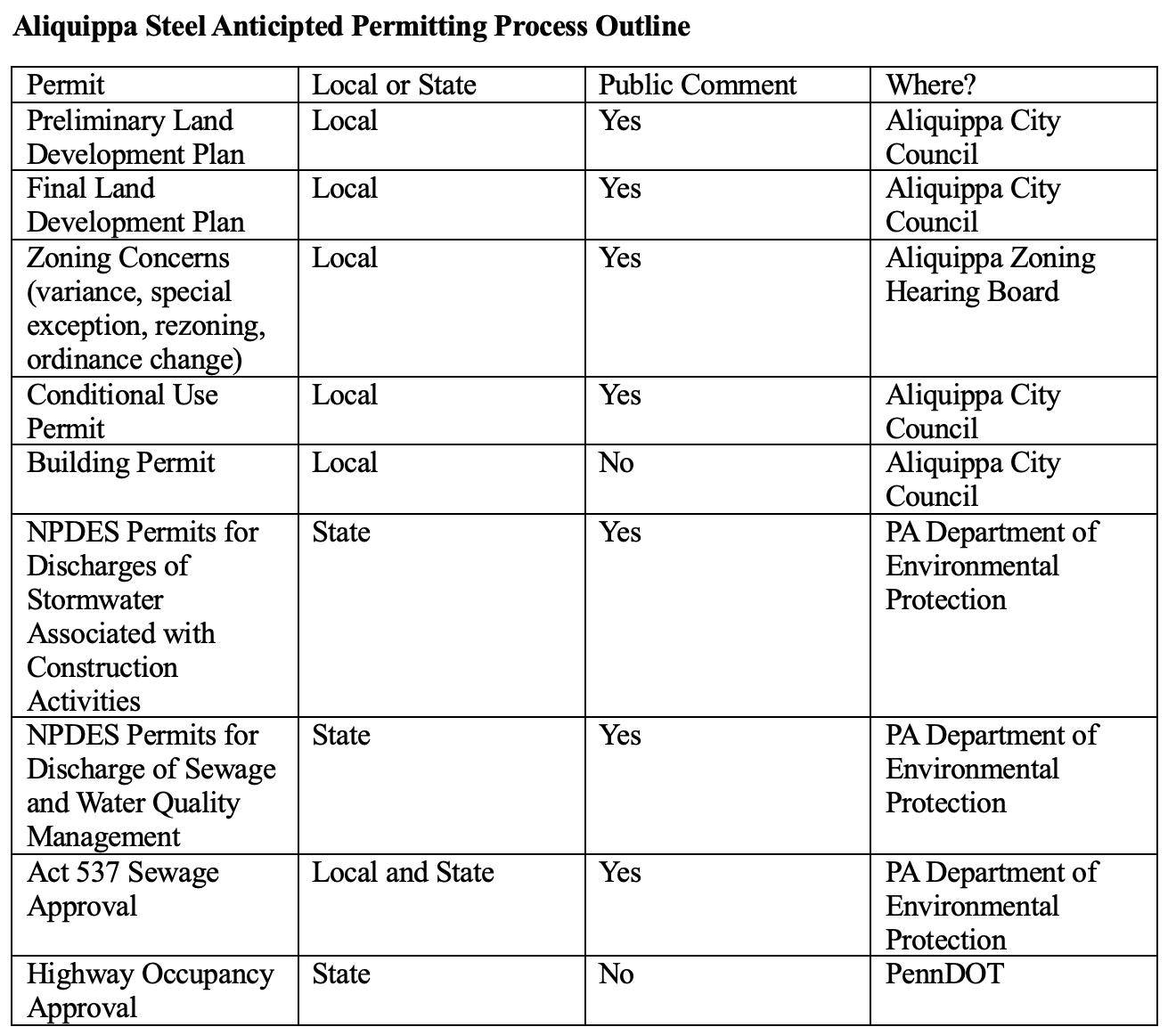
This Aliquippa facility will make steel parts for 72 Steel’s products using an Electric Arc Furnace (EAF). The plant is projected to produce 500,000 tons of steel rebar a year with the potential to expand to steel beam and anchor production. The Aliquippa plant will be 72 Steel’s first venture into steel manufacturing. 72 Steel expects a production capacity and output value of $400 million. Despite the ambitious planning, 72 Steel has yet to close on the property according to the current landowner, Chuck Betters. Also, 72 Steel has yet to complete the appropriate local and state land development permits prior to construction. Much of the permitting process includes opportunities for public participation and comment. The permits listed below are the anticipated stamps of approval 72 Steel needs to satisfy prior to construction.
Local Permits
At the local level, 72 Steel (through its developer) must satisfy multiple different permits and zoning requirements before it can begin constructing the manufacturing plant. Below is a list of local permits and opportunities for public participation. See Fair Shake’s Commenting Tips for ideas and strategies for public commenting.
Preliminary Land Development Plan
72 Steel must submit a preliminary land development plan application that complies with the Aliquippa Subdivision and Land Development Ordinance (SALDO). The plan will include a comprehensive description of the steel plant development including land surveys, erosion plans, stormwater management plans, construction details, phasing schedules, traffic impact studies and other SALDO required documentation. 72 Steel will submit the application to the zoning officer who sends it to the city engineer and planning commission. The city engineer and planning commission will submit recommendations of approval, approval with conditions, or disapproval. Both the city engineer and the planning commission consider the SALDO, zoning ordinances, and other city ordinances that are relevant. If recommended for approval, the city council may hold a public hearing or meeting discussing the application and will make a final approval decision no later than ninety days after filing.
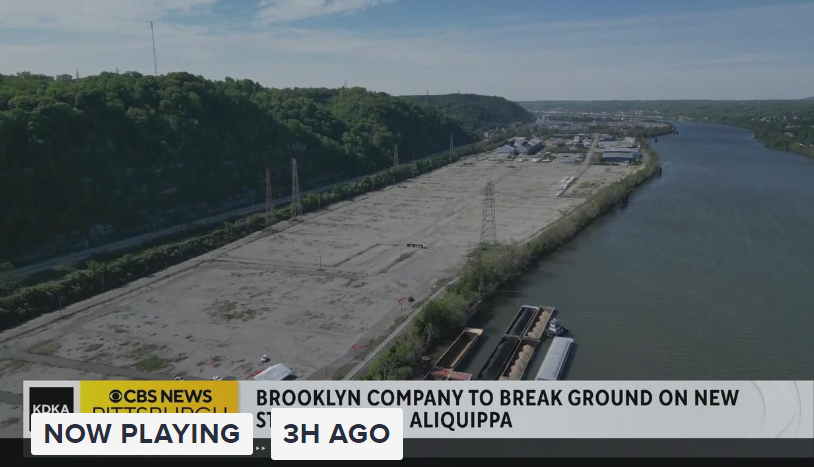
New mill: Aliquippa’s large ‘brownfield’ was the core of the old J&L Steel.
By Lauren Linder CBS News
ALIQUIPPA, Pa. (KDKA) – A major economic boost appears to be heading to Aliquippa, as a Brooklyn company is planning to build a new steel mill in Beaver County.
The official groundbreaking is Tuesday, May 16, which will mark a special moment for the city that was originally built around steel.
Aliquippa Mayor Dwan Walker never thought he would live to see a day when the steel industry returned to the city, but it’s happening in the same spot off Woodlawn Road, where his dad spent 18 years working for J & L in the 1970s and 1980s.
“To have a comeback to where it gave birth to, it’s a beautiful thing,” Walker said. “To hear my dad almost cry about it, that says more to me than any words that I could say.”
The land remained vacant for decades since the J & L and LTV mills closed. Now a Brooklyn, New York company is coming in, 72 Steel, started by Chinese-American entrepreneurs.
New steel mill coming to Aliquippa 01:35 72 Steel Senior Business Advisor Xiaoyan Zhang said they chose Aliquippa for the $218 million facility over sites in Ohio and West Virginia. They will produce rebar at the 44-acre mill and hire 300 to 800 workers for construction, distribution, and the plant.
“We know that history, and so to build a steel mill here is exciting,” Zhang said. “Because this is an old industrial base, there will be a lot of talent, you know, that’s for hiring people and everything else.”
Property owner Chuck Betters was waiting for the right business to move in. In recent years the space was used as a staging area for the Shell cracker plant in Monaca. Then, a couple of years ago, he showed the land to 72 Steel, and eventually, they agreed.
“It’s what I’ve been hoping for,” Betters said. “I think it could be a heck of a good job creation here, a tax base for the city. I think it would be good things.”
This is the hope for Mayor Walker.
“We planted a seed that’s going to last the test of time, and then this is this going to be a caveat,” Walker said.
It’s a full-circle moment as the city heads into the future.
“This is going to be the blessing, you know, to make sure we stay out of distressed and to make sure we’re bringing economics and financial stability back to Aliquippa on a solid ground, on solid footing,” Walker said.
No word on when construction will start but 72 Steel hopes to finish by mid-to-late 2025.
Betters said he sold the rest of the 80-something-acre old mill land to Versatex, which makes products like plastic decking, and U.S. Minerals, which makes abrasives.
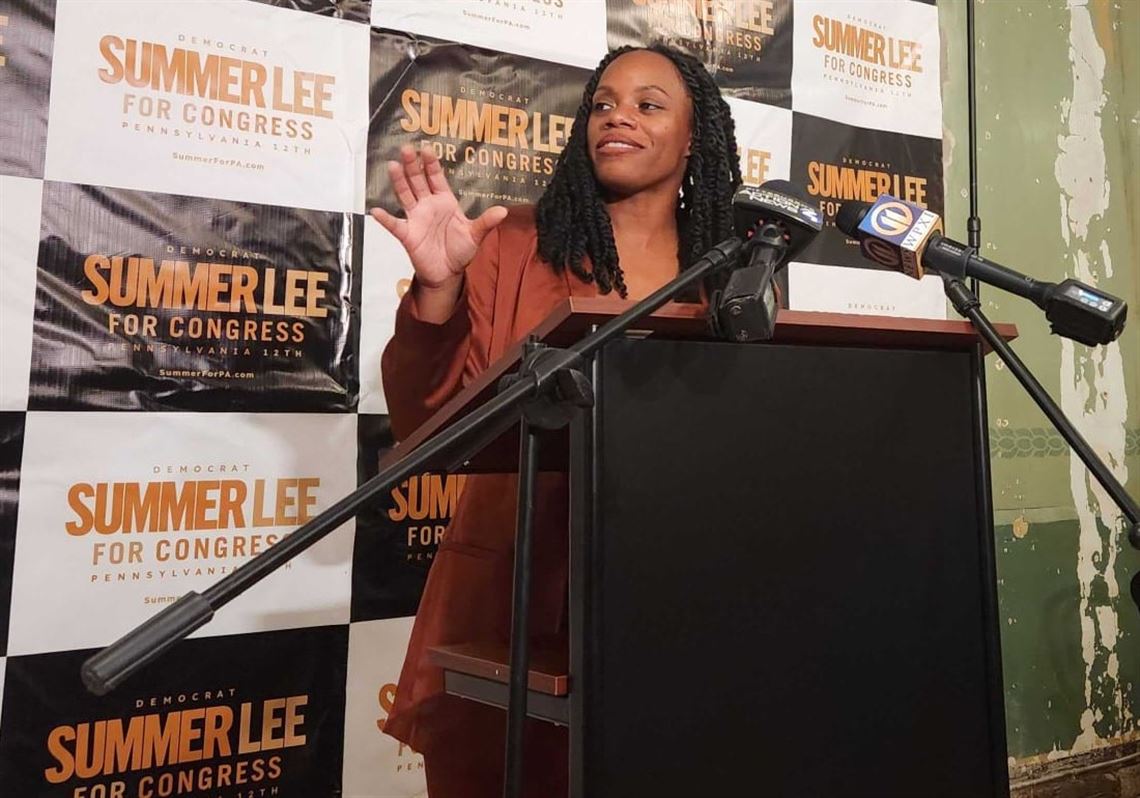
Photo: Democrat Summer Lee gives a speech after Republican Mike Doyle conceded the race in Pennsylvania’s 12th Congressional District on Tuesday, Nov. 8, 2022.
By Megan Guza Pittsburgh Post-Gazette
NOV 13, 2022 – Summer Lee’s historic victory in Tuesday’s midterm election secured her a place in history as Pennsylvania’s first Black congresswoman, but experts and organizers say her win speaks to a broader movement that is focused on representation and beliefs rather than solely electability.
“I think this is a moment that Black voters have been waiting for for quite some time here in Pennsylvania — to know that our voices are being heard and that our needs will begin to get to be met,” said Kadida Kenner, executive director of the New Pennsylvania Project, an organization that focuses year-round on registering Pennsylvanians to vote.
Ms. Lee’s underdog campaign earned her a U.S. House seat last week, but it began in earnest in 2018 when she unseated a 10-year Democratic establishment incumbent in the primary for the Pennsylvania House 34th District.
In her campaign for Congress, she faced replacing the retiring Mike Doyle, a 15-term moderate Democrat, all while going up against a Republican candidate of the same name.
Rep. Austin Davis, D-Allegheny, Josh Shapiro’s running mate and the lieutenant governor-elect, will be the first African American to hold an executive branch elective office in Pennsylvania.
“She is an amazing story of organizing and campaigning and, in many ways, proving the skeptics wrong,” said Debbie Walsh, director of Rutgers University’s Center for American Women and Politics.
She said Ms. Lee’s win is particularly notable because of the odds she had against her: women of color face myriad systemic issues on top of a lack of resources and questions of electability.
Ms. Lee acknowledged those long odds herself in an election-night speech as outlets such as CNN and NBC began calling her race.
“Our work is not done,” she said. “We had to go through ugly to get here. There’s a reason why there had never been a Black woman — ever — to serve in the history of Pennsylvania. They’re not going to let up on us. They’re not going to relent.”
The historic nature of Ms. Lee’s election reverberated far beyond Western Pennsylvania: From the New York Times and MSNBC talk shows to Teen Vogue and Essence, writers and analysts took note of the Mon Valley native.
Ms. Kenner said Black voters — particularly Black women — have acted as a firewall in recent years against extremist policies and legislation and overall come to “the defense of democracy.
“So to know that our voices are being heard, that we can put people who look like us into the highest levels of government — not just here in Pennsylvania but in Congress and D.C. and the presidency, the vice presidency — it just says that … progress is happening,” she said. “It doesn’t always happen as fast as you want it to happen, but it is happening.”
Summer Lee to be 1st Black woman from Pa. in U.S. House after defeating Mike Doyle in 12th district
Black candidates were elevated to state and federal offices in historic firsts nationwide last week.
In Maryland, Democrat Wes Moore became the state’s first Black governor, while Democrat Anthony Brown was elected the first Black attorney general in Maryland. Andrea Campbell, too, became the first Black attorney general in Massachusetts history.
In Connecticut, Democrats Erick Russell and Stephanie Thomas will become the state’s first Black and out LGBTQ treasurer and secretary of state, respectively.
Pennsylvania Lt. Gov.-elect Austin Davis, of McKeesport, will become the highest serving Black man in the state.
“I’m excited to know that Black folks, Black children, and all people are going to see a Black man in the second-highest level of executive leadership in the state in Austin Davis,” Ms. Kenner said.
Mr. Davis, currently serving in the statehouse as the representative from the 35th District, acknowledged his history-making night during a victory remarks late Tuesday night.
“Pennsylvania has elected its first Black lieutenant governor in our Commonwealth’s history,” he said. “I can’t even put into words what this moment means for me and my family … and the message it sends to millions throughout Pennsylvania and the nation.”
Indeed, Ms. Walsh said, the election of Black candidates give children new figures to look up to. She said Ms. Lee’s election is particularly significant for Black girls.
“It just opens up a world of possibilities of things that Black girls in her district can look to her and say, ‘a member of Congress can look like me,’” she said. “She becomes a powerful role model, and it’s important for the future so that new generations of young Black women will step forward and want to follow in her footsteps.”







 Beaver County Blue: Voice of the 17th CD of Progressive Democrats of America